
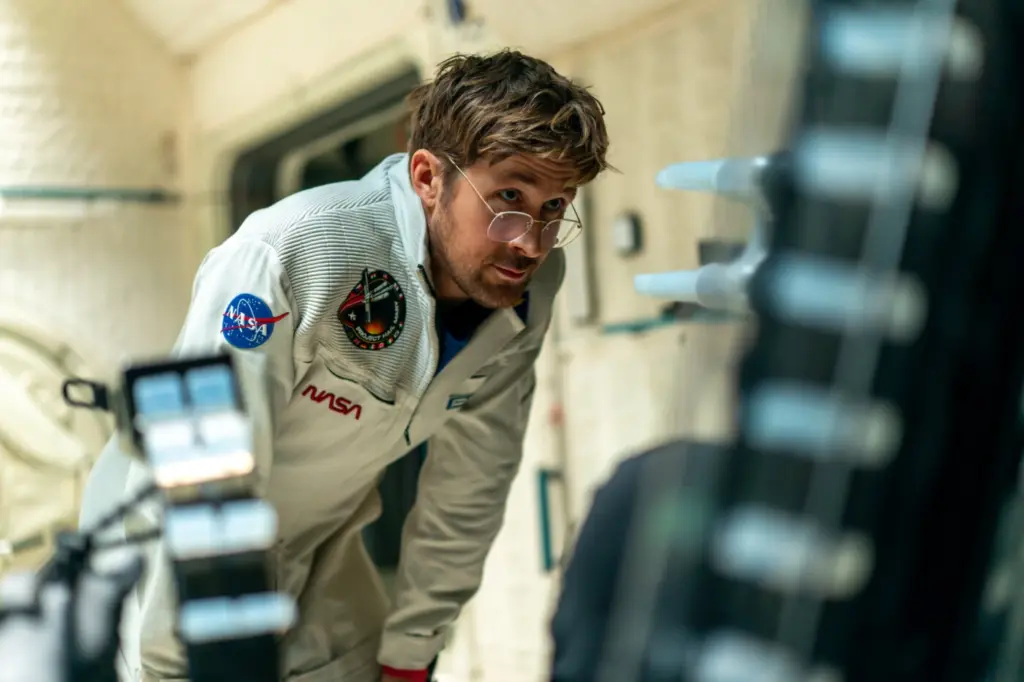
The year’s best romance is between Ryan Gosling and an alien rock in Project Hail Mary, which opens in Prague and cinemas worldwide this weekend. This adaptation of Andy Weir‘s hard science fiction novel from directors Phil Lord and Christopher Miller (The Lego Movie) keeps the science grounded enough to echo the author’s The Martian, but contains such emotional moments of first contact that it resonates on the same crowd-pleasing level as Steven Spielberg‘s E.T. This one’s a real winner, and the best film of early 2026.
Adapted by Drew Goddard from Weir’s notoriously heady source, Project Hail Mary wastes no time digging into the deeper levels of its science-heavy premise. Gosling stars as Dr. Ryland Grace, a middle school teacher and molecular biologist who awakens alone aboard a spacecraft with no memory of how he got there. As his fragmented recollections begin to return, the film reveals a high-stakes mission to save Earth from a mysterious organism slowly draining the sun’s energy, threatening global extinction within decades.
The narrative intercuts Grace’s present-day isolation in deep space with flashbacks that chart the desperate international effort to combat the crisis. Sandra Hüller (Anatomy of a Fall) is Eva Stratt, the steely, uncompromising architect of the mission, who gradually fills us (and Grace) in on the scientific and political groundwork behind the journey. While the structure leans heavily on exposition, the material remains engaging thanks to the filmmakers’ commitment to scientific plausibility and procedural detail.
That sense of realism proves to be one of the film’s greatest strengths—and a surprising one, given Lord and Miller’s background in fast-paced, comedic storytelling. Here, they adopt a far more restrained and methodical approach, allowing the science to breathe and the stakes to feel tangible. The result is a film that, despite its far-out premise, feels grounded in a way that recalls not only The Martian, but also Christopher Nolan’s Interstellar, Alfonso Cuarón’s Gravity, and the recent Ukrainian feature U Are the Universe (not to mention Kubrick’s 2001: A Space Odyssey, which laid the groundwork for all these films).
The grounded approach extends to the production design, which favors a surprising amount of practical sets. The interiors of the Hail Mary spacecraft feel tactile and lived-in, lending weight to Grace’s journey. When the film ventures outside the ship for its more visually ambitious sequences, the impact is heightened by this foundation of realism. Far-out moments during the film’s climax deliver a sense of scale and awe that rivals the genre’s recent high points, but remain tangible thanks the the care put into the earlier scenes.
At the center of it all is Gosling, who balances humor, vulnerability, and reluctant heroism with an ease that makes our protagonist instantly relatable. The film does not present him as a conventional savior figure; Grace is fearful and flawed, and the flashbacks on Earth emphasize his hesitation and moral ambiguity, qualities that enrich his arc and make his later choices carry real emotional weight.
That emotional core comes into full focus with the introduction of Rocky, the alien lifeform Grace encounters near the distant star Tau Ceti. In another film, this relationship might lean into sentimentality or easy anthropomorphism, but Project Hail Mary takes a much more thoughtful route. Rocky is not a cute or expressive creature in any traditional sense, but a rock-like being whose biology and communication methods are entirely foreign.
The process through which Grace and Rocky learn to understand each other—bridging gaps in language, perception, and environment—is one of the film’s most compelling elements. It unfolds gradually, grounded in logic and experimentation, and ultimately becomes the heart of the story. Voice work and puppeteering by James Ortiz, combined with subtle visual effects, give Rocky a distinct presence without sacrificing the character’s alien nature.
Hüller also makes a strong impression as Stratt, whose cold, utilitarian mindset provides a stark contrast to Grace’s flawed humanity. Her single-minded focus on saving Earth at any cost adds a layer of moral tension to the film’s flashbacks.
Cinematographer Greig Fraser (Dune, The Creator) employs shifting aspect ratios to distinguish between timelines, with expansive IMAX framing used for space sequences and a more traditional widescreen look for scenes on Earth. Even outside of full IMAX presentations (The Prague Reporter caught the film in a Dolby Atmos cinema), the transitions are noticeable and effective, reinforcing the film’s dual narrative structure. The overall aesthetic complements the story’s emphasis on realism, favoring clarity and scale over stylization.
At 156 minutes, Project Hail Mary occasionally feels overextended, particularly given its relatively straightforward narrative trajectory. The reliance on flashbacks means that key information continues to surface deep into the runtime, sometimes slowing the momentum of the present-day storyline. A more streamlined edit—or even a linear structure, in line with the source novel—might have improved the pacing without sacrificing depth.
But this is a minor quibble in a film that is otherwise such a clear success. By combining rigorous scientific detail with a genuinely affecting emotional core, Project Hail Mary achieves a rare balance between intellect and heart. Its central relationship—between a lonely human and a truly alien being—echoes the timeless appeal of E.T. while feeling entirely its own.
In an era where big-budget Hollywood science fiction often leans toward spectacle over substance, Project Hail Mary stands out as something richer and more enduring. It’s a crowd-pleaser of the highest order: smart, sincere, and deeply entertaining. This bond between man and rock is exactly what our cosmos needs right now.