

A recreation of Robert Goddard’s first liquid-fueled rocket blasts off during a 1976 celebration marking the 50th anniversary of Goddard’s initial launch.
NASA
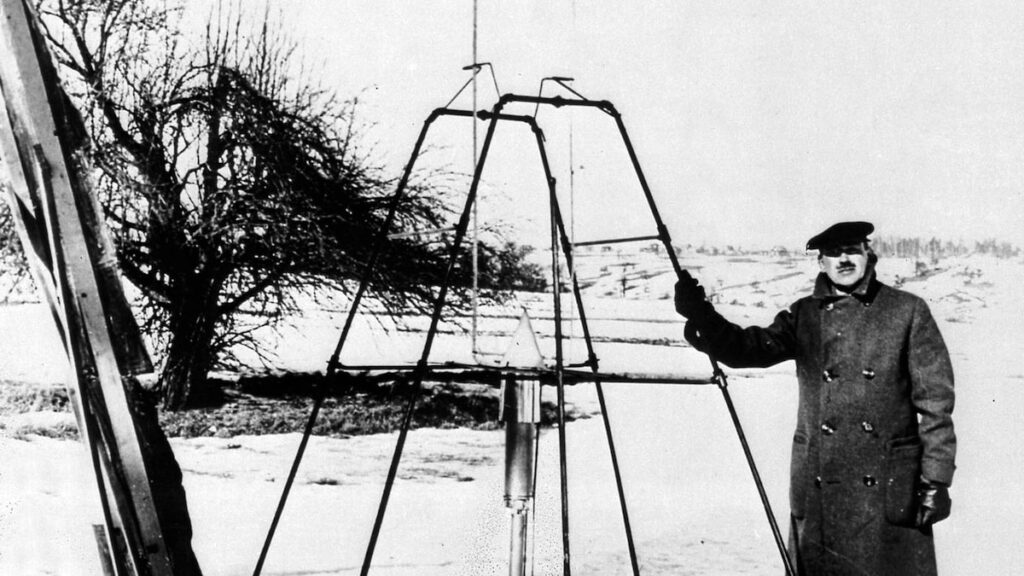
But Goddard was serious—and he was closer to realizing liquid rocket propulsion than he let on. The physicist continued his testing in secret, and on March 16, 1926, he succeeded in launching a rocket using a combination of gasoline and liquid oxygen from a test site on his aunt’s farm in Auburn, Massachusetts. Nicknamed “Nell,” the rocket traveled 41 feet upward during a 2.5-second flight.
Stung by the media’s treatment of his past work, Goddard kept his success a secret. He continued his experiments, refining his rocket and replacing its fins with removable vanes controlled by a gyroscope that allowed it to be steered.
Advances in rocket technology
Goddard was secretive about his work, but it became increasingly hard to hide his increasingly advanced rocket experiments. As word of his work spread, he gained some famous fans, including officials at the Smithsonian Institution, the Guggenheim family and aviator Charles Lindbergh, all of whom quietly funded his research at various points in his career. The increasing visibility of his donors and his rocket launches—and some well publicized noise complaints from his Massachusetts neighbors—pushed him to find a more remote place for his rocket research, and in 1930 he moved his laboratory to Roswell, New Mexico.
By World War II Goddard’s rocket research was advanced enough that he attempted to offer his services to the U.S. armed forces. But though he did briefly work with the Navy on jet-assisted takeoff and liquid propellants during the war, his dreams of using large rockets to put cargo, people, and scientific instruments into space were not taken seriously by much of the skeptical scientific establishment. Goddard had previously predicted that German scientists were developing their own advanced rocketry, but the U.S. was slow to recognize the technology’s potential.
Thus, Nazi German scientists developed their own rockets independently. The V-2 rocket, a liquid-propelled missile, became the first rocket to leave Earth’s atmosphere in launch liquid-propelled rockets, and the V2 rocket eventually became the first to leave Earth’s atmosphere in late 1944. By then, Goddard was terminally ill with throat cancer. He died on August 10, 1945.