
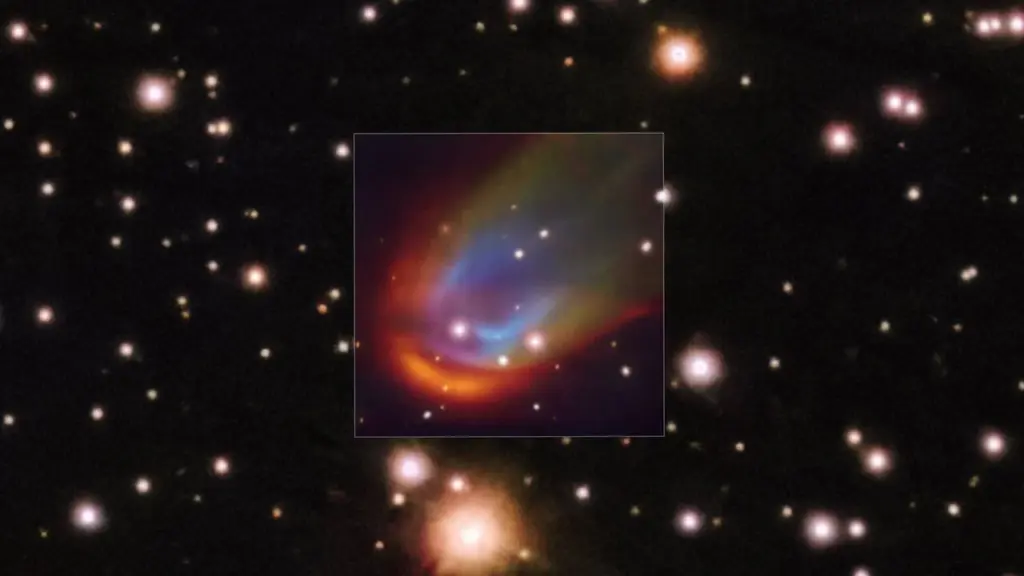
Astronomers have stumbled upon a true cosmic mystery that is forcing a reevaluation of textbooks on stellar evolution. The object, codenamed RXJ0528+2838, is a white dwarf—the remnant of a star—located 730 light-years away. A massive shock wave was detected around it—one that, according to all current models, simply cannot exist there.
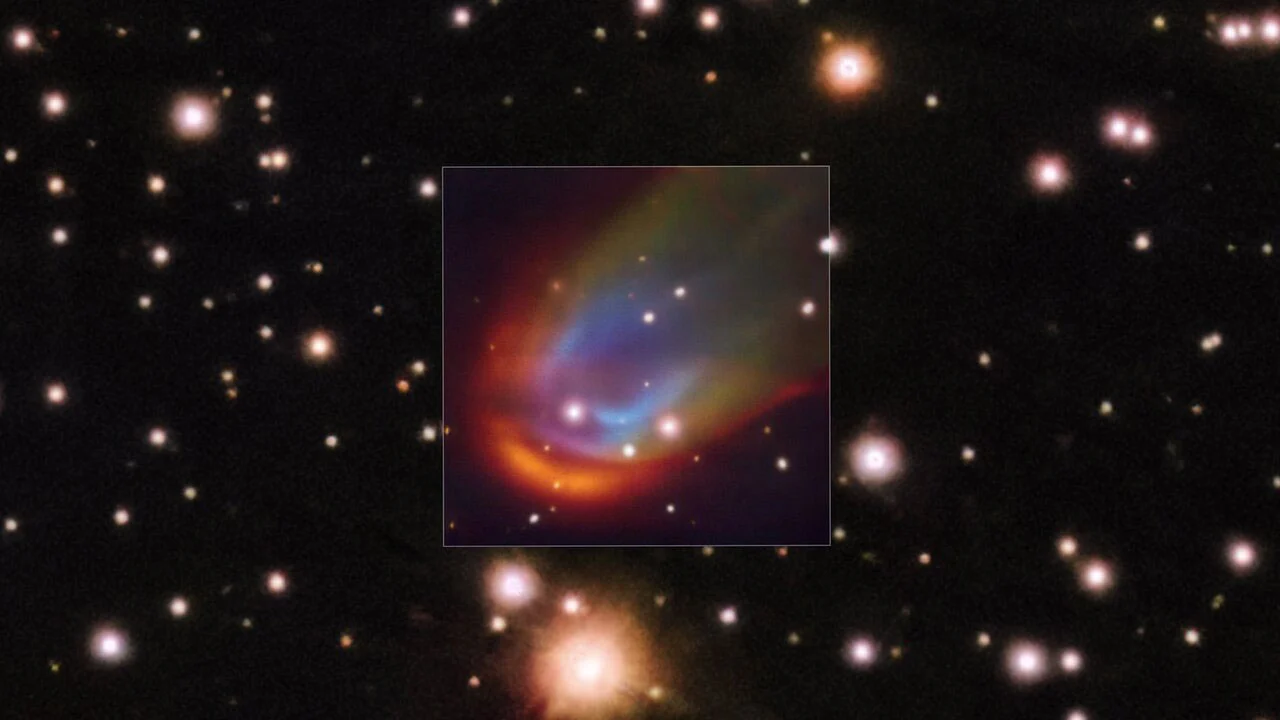 The central image, taken with the MUSE instrument on the Very Large Telescope, shows shock waves around the dead star RXJ0528+2838. As a star moves through space, it can push away the surrounding matter, creating what is known as a bow shock, which appears in red, green, and blue in this image. The colors correspond to hydrogen, nitrogen, and oxygen, respectively. These shock waves are typically formed as a result of a powerful outburst emitted by the star. However, in the case of RXJ0528+2838—a white dwarf with a Sun-like companion—astronomers found that the shock wave cannot be explained by any known mechanism. Source: ESO/K. Ilkiewicz and S. Scaringi et al. Image: PanSTARRS
As they move through interstellar gas, systems often form what is known as an arc shock. It resembles a wave spreading out in front of a ship’s bow in the ocean. This phenomenon usually occurs when a star is actively ejecting material into space.
However, in the case of RXJ0528+2838, the situation seems unusual. This system consists of a white dwarf and a normal star similar to the Sun. In such pairs, material typically flows from the living star to the dead one, forming a bright accretion disk around the latter. This disc is typically the “engine” that ejects jets of gas and forms nebulae.
But the fact is that RXJ0528+2838 doesn’t have an accretion disk at all. Nevertheless, it has an impressive arc of hot gas surrounding it.
Mapping: Impossible
The unusual cloud was first spotted using the Isaac Newton telescope in Spain. To understand the nature of the object, scientists brought out the “heavy artillery”—the MUSE instrument on the Very Large Telescope (VLT) in Chile.
“We’ve discovered something completely unexpected. Our observations show a massive outflow of material where it shouldn’t be,” notes Krystian Iłkiewicz, a co-author of the study from the Nicolaus Copernicus Astronomical Center.
Analysis has shown that this outflow has been ongoing for at least 1,000 years. How a “quiet” disk-less system can maintain such activity over the course of a millennium remains a mystery.
A magnetic “ghost” in the engine
Scientists have a working hypothesis: it’s all due to the white dwarf’s extremely powerful magnetic field. It is so powerful that it literally intercepts gas from a neighboring star and directs it straight toward the dwarf’s poles, preventing a disk from forming.
However, calculations show that the energy of the magnetic field alone would only be sufficient to generate such a wave for a few hundred years. It is still unclear where the system draws the energy needed to sustain its activity for hundreds of years to come. Astronomers refer to this as a “mysterious engine,” the nature of which remains to be determined.
According to SciTechDaily