
How It Works
The study authors relied on the fact that because geologic features like seamounts and abyssal hills have more mass than their surroundings, they exert a slightly stronger gravitational pull that creates small, measurable bumps in the sea surface above them. These subtle gravity signatures help researchers predict the kind of seafloor feature that produced them.
Through repeated observations — SWOT covers about 90% of the globe every 21 days — the satellite is sensitive enough to pick up these minute differences, with centimeter-level accuracy, in sea surface height caused by the features below. Sandwell and his colleagues used a year’s worth of SWOT data to focus on seamounts, abyssal hills, and underwater continental margins, where continental crust meets oceanic crust.
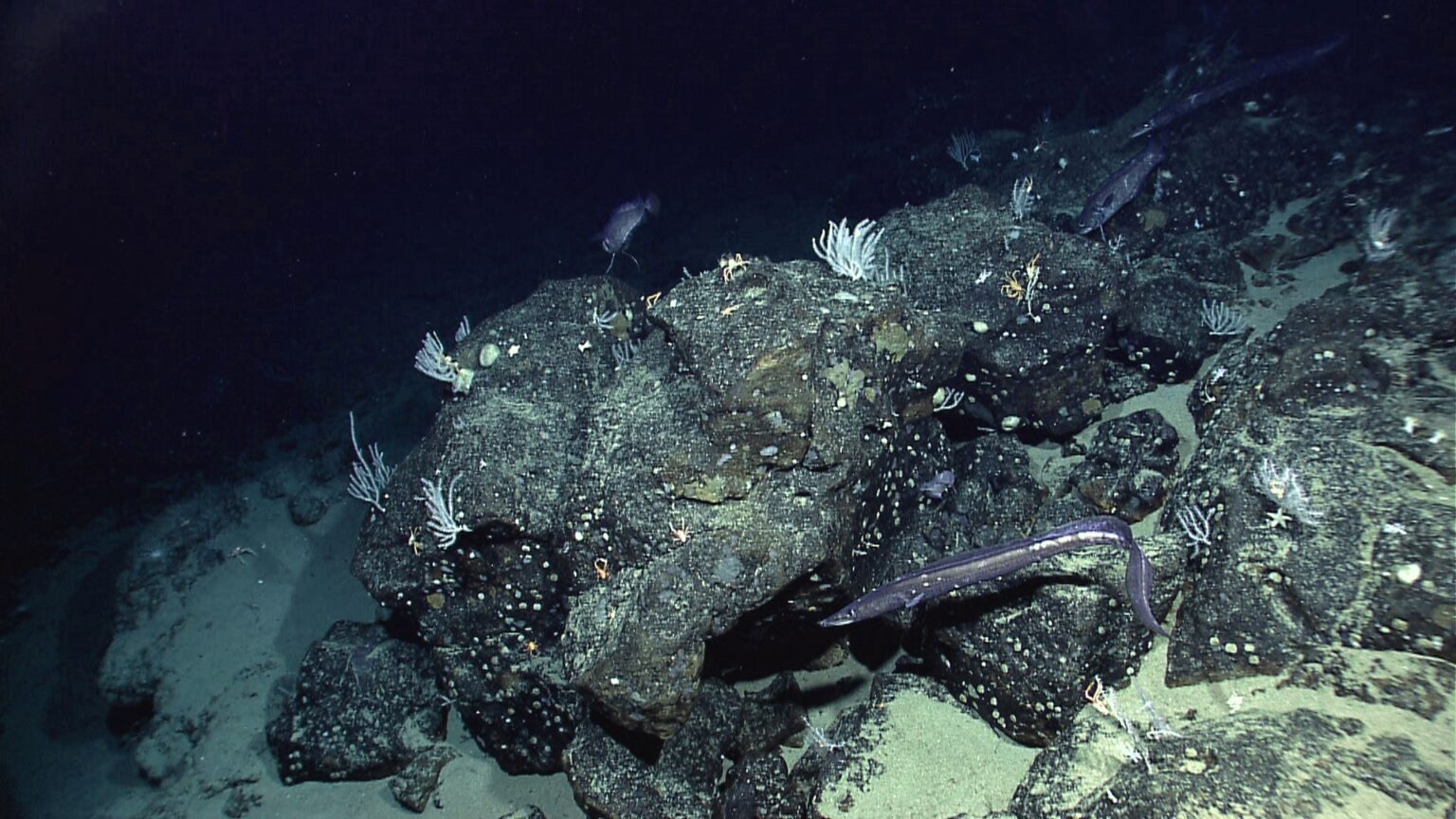
Previous ocean-observing satellites have detected massive versions of these bottom features, such as seamounts over roughly 3,300 feet (1 kilometer) tall. The SWOT satellite can pick up seamounts less than half that height, potentially increasing the number of known seamounts from 44,000 to 100,000. These underwater mountains stick up into the water, influencing deep sea currents. This can concentrate nutrients along their slopes, attracting organisms and creating oases on what would otherwise be barren patches of seafloor.
Looking Into the Abyss
The improved view from SWOT also gives researchers more insight into the geologic history of the planet.
“Abyssal hills are the most abundant landform on Earth, covering about 70% of the ocean floor,” said Yao Yu, an oceanographer at Scripps Institution of Oceanography and lead author on the paper. “These hills are only a few kilometers wide, which makes them hard to observe from space. We were surprised that SWOT could see them so well.”
Abyssal hills form in parallel bands, like the ridges on a washboard, where tectonic plates spread apart. The orientation and extent of the bands can reveal how tectonic plates have moved over time. Abyssal hills also interact with tides and deep ocean currents in ways that researchers don’t fully understand yet.
The researchers have extracted nearly all the information on seafloor features they expected to find in the SWOT measurements. Now they’re focusing on refining their picture of the ocean floor by calculating the depth of the features they see. The work complements an effort by the international scientific community to map the entire seafloor using ship-based sonar by 2030. “We won’t get the full ship-based mapping done by then,” said Sandwell. “But SWOT will help us fill it in, getting us close to achieving the 2030 objective.”
More About SWOT
The SWOT satellite was jointly developed by NASA and CNES, with contributions from the Canadian Space Agency (CSA) and the UK Space Agency. NASA’s Jet Propulsion Laboratory, managed for the agency by Caltech in Pasadena, California, leads the U.S. component of the project. For the flight system payload, NASA provided the Ka-band radar interferometer (KaRIn) instrument, a GPS science receiver, a laser retroreflector, a two-beam microwave radiometer, and NASA instrument operations. The Doppler Orbitography and Radioposition Integrated by Satellite system, the dual frequency Poseidon altimeter (developed by Thales Alenia Space), the KaRIn radio-frequency subsystem (together with Thales Alenia Space and with support from the UK Space Agency), the satellite platform, and ground operations were provided by CNES. The KaRIn high-power transmitter assembly was provided by CSA.
To learn more about SWOT, visit: