
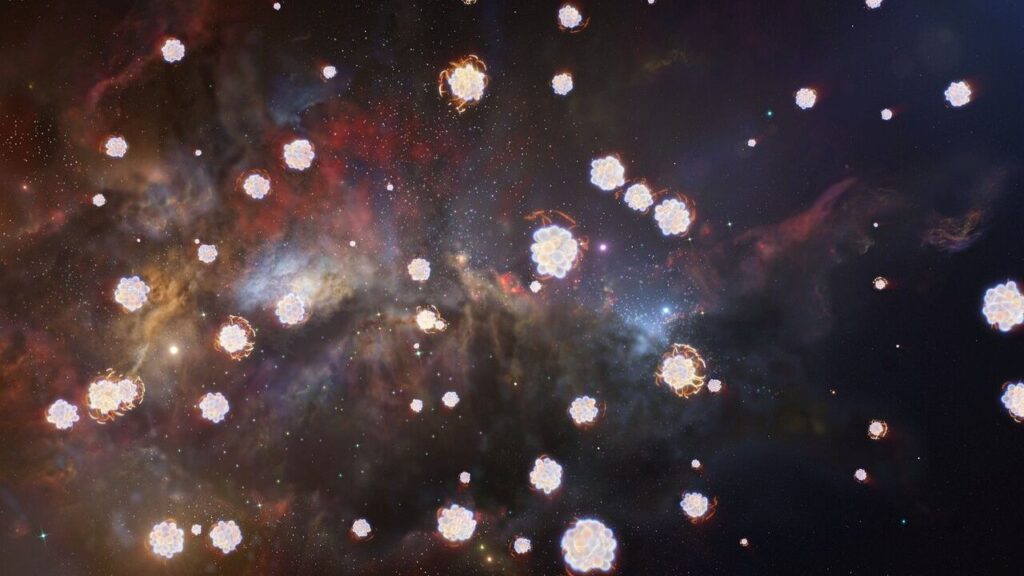
For the first time, researchers have recreated the universe’s first ever molecules by mimicking the conditions of the early universe.
The findings shake up our understanding of the origin of stars in the early universe and “calls for a reassessment of the helium chemistry in the early universe,” the researchers wrote in the new study, published July 24 in the journal Astronomy and Astrophysics.
The first stars in the universe
Just after the Big Bang 13.8 billion years ago, the universe was subject to extremely high temperatures. A few seconds later, though, temperatures decreased enough for hydrogen and helium to form as the first ever elements. Hundreds of thousands of years after those elements formed, temperatures became cool enough for their atoms to combine with electrons in a variety of different configurations, forging molecules.
Article continues below
You may like
According to the researchers, a helium hydride ion — or HeH+ — became the first ever molecule. The ion is needed to form molecular hydrogen, now the most abundant molecule in the universe.
Both helium hydride ions and molecular hydrogen were critical to the development of the first stars hundreds of millions of years later, the researchers said.
For a protostar to begin fusion — the process that enables stars to create their own energy — atoms and molecules within it must collide with each other and release heat. This process is largely ineffective at temperatures under 18,000 degrees Fahrenheit (10,000 degrees Celsius).
However, helium hydride ions are particularly good at continuing the process, even under cool temperatures, and are considered to be a potentially integral factor of star formation in the early universe.
The amount of helium hydride ions in the universe may therefore have had significant bearing on the speed and efficacy of early star formation, the researchers said in a statement.
Far more important than previously assumed
In the new study, the researchers recreated early helium hydride reactions by storing the ions at minus 449 degrees Fahrenheit (minus 267 degrees Celsius) for up to 60 seconds to cool them down before forcing them to collide with heavy hydrogen. Researchers studied how the collisions — similar to those that kickstart fusion in a star — changed depending on the temperature of the particles.
They found that reaction rates between these particles do not slow down at lower temperatures, which contradicts older assumptions.
“Previous theories predicted a significant decrease in the reaction probability at low temperatures, but we were unable to verify this in either the experiment or new theoretical calculations,” study co-author Holger Kreckel, who studies nuclear physics at the Max Planck Institute for Nuclear Physics in Germany, said in the statement.
This new finding of how helium hydride ions function challenges how physicists think stars formed in the early universe. Reactions between the ions and other atoms “appear to have been far more important for chemistry in the early universe than previously assumed,” Kreckel said.
This story was provided by Live Science, a sister site of Space.com.