
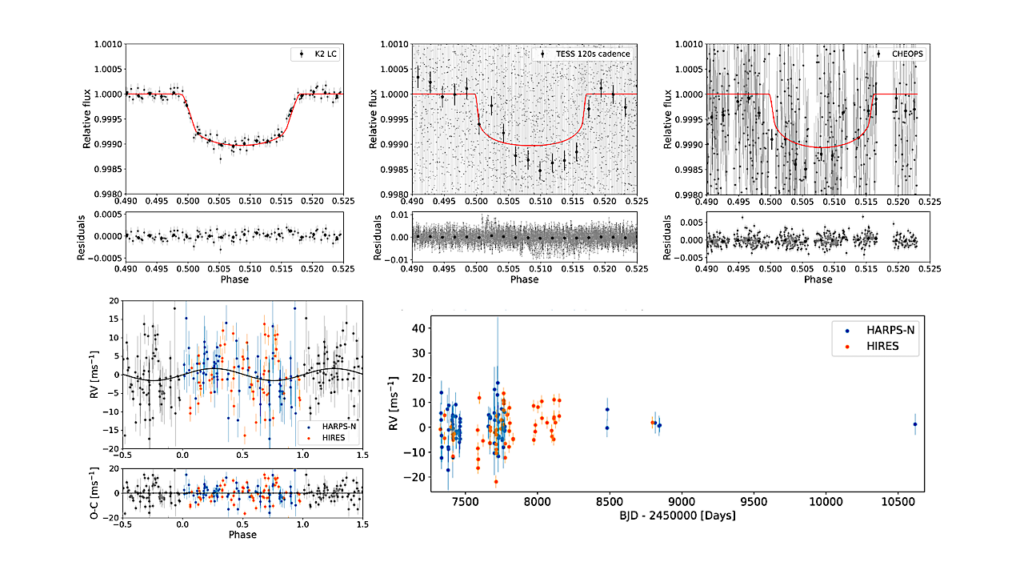
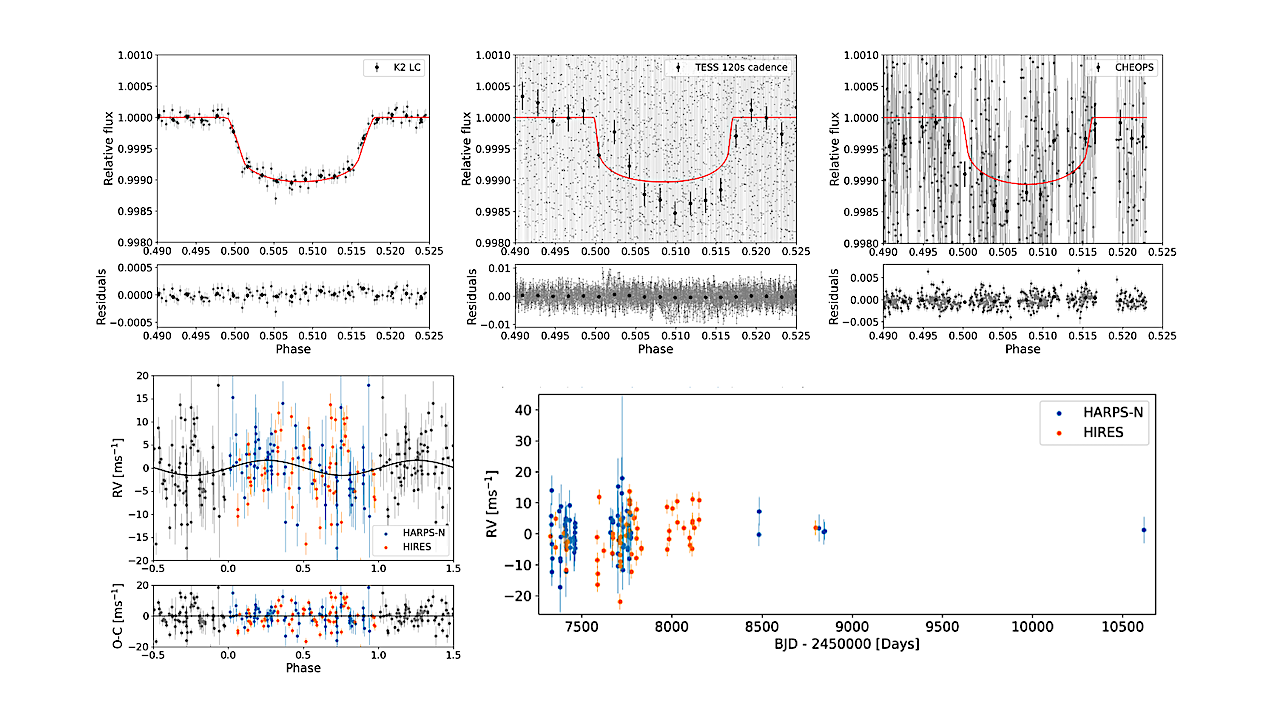
Combined fit results for K2-79 b. Transit fit to the light curve data from K2 long cadence (first row left), TESS long cadence (first row centre), and CHEOPS (first row right). The cadence (29.4 min for K2 long cadence, 120 s for TESS long cadence, and 60 s for CHEOPS) fluxes are plotted in grey, the fluxes binned every 30 min are over-plotted in black, and the fitted transit is shown by the red solid line. The RV fit to the HARPS-N & HIRES RVs is shown in the second row for K2-79 b. Coloured circular points show the phase folded RVs, grey points show these same values in subsequent phases, and the black line shows the best fit Keplerian model. The third row shows the RVs over the full ∼ 9 yr baseline, illustrating the absence of any significant long term trend. — astro-ph.EP
Accurate mass and radius measurements of small transiting exoplanets are essential for probing their compositions, formation histories, and potential habitability.
We present a uniform analysis of six planetary systems (each hosting at least one small transiting planet): K2-79, K2-106, K2-111, K2-222, K2-263, and TOI-1634. Our study combines new CHEOPS transit observations with archival photometry from K2, TESS, and ground-based facilities, alongside new and archival radial velocity data from HARPS-N, HIRES, ESPRESSO, and others.
For each system, we perform joint transit and RV modelling, achieving typical precisions better than 15% and 5% for mass and radius, respectively, and thus enabling precise bulk density determinations.
These reveal a range of compositions, including rocky planets near the radius valley (e.g. K2-106 b, TOI-1634 b), intermediate-density planets requiring steam-rich or mixed volatile envelopes (e.g. K2-111 b, K2-263 b), and low-density regimes, consistent with gas dwarfs or water-worlds (e.g. K2-79 b, K2-222 b). Several systems show evidence of additional companions detectable via RVs but not seen in transit.
The results highlight the value of coordinated CHEOPS and HARPS-N observations in delivering some of the most precise bulk densities for small planets to date and support the preparation for future atmospheric characterisation missions.
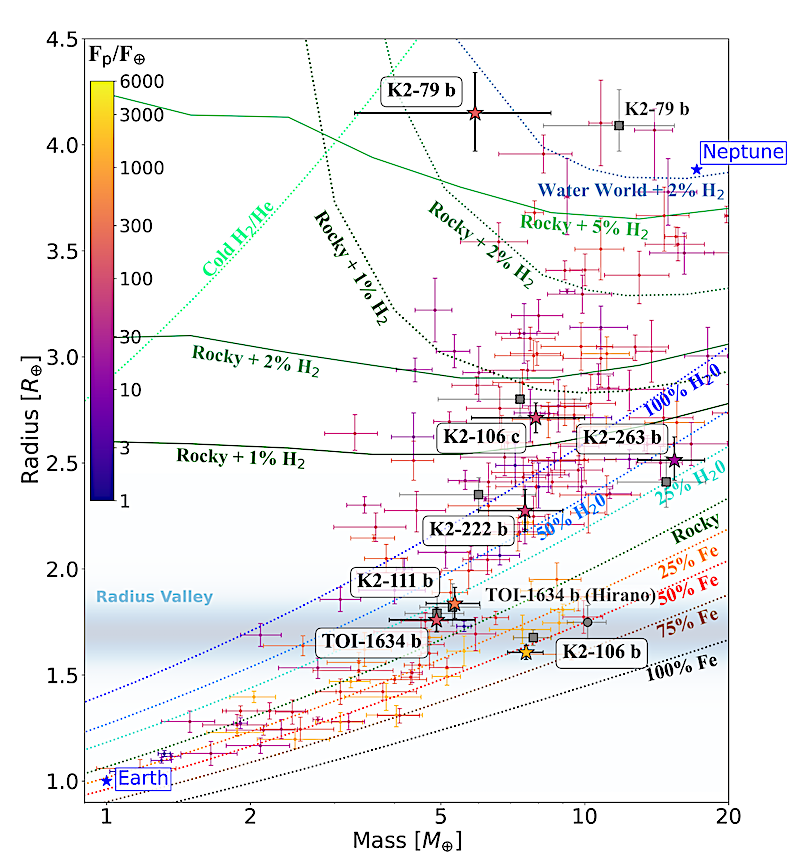
M–R diagram. Planet results from this study are shown as coloured stars, while archival literature values for the same planets (Table 1) appear as grey symbols with error bars; squares for most planets and a circle for the alternative TOI-1634 b value from Hirano et al. (2021). Other confirmed planets with mass and radius precisions better than 20% and 5%, taken from TepCat (Southworth 2011), are also plotted. Dotted lines show compositions from Zeng et al.(2019) (1000 K), and solid lines from Lopez & Fortney (2014) (1 Gyr, solar metallicity, 1000 𝐹⊕). Points are colour-coded by incident flux. Earth, Neptune, and the approximate radius valley (Fulton et al. 2017) are indicated. Archival points are not individually labelled; exceptions are K2- 79 b and one of the TOI-1634 b measurement, where the closest grey point corresponds to the Cloutier et al. (2021) solution. — astro-ph.EP
Larissa Palethorpe, Annelies Mortier, Jo Ann Egger, Ken Rice, Thomas G. Wilson, Andrew Vanderburg, Aldo S. Bonomo, Walter Boschin, Andrew Collier Cameron, Yoshi Nike Emilia Eschen, Avet Harutyunyan, Luca Malavolta, Aldo F. Martínez Fiorenzano, Alessandro Sozzetti, Manu Stalport, Vincent Van Eylen, Christopher Allan Watson
Comments: 30 pages, 16 figures, 6 tables, accepted for publication in MNRAS
Subjects: Earth and Planetary Astrophysics (astro-ph.EP)
Cite as: arXiv:2603.14552 [astro-ph.EP] (or arXiv:2603.14552v1 [astro-ph.EP] for this version)
https://doi.org/10.48550/arXiv.2603.14552
Focus to learn more
Submission history
From: Larissa Palethorpe
[v1] Sun, 15 Mar 2026 19:00:01 UTC (11,397 KB)
https://arxiv.org/abs/2603.14552
Astrobiology, exoplanet,
Astrobiology, exoplanet,