
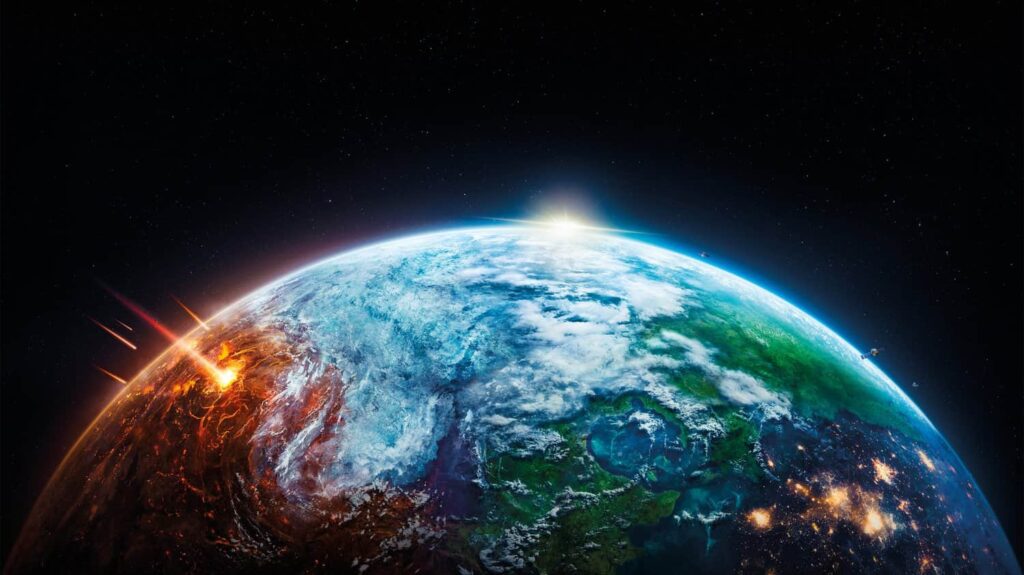
 Credit: PBS/NOVA.
When geologist John Wesley Powell explored the Grand Canyon in 1869, he noticed a glaring omission in the rocks. A layer of rock just 520 million years old sat directly on top of ancient rock dating back 1.4 to 1.8 billion years. Somewhere in between, up to a billion years of Earth’s history had vanished.
Scientists call this massive gap in Earth’s geological history the Great Unconformity. It appears not just in North America, but all over the planet. The missing layers represent anywhere from several million to over a billion years of time.
“There’s more than a billion years that’s gone,” said Barra Peak, co-author of a 2021 study on this puzzling gap in Earth’s history. “It’s also a billion years during an interesting part of Earth’s history where the planet is transitioning from an older setting to the modern Earth we know today”.
Geologists have argued over what scoured away so much of the Earth’s crust. One popular theory, proposed in 2019, blamed “Snowball Earth”. This hypothesis suggests that around 700 million years ago, massive glaciers encased the globe from pole to pole. As these epic ice sheets grew and retreated, they supposedly bulldozed the rock away and dumped it into the ancient oceans.
But a new study published this week challenges this icy origin story.
A Tectonic Shift in Thinking
 Infographic by ZME Science.
An international team of scientists led by Rong-Ruo Zhan of Northwest University in China has presented fresh evidence pointing to a much older, tectonic culprit. The researchers argue that the Great Unconformity was actually carved out by the violent birth and death of ancient supercontinents.
To figure this out, the team traveled to five different sites in North China to sample ancient basement rocks. They looked deep into the thermal history of these rocks, using multiple dating methods to track how and when the crust cooled and moved. Specifically, they examined microscopic, incredibly resilient crystals called zircons.
By analyzing radioactive decay within these ancient crystals — specifically using advanced techniques like zircon U-Pb dating and (U-Th)/He thermochronology — the team could track exactly how and when the Earth’s crust cooled and moved over billions of years.
×
Thank you! One more thing…
Please check your inbox and confirm your subscription.
Supercontinent Colombia
Their data revealed a fascinating timeline. The most intense period of erosion and crustal exhumation — the process by which buried rocks are pushed upward toward Earth’s surface — did not happen during the Snowball Earth era. Instead, it occurred much earlier, between 2.1 billion and 1.6 billion years ago.
This older window of time perfectly aligns with the assembly of Columbia, one of Earth’s earliest supercontinents.
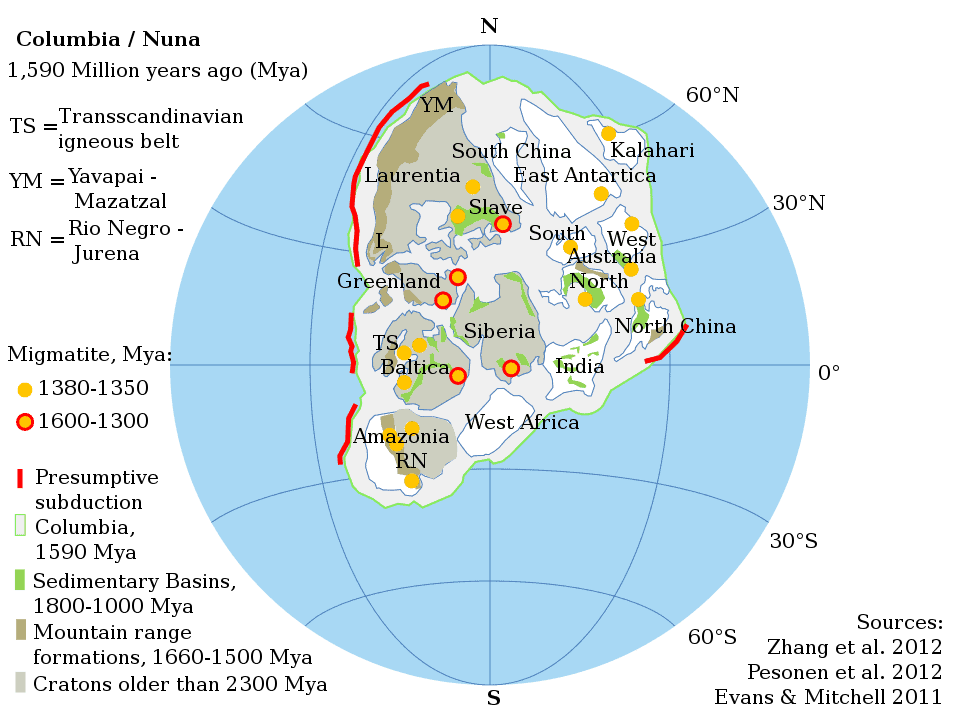 The supercontinent Columbia about 1.6 billion years ago. Columbia is estimated to have been approximately 12,900 km (8,000 mi) from north to south at its broadest part. The eastern coast of India was attached to western North America, with southern Australia against western Canada. In the Paleoproterozoic most of South America was rotated such that the western edge of modern-day Brazil lined up with eastern North America, forming a continental margin that extended into the southern edge of Scandinavia. Credit: Wikimedia Commons.
“The contribution of this paper is to show that exhumation of mid-crustal metamorphic/igneous rocks in North China occurred mostly between 2.1 and 1.6 billion years ago, and that the timing of exhumation varies from one continent to another,” said study co-author Nicholas Christie-Blick, professor emeritus at Lamont-Doherty Earth Observatory of Columbia University, in an email to 404 Media.
The team found that the immense tectonic forces involved in slamming landmasses together to form Columbia drove massive amounts of rock to the surface, where it eventually eroded away.
Plural Unconformities
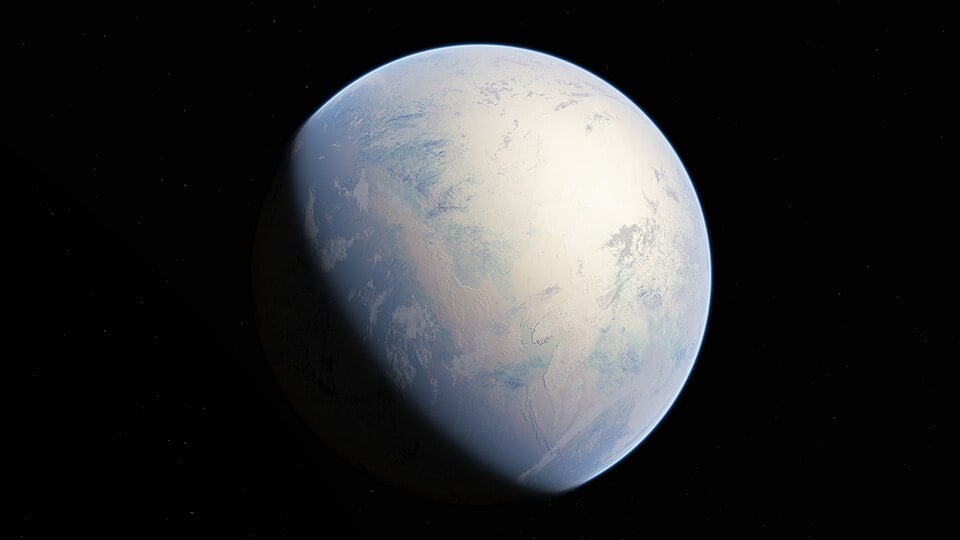 Artist’s rendition of a fully-frozen Snowball Earth with no remaining liquid surface water. Credit: Wikimedia Commons.
This new timeline punches a hole in the idea that a single, global event wiped the geological slate clean. If erosion happened at drastically different times in different places, geologists cannot blame a single ice age.
In fact, the researchers point out that the Grand Canyon itself holds clues that undermine the Snowball Earth theory. In the eastern Grand Canyon, geologists have found layers of preserved rock that date exactly to the time when Snowball Earth glaciers were supposed to be relentlessly grinding away the crust.
As the study authors note, this preserved rock “speaks volumes about the weakness of ‘snowball Earth’ as an agency of erosion in this region”. Furthermore, across other cratons like the Congo margin in Namibia, researchers have documented only a few tens of meters of erosion beneath the glacial surface.
Instead of one unified global wipeout, the Earth likely experienced several regional erasure events. A 2020 study focused on Pikes Peak in Colorado and came to a similar conclusion. They found that older rock was pushed to the surface and eroded before the Snowball Earth glaciations even began. Those researchers tied the North American unconformity to the breakup of a different supercontinent, Rodinia, around 700 to 800 million years ago.
“We’re left with a feature that looks similar across the world when, in fact, there may have been multiple great unconformities, plural,” lead author of the 2020 study, Dr. Rebecca Flowers said at the time. “We may need to change our language if we want to think about the Great Unconformity as being more complicated, forming at different times in different locations and for different reasons.”
Christie-Blick echoes this sentiment. “In other words, the surface may appear to be global, but its significance varies,” he added during an interview with 404 Media.
The Cambrian Connection
 Field relationships of the Great Unconformity (GUn) in North China. Credit: PNAS, 2026.
Disconnecting the Great Unconformity from Snowball Earth also changes how we think about the evolution of complex life.
For years, scientists speculated that the massive erosion event directly triggered the Cambrian explosion. This was a biological renaissance around 530 million years ago when most major animal families suddenly appeared on Earth.
The old theory suggested that Snowball Earth glaciers scraped massive amounts of nutrients off the continents. and dumped them into the oceans, fertilizing the sudden burst of complex life.
But if the bulk of the erosion actually happened a billion years earlier during the Columbia supercontinent cycle, that convenient narrative falls apart.
“The conclusion therefore isn’t surprising,” Christie-Blick said to 404 Media. “It is just very nice to have shown in a previously less documented example (North China) that the timing has nothing much to do with late Proterozoic glaciation (720-635 million years ago) or the emergence of animals in the Cambrian”.
The Earth is a dynamic engine, and its history is rarely simple. While the Snowball Earth glaciers and the rising seas of the Cambrian period certainly contributed to wearing down the planet’s surface, they were merely the final polish on a job started billions of years earlier by shifting tectonic plates.
As researchers continue to probe these missing chapters of deep time, they remind us that the planet’s history is written just as much in the rocks that are missing as in the ones that remain.
The findings appeared in the Proceedings of the National Academy of Sciences.