
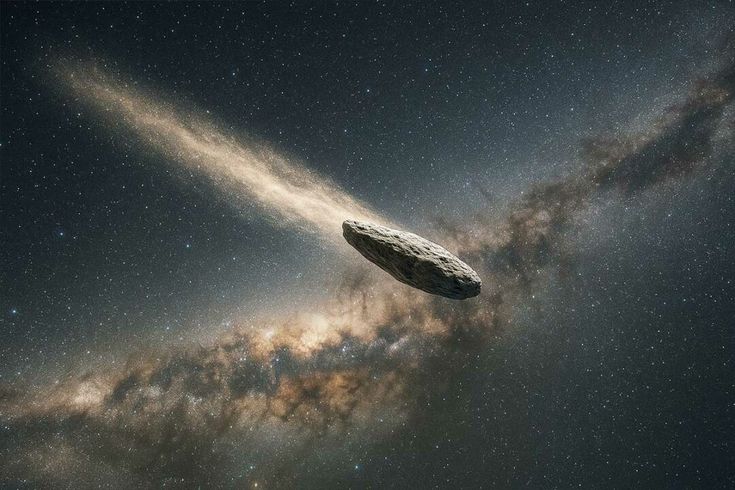
Astronomers have identified unusual chemical features in the interstellar comet 3I/ATLAS as it passed near Jupiter, offering new insights into objects that originate outside our solar system. The discovery is helping scientists better understand the diversity of materials found in distant star systems.
The comet, detected by the ATLAS Survey, is believed to have entered our solar system from interstellar space. Unlike typical comets that orbit the Sun, interstellar comets travel on paths that show they are not bound to our solar system, making them extremely rare and scientifically valuable.
As the comet approached Jupiter, astronomers used advanced instruments to analyze the gases and dust released from its surface. Observations from NASA and other research groups revealed an unexpected chemical composition, including unusual ratios of carbon-based molecules and a lower presence of water vapor than typically seen in comets from our own solar system.
These findings suggest that the comet formed in a very different environment, possibly around another star with different conditions for planet and comet formation. Scientists believe this could provide important clues about how other planetary systems evolve.
The flyby near Jupiter also played a key role in the observations. The planet’s strong gravity influenced the comet’s path, allowing scientists to track it more precisely. Additionally, Jupiter’s position made it easier for telescopes to observe the comet under favorable conditions.
Researchers are particularly interested in the presence of complex organic compounds within the comet. Such materials are considered important building blocks for life. Studying them in interstellar objects helps scientists explore the possibility that the ingredients for life may be common throughout the galaxy.
The discovery adds to a growing list of interstellar visitors, following earlier objects like ‘Oumuamua and Comet Borisov. Each new detection provides a rare opportunity to study material that formed far beyond our solar system.
Scientists plan to continue monitoring 3I/ATLAS as it moves away from the Sun. Further analysis may reveal more details about its origin, age, and structure.
This event highlights the importance of modern sky surveys and space observation technology. As detection methods improve, astronomers expect to find more interstellar objects, each offering valuable information about the wider universe.
For now, the unusual chemistry of this comet stands as a reminder that space is filled with diverse and surprising materials, many of which may hold the key to understanding how planets—and possibly life—form across the cosmos.