
As a journalist, I love a punchy, even sensationalistic headline. The late Vincent A. Musetto’s 1983 New York Post front-page crime-story zinger “Headless Body in Topless Bar” remains the apex of the art form, the kind of sublime wordplay that many of my fellow ink-stained wretches would rather have on their résumé than actual journalism awards.
But even so, I was dismayed to see the lurid and exaggerated headlines that followed after neuroscientist Jared Cooney Horvath testified before the U.S. Senate Committee on Commerce, Science, and Transportation in January about whether screen time is affecting the cognitive development of American kids: “Gen Z Is the First Generation Dumber Than Their Parents,” one popular news site shouted.
Horvath’s testimony—and his recent book The Digital Delusion—made the argument that laptops and smartphones have undermined childhood education and caused falling test scores: “Gen Z is the first generation in modern history to underperform us on basically every cognitive measure we have,” he said in the hearing, “from basic attention to memory to literacy to numeracy to executive functioning to even general IQ.”
It’s a reasonable argument (even if unproven), but it feeds directly into a far less reasonable, age-old “What’s the matter with kids today?” narrative that delights unscrupulous headline writers as much as it rankles those of us who care about the data.
In this issue’s cover story, “The Kids Are All Right,” science journalist and Scientific American contributor Melinda Wenner Moyer digs into the actual numbers, and what she finds is surprisingly optimistic. Far from being a lost cause, today’s youths are, in many measurable ways, doing better than their parents. Research suggests they are more open-minded and inclusive than previous cohorts, display higher levels of empathy than seen at almost any other point in the past four decades, and show significantly lower levels of drug use and violence. Moyer’s reporting suggests that shifts in parenting—specifically, a move toward more emotionally literate interactions—may be raising a generation that is smarter, kinder and more self-aware than the ones before them were.
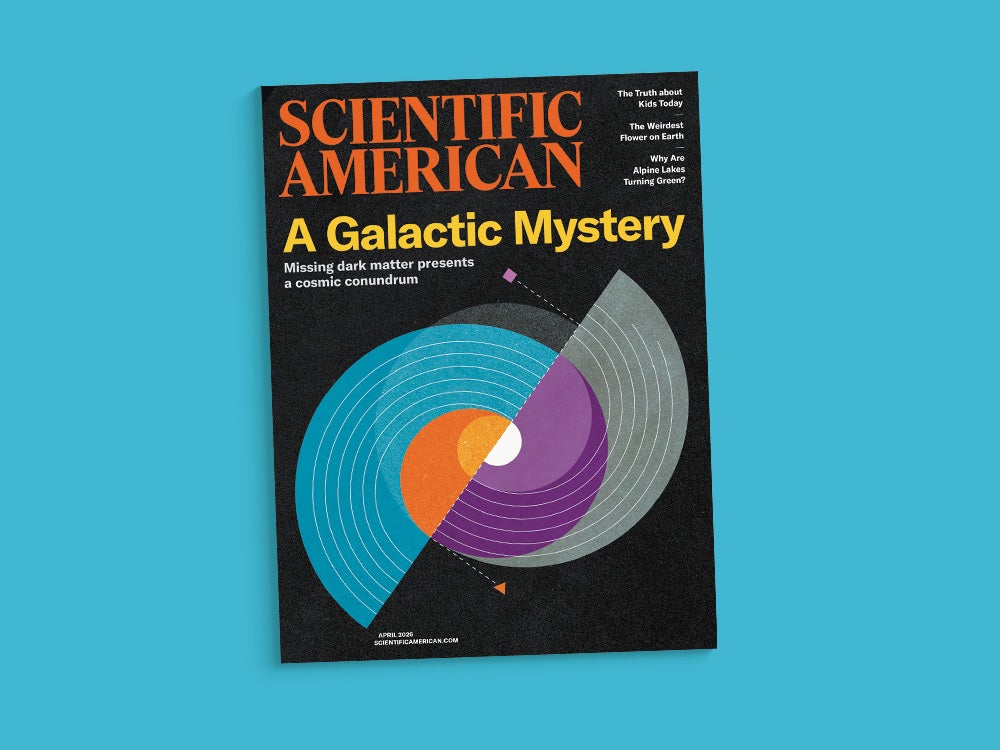
Some of you might have wondered why Moyer’s story isn’t featured on the cover of the issue you’re holding. It’s no April Fool’s joke. We’re trying a little experiment: our newsstand copies have a kid on the cover, whereas the subscribers-only edition features a stylized drawing of a spiral galaxy.
In our other cover article, “A Galactic Mystery,” astrophysicist Maria Luísa Buzzo describes a cosmic conundrum that is keeping astronomers up at night: Scientists assumed galaxies are held together by dark matter because without that invisible material, all those stars would simply fly away from one another. So what is keeping together recently discovered dwarf galaxies that seem to have no dark matter at all?
Buzzo explores the detective story surrounding these ghostly objects and explains how they’re forcing researchers to reconsider how galaxies form. One leading theory involves high-speed collisions between dwarf galaxies that separate visible matter from dark matter, a violent celestial divorce that leaves behind star-rich orphans that are poor in dark matter.
Elsewhere in the magazine, I recommend you check out evolutionary biologist Jacob S. Suissa’s deep dive into the world of the corpse flower. This botanical monster, which smells like rotting flesh to attract carrion beetles, is a remarkable example of adaptation in action. It’s a tale of gigantism, mimicry, and the strange, smelly paths that life can take to ensure survival. No fooling.