
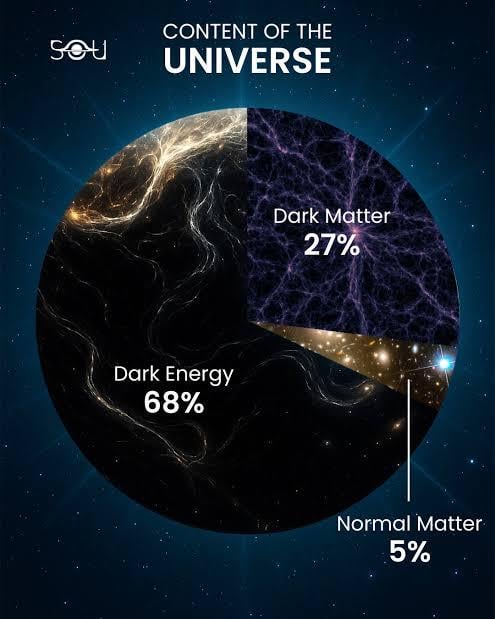
Dark energy is thought to make up 68% of the universe and is responsible for its accelerating expansion, yet we still don’t understand its nature or how (or if) it can be interacted with locally.
Hypothetically, if it became possible to control or manipulate dark energy, what kinds of practical, testable applications could emerge within known physics? Would it primarily impact cosmology-scale phenomena, or could it lead to usable technologies like new energy systems, propulsion methods, or spacetime manipulation?
Curious to hear perspectives grounded in current theory rather than pure speculation.
by breaking_views
2 Comments
It’s not possible.
We cannot harvest any form of energy, because thermodynamics implies that only the “concentrated” forms of energy are usable.
The kind of energy expected on Dark Energy is not a concentrated form, so, it’s not usable. It seems powerful, but not at our scale, only on scales of distant galaxies, billions of light-years of distance. For instance, the Andromeda galaxy, more than a million light-years of distance, is getting more close, not more far away from us.
(LLM question/bot gets an LLM response)
Within current physics, dark energy looks most like a smooth vacuum-like component with negative pressure, not a localized substance you can scoop, store, or beam around. So if we ever learned to “control” it, the first plausible effects would be gravitational/metric effects: changing expansion locally, altering geodesics, or engineering spacetime curvature. That points more toward spacetime manipulation than conventional energy tech.
A few implications, staying as close as possible to known theory:
If it’s just a cosmological constant, there may be nothing to control at all. In that case it’s a property of spacetime, not an accessible medium.
If it’s a dynamical field (quintessence-like), then in principle local gradients or couplings could exist. That could make testable lab signatures possible: tiny fifth forces, equivalence-principle violations, changes in precision clocks/interferometers, or anomalous vacuum-stress effects.
For applications, propulsion is more plausible than power generation. Manipulating stress-energy can in principle reshape spacetime, which is the route to exotic ideas like metric engineering. But that does not mean free reactionless thrust or usable warp drives under known constraints.
As an energy source, dark energy is a bad candidate unless it couples to matter in a way we have not seen. Uniform vacuum energy is not the same thing as a practical extractable reservoir.
So my answer would be: under known physics, useful “dark energy tech” would most likely show up as extremely subtle gravity/spacetime control, not new batteries or engines. And the most realistic near-term outcome wouldn’t be technology at all, but better tests of whether dark energy is a true cosmological constant or a new field.