
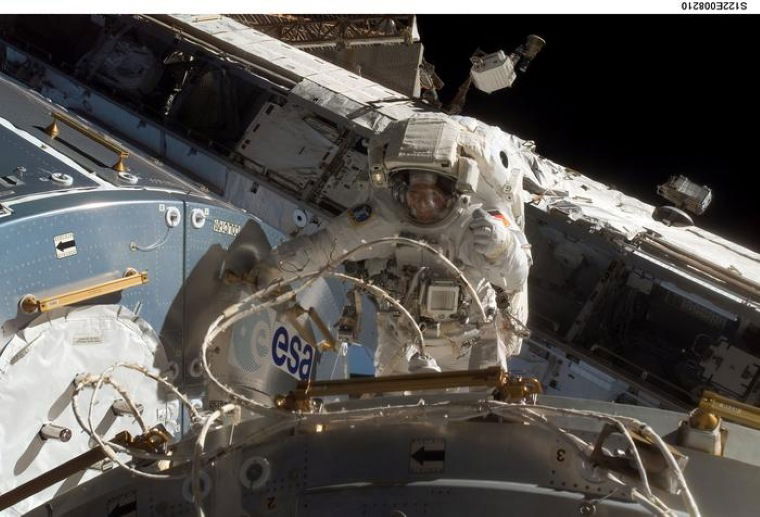
The GSI/FAIR accelerator facility has accepted a galactic cosmic ray (GCR) simulator from the European Space Agency (ESA) for installation at its massive complex in Darmstadt, Germany, which can generate the same high-energy cosmic rays to which astronauts, satellites, and other spacecraft are exposed in space.
The team behind the new GCR simulator said their system will let designers and engineers test systems and components intended for space-based operations to expose any vulnerabilities to potentially harmful GCRs on Earth, rather than performing costly experiments in space.
“Until now, there has been no reliable way to simulate GCRs in Europe,” explained Marco Durante, professor at the Technical University of Darmstadt and head of GSI/FAIR’s research department Biophysics.
Galactic Cosmic Ray Simulator Mimics Real Danger to Astronauts
Astronauts and human-made objects operating in space outside of Earth’s protective magnetic field are continuously exposed to several forms of damaging radiation. While high-energy particles ejected by the Sun are considered the most harmful to humans and electronics, the next most harmful are galactic cosmic rays originating from distant arms of the Milky Way galaxy.
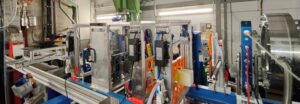 Experimental setup of the GCR simulator at GSI/FAIR. Image Credit:
© E. Pierobon, GSI/FAIR.
Formed by supernova and other extreme cosmic events, GCRs consist primarily of helium nuclei and protons. However, the team behind the new simulator notes that these harmful rays also contain other high-charge and high-energy particles, “which contribute significantly to the radiation exposure of astronauts.”
According to a GSI/FAIR statement announcing the acquisition of the GCR simulator, estimates suggest an astronaut’s body is “traversed” by a proton at least once every few days. If an astronaut is in space long enough, estimates show that their cells will also be passed by helium nuclei every few weeks and high-charge/high-energy (HZE) particles every few months.
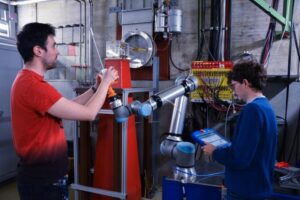 Postdoc Dr. Enrico Pierobon (left) and PhD-student Luca Lunati from GSI/FAIR Biophysics mount a microdosimeter on a robotic arm. Image Credit: © A. Dörr, GSI/FAIR.
When GCRs pass through a spacecraft’s shielding, they create neutrons and other fragments. According to the GSI/FAIR team, this added exposure can be “particularly problematic during long-term missions to the Moon or to Mars,” where long-term scientists and even longer-term colonists will experience radiation levels higher than those astronauts in Low Earth Orbit experience.
“GCRs are therefore the most significant long-term health risk for astronauts and can lead to cancer, degenerative cell effects, or disorders of the central nervous system,” they explain.
Bringing the Universe to the Lab
Because GCRs can also be harmful to spacecraft and satellite electronics, the Technical University of Darmstadt researchers were eager to adopt a new system designed to test the readiness of components and astronauts on Earth, without the added costs and complexities of conducting these experiments in space.
“This enables researchers to better understand the doses that affect technical components and human tissue and how these effects can be controlled or limited in a targeted approach,” Durante explained. “That’s why our research team, with the support of our ESA partners, developed a simulator for GCRs and put it into operation at GSI/FAIR as part of the FAIR Phase 0 experiment program.”
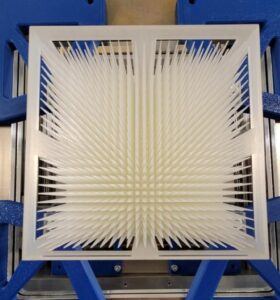 The GCR simulator is based on a hybrid, active-passive method: the energy of a primary beam of iron ions is actively varied before hitting passive beam modulators — a well-known and proven method from particle therapy. Image credit: GSI/FAIR
According to Dr. Christoph Schuy, of the Biophysics department and leader of the Space Radiation Physics group, the Galactic Cosmic Ray simulator employs a hybrid ‘active-passive’ method. This means the energy from a primary ion beam generated by the facility’s accelerators is actively varied before it impacts the system’s passive beam modulators, a process that they noted is “a well-known and proven method from particle therapy.”

In the current application, the geometry, material, composition, and thickness of the modulators are optimized to best approximate a real, deep-space radiation environment analog. According to Dr. Schuy, early tests show “good agreement with the values known from space missions.”
“True to our claim, we bring the Universe to the lab with this achievement,” the researcher said.
The study “Hybrid active–passive Galactic Cosmic Ray simulator: In-silico design and optimization” was published in Life Sciences in Space Research.
Christopher Plain is a Science Fiction and Fantasy novelist and Head Science Writer at The Debrief. Follow and connect with him on X, learn about his books at plainfiction.com, or email him directly at christopher@thedebrief.org.