
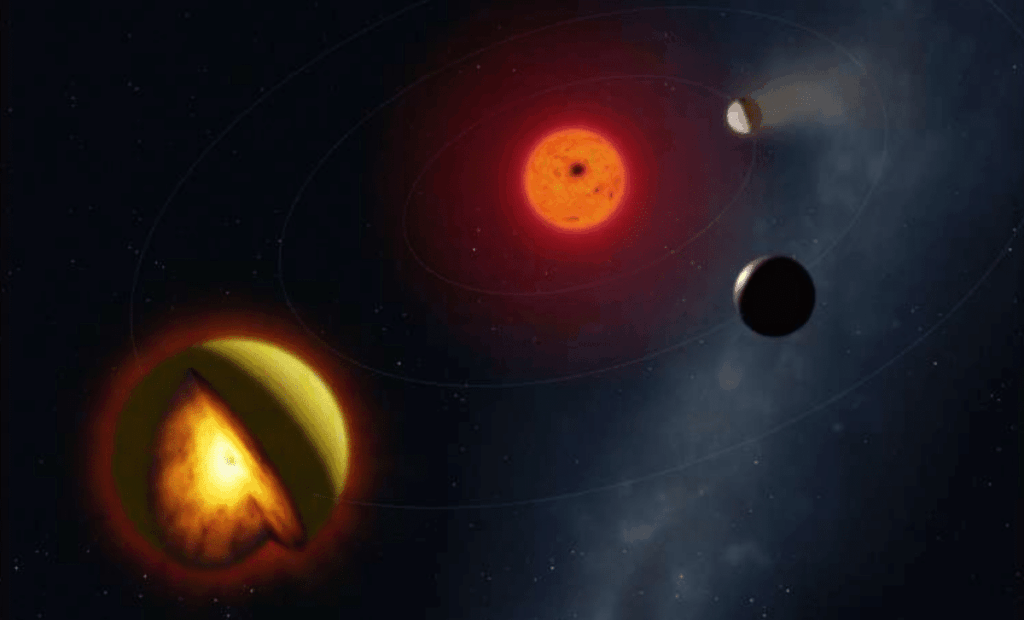
Astronomers have discovered a new class of exoplanet that defies traditional categories of planetary classification. In a groundbreaking study published in Nature Astronomy, researchers led by the University of Oxford reveal L 98-59 d, an alien world that features a persistent magma ocean and stores vast amounts of sulfur deep within its molten interior. This discovery challenges everything scientists thought they knew about planet formation, providing us with a glimpse into the diversity of worlds that exist far beyond our solar system.
Unveiling the Mystery of L 98-59 d
L 98-59 d, located 35 light-years from Earth, is an exoplanet that possesses a host of strange and unique features. Measuring about 1.6 times the size of Earth, this planet doesn’t fit neatly into the typical categories astronomers have used to classify smaller planets. Rather than falling into the familiar types of rocky “gas-dwarfs” or water-rich worlds, L 98-59 d belongs to a completely new category, one that is rich in sulfur and retains a molten surface.
What makes L 98-59 d so remarkable is its low density combined with its unusual atmospheric composition. Observations from the James Webb Space Telescope (JWST) revealed the presence of sulfur gases, including hydrogen sulfide, which is responsible for the foul smell of rotten eggs. These findings suggest a dynamic interaction between the planet’s molten interior and its thick atmosphere.
A Molten Ocean That Shapes the Planet’s Composition
The researchers used advanced computer simulations to recreate the history of L 98-59 d, tracing its evolution over nearly five billion years. According to the study, published in Nature Astronomy, the planet’s mantle is made of molten silicate, similar to the lava on Earth, with a global magma ocean stretching thousands of kilometers beneath the surface. This immense magma reservoir allows the planet to store significant quantities of sulfur, which would normally be lost to space due to the X-ray radiation from its host star.
The study found that the deep magma ocean is a critical factor in shaping the planet’s sulfur-rich atmosphere. It not only retains the planet’s volatile gases but also regulates them, allowing sulfur-bearing gases such as hydrogen sulfide to persist. The planet’s unique ability to retain these gases challenges previous assumptions about how exoplanets lose their atmospheres over time. As lead author Dr. Harrison Nicholls of the University of Oxford explained,
“This discovery suggests that the categories astronomers currently use to describe small planets may be too simple.”
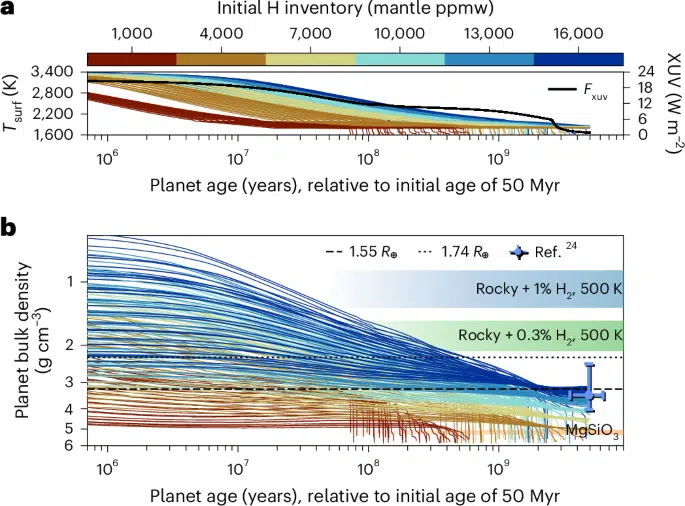 Temporal evolution of L 98-59 d’s bulk density simulated over its lifetime. (Nature)
How Computer Models Reconstruct the Planet’s Deep Past
One of the most exciting aspects of this discovery is how the researchers were able to use computer models to uncover the interior of a planet they will never physically visit. Co-author Professor Raymond Pierrehumbert from the University of Oxford noted,
“What’s exciting is that we can use computer models to uncover the hidden interior of a planet we will never visit… and discover types of planets with no equivalent in our own solar system.”
By simulating various planetary processes, the team was able to track the planet’s history and uncover the chemical interactions between its molten interior and the atmosphere. These simulations suggest that L 98-59 d likely began as a volatile-rich planet, much larger than it is today. Over time, the planet cooled and shrank, shedding much of its atmosphere. This process, combined with the deep storage of sulfur in the planet’s magma ocean, has allowed L 98-59 d to retain a unique, sulfurous atmosphere that scientists had never before observed on such a scale.
What This Means for the Search for Life and Other Worlds
While L 98-59 d is unlikely to support life, its discovery expands our understanding of planetary diversity. The findings suggest that there are many more types of planets in the universe than previously thought, which could open up new avenues for exploring the conditions that might allow life to thrive elsewhere. As Dr. Harrison Nicholls pointed out, “We may then ask: what other types of planet are waiting to be uncovered?”
For scientists, this is not just about understanding L 98-59 d itself, but about recognizing that the universe holds far more mysteries than we can yet comprehend. The study reveals just how much we still need to learn about planets beyond our solar system and the processes that shape them. As Dr. Richard Chatterjee from the University of Leeds explained, “Our computer models simulate various planetary processes, effectively enabling us to turn back the clock and understand how this unusual rocky exoplanet, L 98-59 d, evolved.”