
The passing asteroid apparently offers an opportunity for scientists to observe how Earth’s gravity may affect the structure and behavior of an asteroid. In turn, this will help improve models used to understand and reduce planetary defense risks, says ESA.
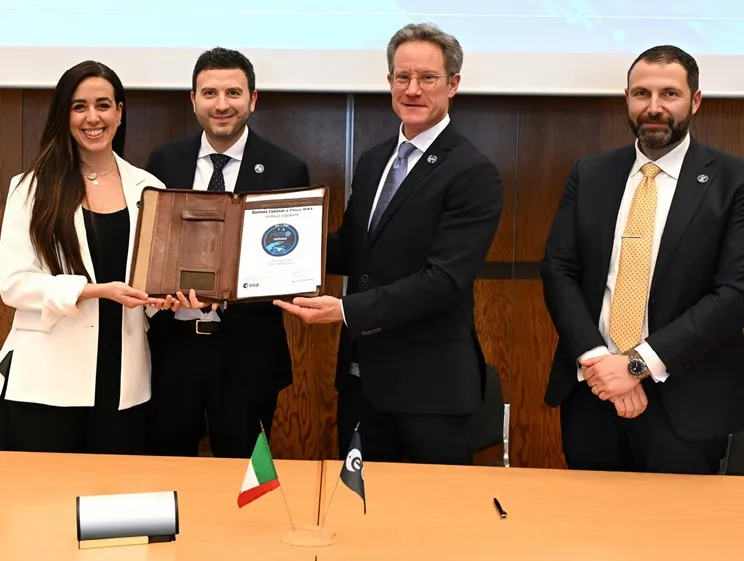
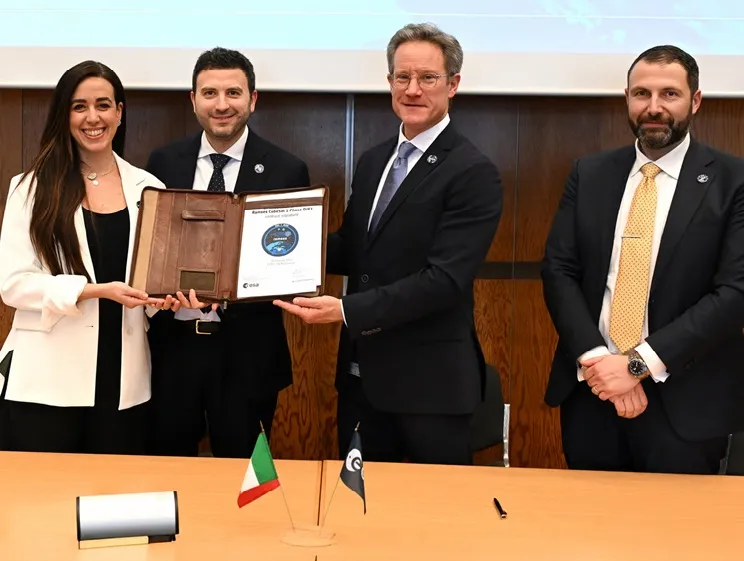
Having successfully completed a Critical Design Review in January 2026, Tyvak will now begin the implementation phase. The launch date is currently 2028.
Tyvak International is a subsidiary of Terran Orbital, which itself is a Lockheed Martin Company.
Farinella
“Planetary defense is an area where international collaboration and technological innovation are essential,” said Peter Krauss, CEO of Terran Orbital. “Through Tyvak International, Terran Orbital is proud to support the European Space Agency’s RAMSES mission and contribute advanced small-satellite capabilities that will help us better understand near-Earth asteroids and strengthen global efforts to protect our planet.”
The CubeSat takes its name from the Italian scientist Paolo Farinella.
RAMSES
The RAMSES mission aims to study the asteroid Apophis during its close approach to Earth. This will be on 13 April 2029 when the asteroid will pass closer than geostationary orbit.
Operating aboard the RAMSES spacecraft, made by OHB Italia, the Farinella CubeSat will be one of two spacecraft to explore the asteroid’s subsurface. This will be using low-frequency radar.
The Farinella satellite will also carry Horus and Vista. The former is an optical instrument that acts as both a science imager and navigation camera. And the latter is a dust detector that previously flew on the Milani CubeSat from ESA’s Hera mission. That CubeSat was also made by Tyvak.
The Japanese space agency JAXA is also taking part. Its contributions include spacecraft components such as the solar arrays and thermal infrared imager, and a potential rideshare launch with JAXA’s Destiny+ mission. Japanese researchers also participate in Ramses’ scientific activities.
Image: Terran Orbital
See also: Terran Orbital satellite to test Quantum Key Distribution in space