
For decades, humanity has scoured the cosmos for any signs that we aren’t alone in the universe.
NASA spacecraft like the twin Voyager probes – launched in the 1970s bearing the iconic Golden Record – exoplanet-hunting missions and ground telescopes here on Earth have searched far and wide for any indication that extraterrestrials are out there.
And the only answer they’ve gotten in return? Radio silence.
But now, researchers at the SETI institute are wondering if the reason first contact has yet to be made with alien life is because we simply aren’t getting their messages.
Could space weather be messing with calls coming from advanced extraterrestrial life that’s diluting the radio signals into something scientists on Earth tend to ignore? New research published by scientists at SETI suggests it’s definitely possible.
2025 was a year of cosmic discoveries. Here’s a look back at 6
1 of 11
NASA’s Hubble Space Telescope last observed come 3I/ATLAS on Nov. 30, about four months after Hubble’s first look at the interstellar comet. 3I/ATLAS became one of the biggest cosmic stories of the year when astronomers deemed it to be the third-ever discovered interstellar object in our solar system originating from an entirely different part of the galaxy.
Here’s everything to know about SETI’s new research, and how solar winds and other factors could be interfering with alien messages.
Why SETI might have missed alien radio signals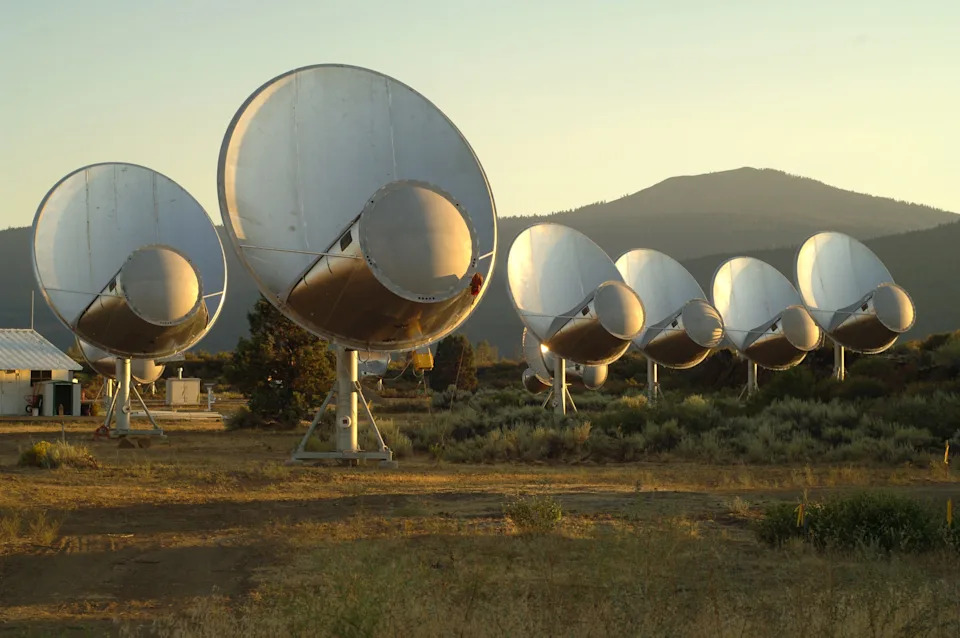
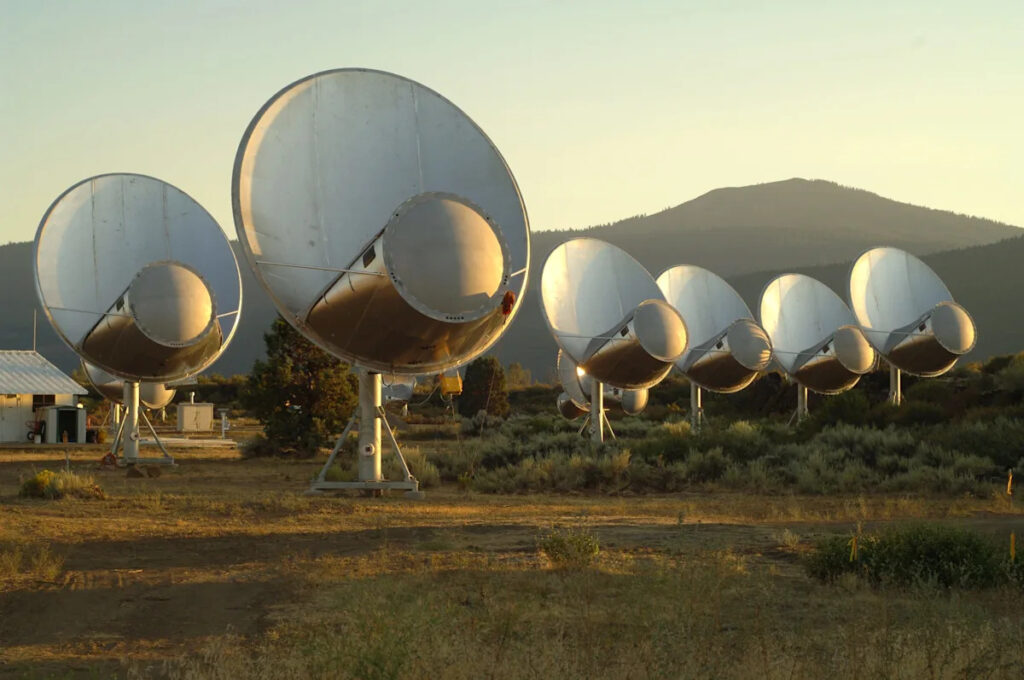
The Allen Telescope Array is a large number of small dishes in northern California dedicated to astronomical observations and a simultaneous search for extraterrestrial intelligence.
If aliens are trying to make contact with us here on Earth, new research suggests that commonplace space weather could be interfering with those radio signals.
The study, published in March in the Astrophysical Journal by researchers at the SETI Institute, suggests radio signals from extraterrestrial intelligence could be harder to detect if solar activity in other star systems gets in the way.
For instance, if, say, aliens are attempting a transmission from an exoplanet beyond our solar system, space weather could broaden and scatter an otherwise “ultra-narrow signal” intended just for Earth. Spread across more frequencies, the technosignature would be far less likely to be detected in traditional narrowband searchers, SETI said in a press release.
Such distortions could be caused not just by solar winds, but coronal mass ejections – bursts of plasma and charged particles from a sun – in other star systems. According to the researchers, the effect could be most common among planets orbiting low-mass M-dwarf stars, which are not only possibly habitable, but exceedingly common in the Milky Way.
“By quantifying how stellar activity can reshape narrowband signals, we can design searches that are better matched to what actually arrives at Earth, not just what might be transmitted,” study co-author Grayce C. Brown, a research assistant at SETI, said in a statement.
What is SETI? Institute searches for extraterrestrial life
Research teams at the Search for Extraterrestrial Intelligence (SETI) Institute have for years famously used radio telescopes to search for signals in outer space that could originate from intelligent life beyond our world.
In September 2024, SETI took their work beyond our own Milky Way galaxy – beginning the complex task of searching for signs of advanced extraterrestrial civilizations in other distant galaxies.
Using the Murchison Widefield Array (MWA) in Western Australia, researchers began the hunt for “extragalactic” civilizations in more than 2,880 galaxies, which SETI hailed as the first attempt to search for signs of alien technology in galaxies beyond our own.
SETI’s work remains ongoing to also search for signs of alien technology in the TRAPPIST-1 star system, home to several terrestrial planets similar to Earth.
2025 spaceflight in photos. See images of Blue Origin, SpaceX missions
1 of 13
Firefly’s Blue Ghost lunar lander captures its shadow on the moon’s surface after completing a successful landing March 2 near a volcanic feature on the moon called Mons Latreille. The vehicle became the first of two landers manufactured by a U.S. company to reach the moon is 2025 in crucial missions to lay the groundwork for NASA to return humans to the lunar surface in the years ahead.
Interest around aliens, UFOs heightened after Obama comments
Of course, many people believe aliens are already here.
Public interest in aliens and UFOs remains high across the United States amid a series of high-profile Congressional hearings in which military officers and other witnesses have testified about what they’ve seen.
The hearings have been filled with astonishing claims of strange objects outmaneuvering U.S. aircraft and shadowy government programs to retrieve not just downed alien spacecraft, but the extraterrestrial pilots themselves. While almost all of the claims have been offered without concrete evidence, lawmakers in September saw a whistleblower video purporting to show a U.S. military drone trying – and failing – to shoot down a mysterious object.
Former President Barack Obama also recently weighed in, saying of aliens, “they’re real,” in a podcast soundbite that quickly went viral. Though Obama later walked back the comment, President Donald Trump accused him of revealing classified information before doing an about-face of his own: claiming he was ordering the Pentagon to release files on UFOs, which it now refers to as unidentified anomalous phenomena (UAP).
Eric Lagatta is the Space Connect reporter for the USA TODAY Network. Reach him at elagatta@usatodayco.com
This article originally appeared on USA TODAY: Solar weather may have interfered with alien radio signals, SETI says