
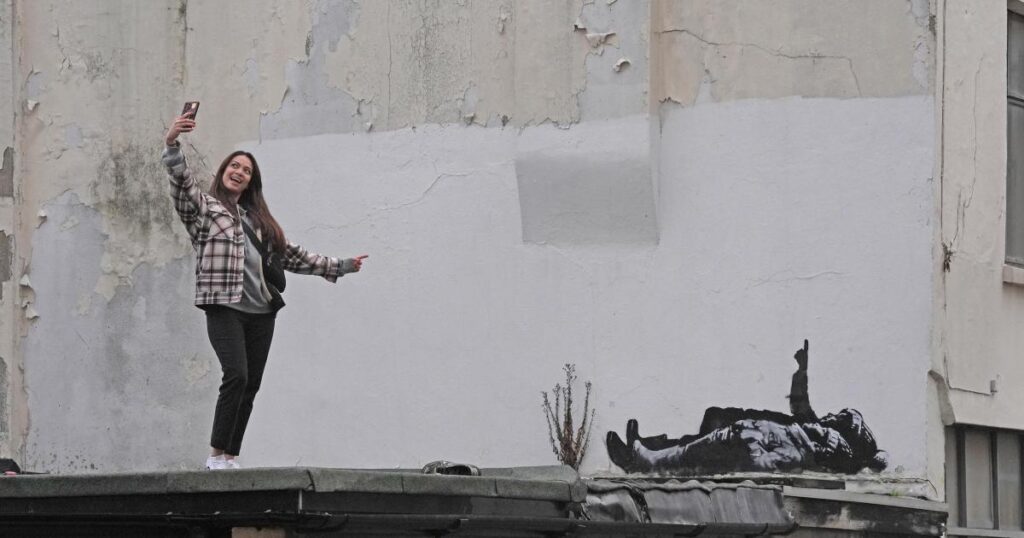
Banksy is famous for his graffiti artwork, which has appeared across the UK and around the world, including in Ukraine and the West Bank Barrier.
Some of his pieces include:
Balloon Girl
Kissing Coppers
Flower Thrower
Love is in the Bin
Pulp Fiction
Show Me the Monet
He has managed to avoid being named since first catching the public’s attention in the late 1990s.
However, a recent investigation by Reuters is believed to have finally uncovered Banksy’s identity.
Who is Banksy?
Banksy is believed to be 51-year-old Robin Gunningham from Bristol, according to Reuters.
A signed confession from 26 years ago is said to have been what gave the British artist away.
The Telegraph explains: “Reuters claims that in 2000, Banksy was in New York during Fashion Week, and a billboard for Marc Jacobs clothing had been erected on the roof of a brownstone apartment block, sporting the slogan ‘Boys Love Marc Jacobs’.
“Friends of Banksy told Reuters that the artist had become intrigued by the billboard, and climbed onto the roof to alter the advertisement.”
Banksy’s former manager, photographer Steve Lazarides, said the artist “doctored the Marc Jacobs Men billboard so that the model had goofy teeth”.
But before Banksy could finish, he was arrested by New York police officers and charged with misdemeanour, according to Reuters reports.
He was also forced to pay a fine of US$310 (£247).
The Telegraph added: “The investigation claims that police reports and court documents from this 2000 arrest were unearthed, showing the name ‘Robin Gunningham’.”
Banksy’s lawyer says his identity remains a secret
While the Reuters investigation claims to have proof of Banksy’s identity, the artist’s lawyers have denied the claims and said his identity remains a secret.
Banksy’s lawyer, Mark Stephens, told Reuters that his client “does not accept that many of the details contained within your enquiry are correct”, adding that this was important because he had been “subjected to fixated, threatening and extremist behaviour”.
Mr Stephens continued: “[Working] anonymously or under a pseudonym serves vital societal interests.
“It protects freedom of expression by allowing creators to speak truth to power without fear of retaliation, censorship or persecution – particularly when addressing sensitive issues such as politics, religion or social justice.”