
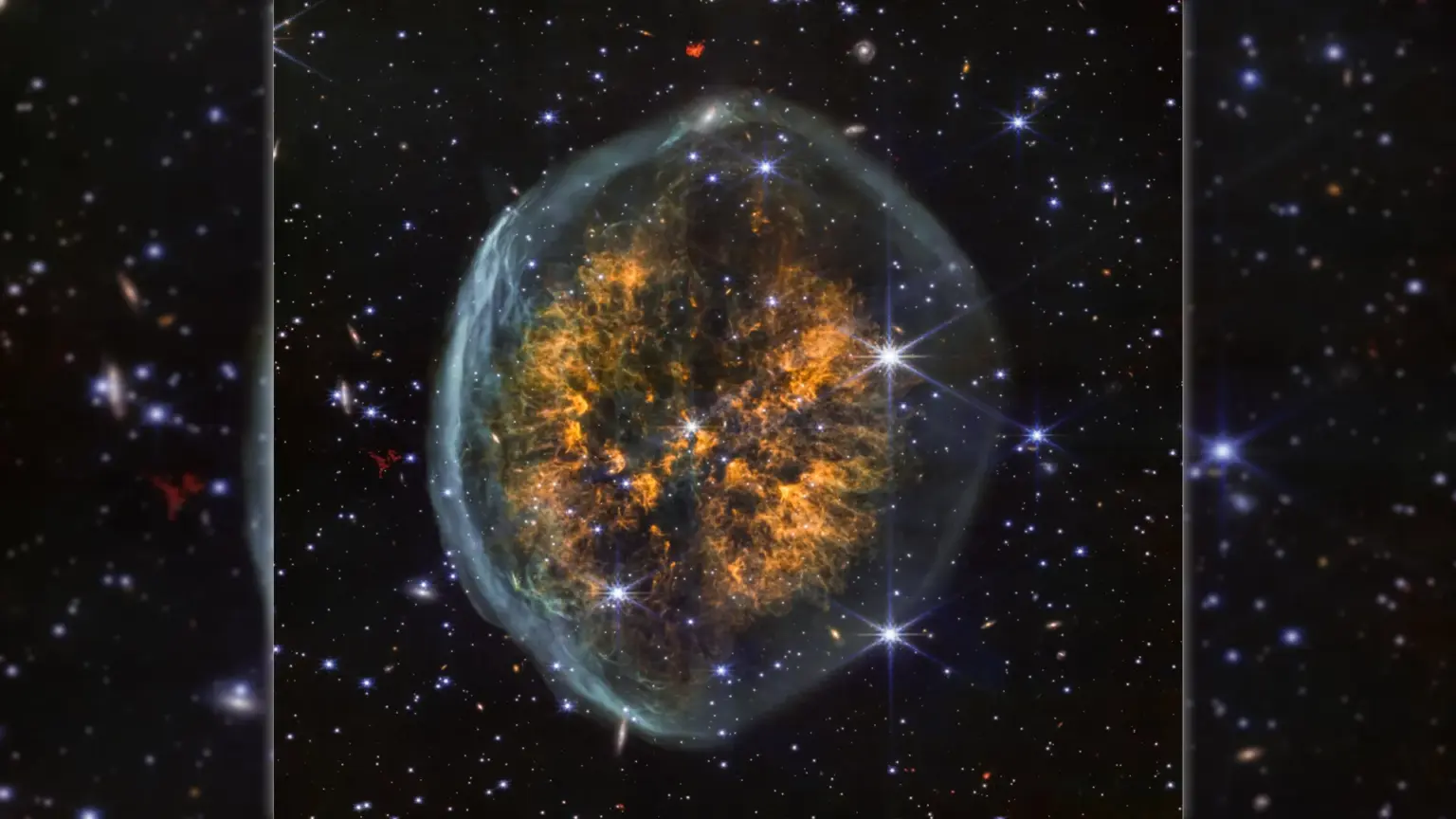
New images from NASA’s James Webb Space Telescope are providing a clearer look at a mysterious and rarely studied nebula surrounding a dying star. The observations reveal new details about the structure of this unusual cloud of gas and dust and how it is changing over time.
Called Nebula PMR 1, the object has a striking appearance that resembles a brain inside a transparent skull, which is why it has been nicknamed the “Exposed Cranium” nebula. Webb observed it using both near infrared and mid infrared light, uncovering features that were not previously visible. The nebula was first detected in infrared light more than a decade ago by NASA’s now-retired Spitzer Space Telescope, but Webb’s more advanced instruments provide a much sharper and more detailed view, making its brain-like structure stand out even more clearly.
Layers, Jets, and a Dividing Lane
The nebula shows clear signs of different stages in its development — an outer shell of gas that was expelled earlier and is made mostly of hydrogen, along with a more complex inner region that contains a mix of gases and more detailed structures. These layers reflect how the star has shed material over time.
Images from Webb’s NIRCam (Near-Infrared Camera) and MIRI (Mid-Infrared Instrument) both highlight a dark lane running vertically through the center of the nebula. This feature splits the cloud into two sections that resemble the left and right sides of a brain. Webb’s high resolution suggests that this dark lane may be connected to an outburst or flow of material from the central star, a process often driven by twin jets shooting out in opposite directions. Evidence of this activity is especially visible near the top of the nebula in the MIRI image, where gas from the inner region appears to be pushed outward.
A Star in Its Final Stages
Although many details about this object are still uncertain, scientists know it is being shaped by a star nearing the end of its fuel-burning “life.” During this phase, stars shed their outer layers into space. While this may sound slow, it is relatively fast on cosmic timescales.
Webb has captured a snapshot of this process as it unfolds. The star’s eventual fate depends on its mass, which has not yet been determined. If it is large enough, it could end its life in a supernova explosion. If it is more like our Sun, it will continue to lose material until only its dense core remains as a white dwarf, which will gradually cool over vast stretches of time.
The Role of the James Webb Space Telescope
The James Webb Space Telescope is the most advanced space observatory ever built for studying the universe. It is designed to investigate objects within our solar system, examine planets orbiting other stars, and explore the origins and structure of galaxies across cosmic history.
Webb is an international collaboration led by NASA in partnership with ESA (European Space Agency) and CSA (Canadian Space Agency), and it continues to deliver new insights into how the universe formed and evolved.