
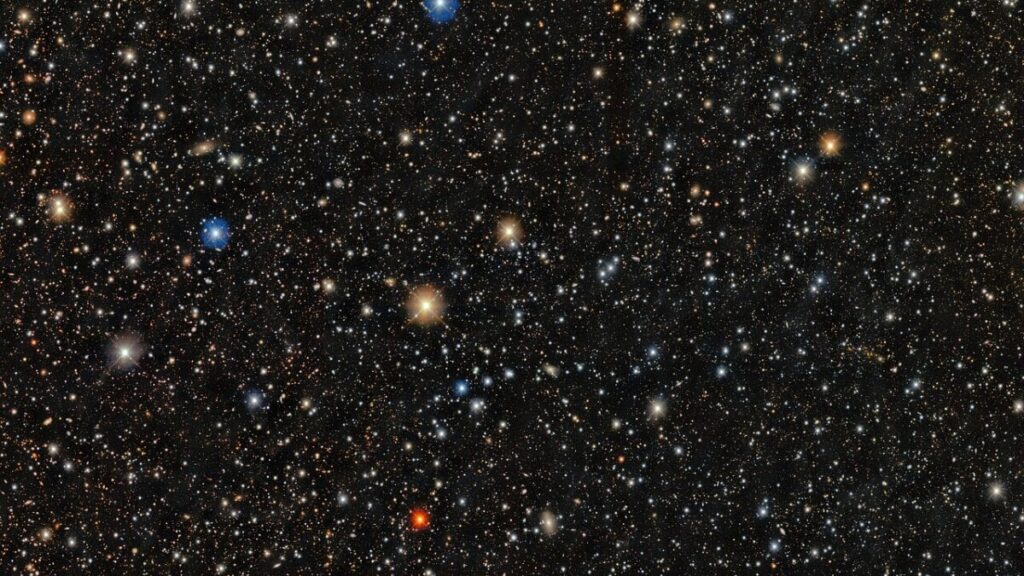
Astronomers have discovered the first clear example of a star made entirely of materials from one of the very first stars.
Researchers spotted the extremely ancient and chemically primitive star in Pictor II, a satellite of a satellite: Pictor II is a dwarf galaxy that orbits the Large Magellanic Cloud, which, itself, circles the Milky Way. The star’s unusual makeup suggests it formed after a weak supernova of one of the original stars in the universe.
The star, known as PicII-503, bolsters the idea that small early galaxies like Pictor II shaped the chemical evolution of larger galaxies, like our own, when the larger ones eventually absorbed those relics. The discovery reveals a stage of cosmic history astronomers can’t directly see, even with powerful tools like NASA‘s James Webb Space Telescope.
Scientists say relatively close examples in space like PicII-503 can serve as time capsules, providing crucial insight into how the first stars seeded the universe with the heavier elements necessary to build planets and ultimately life.
“What excites me the most is that we have observed an outcome of the very initial element production in a primordial galaxy, which is a fundamental observation,” Anirudh Chiti, a Stanford University researcher who led the study, said in a statement.
Mashable Light Speed
SEE ALSO:
Space-traveling microbes? An unusual experiment shocked skeptics.
In the beginning, the first stars formed when the universe was mostly composed of hydrogen and helium, the two lightest elements on The Periodic Table. When those first stars died in supernovas, they blasted out heavier elements, such as carbon, iron, and calcium. It was only after subsequent generations of stars that they began to incorporate these ingredients.
The recently discovered star, roughly 600,000 light-years away from Earth in the constellation Pictor, has remarkably low iron and calcium elements, much lower than practically any star known outside the Milky Way. By comparison, PicII-503 has less than 1-40,000th of the sun‘s iron. But it also contains a relatively high amount of carbon.
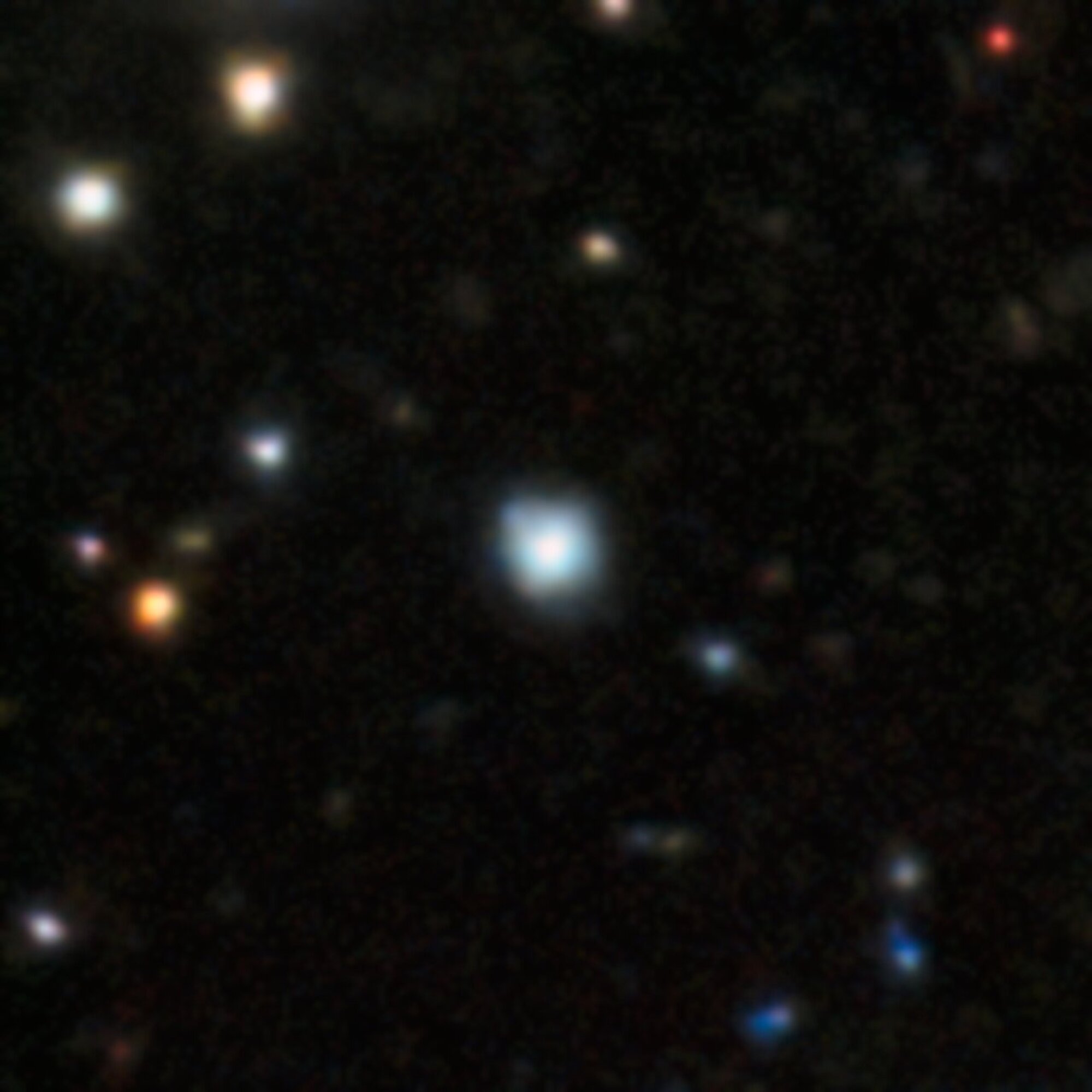
PicII-503 is the first clear example of a star containing chemicals from one of the universe’s first supernovas.
Credit: CTIO / NOIRLab / DOE / NSF / AURA / T.A. Rector / M. Zamani / D. de Martin
This unusual mix suggests the star formed from gas polluted by just one very early — and very weak — star explosion. The idea is that a less powerful explosion would result in heavy elements like iron staying trapped in the dead star’s collapsed core, with lighter elements like carbon blasting into space. That would explain stars with low iron content but lots of carbon.
In the new study, published in Nature Astronomy, researchers believe PicII-503 is probably more than 10 to 12 billion years old. They discovered it with the U.S. Department of Energy’s Dark Energy Camera, an instrument mounted on the U.S. National Science Foundation’s Víctor M. Blanco 4-meter Telescope in Chile. The facility is a program of the NSF NOIRLab.
“Discoveries like this are cosmic archaeology, uncovering rare stellar fossils that preserve the fingerprints of the Universe’s first stars,” said Chris Davis, NSF program director for NOIRLab, in a statement.
The finding hints where astronomers should look for other ancient stars, the researchers say. PicII-503 sits far from the center of its own galaxy. That may suggest the oldest and most chemically primitive stars reside in galaxy outskirts.