
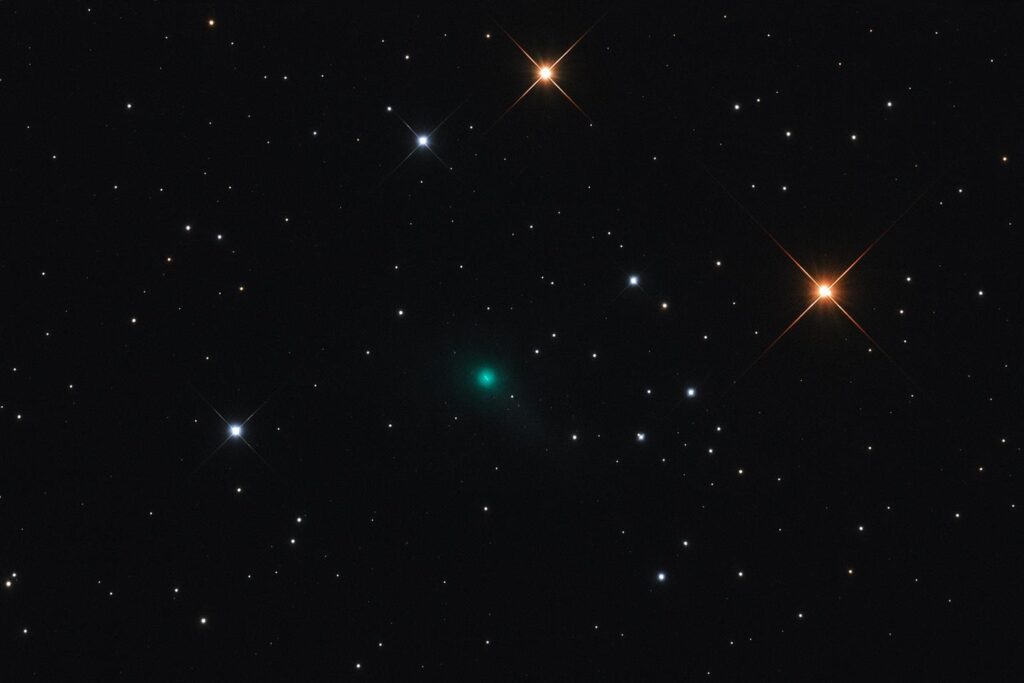
In early April 2026, astronomy enthusiasts and scientists will be holding their breath. The recently discovered MAPS comet (C/2026 A1) is preparing for a rendezvous with our star. On April 4, it will reach perihelion—the point of closest approach to the Sun.
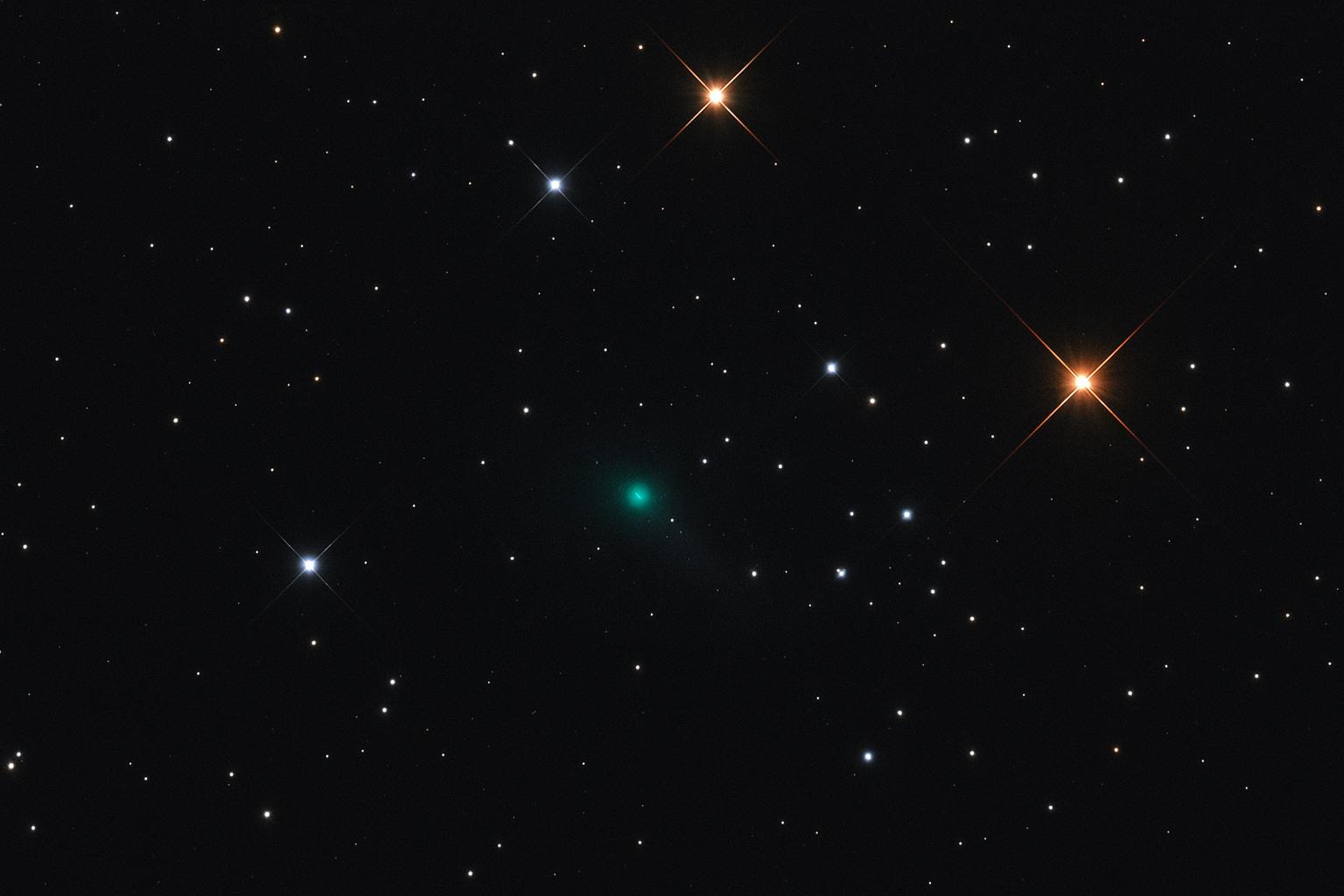 Comet Kreutz C/2026 A1 (MAPS), which glowed a bright turquoise color due to the emission of diatomic carbon, had a magnitude of just 17 when this photo was taken on January 17. The comet will remain relatively faint, except for a few days around its perihelion on April 4, 2026, when it may reach negative magnitudes for a few hours. Photo: Gerald Remann and Michael Jäger
How the “stranger” was found
The object was detected very recently—on January 13, 2026. The discovery was made in Chile’s Atacama Desert using the AMACS1 observatory. There’s a whole story behind the name: the acronym MAPS is formed from the first letters of the surnames of four asteroid hunters: Alain Maury, Georges Attard, Daniel Parrott, and Florian Signoret.
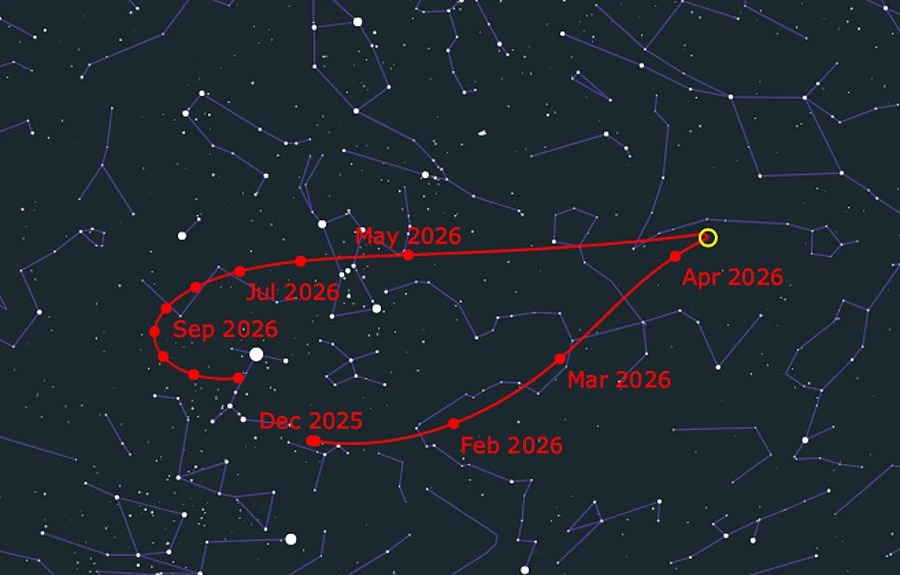 Comet C/2026 A1 is currently moving northwestward in the constellation Eridanus. After it passes the Sun in early April, it will change direction and begin moving rapidly eastward. The yellow circle indicates the Sun’s position at perihelion.
At the time of its discovery, the comet was located in the constellation Cygnus, more than 300 million kilometers from the Sun. At that time, it was extremely faint. However, within a matter of weeks, its brightness increased a thousandfold. It is now visible through small amateur telescopes.
The Kreutz Family
Astronomers have classified MAPS as a member of the Kreutz comet family. This is a special class of objects that pass extremely close to the Sun. Scientists believe that they are all fragments of a single giant primordial comet that broke apart many centuries ago.
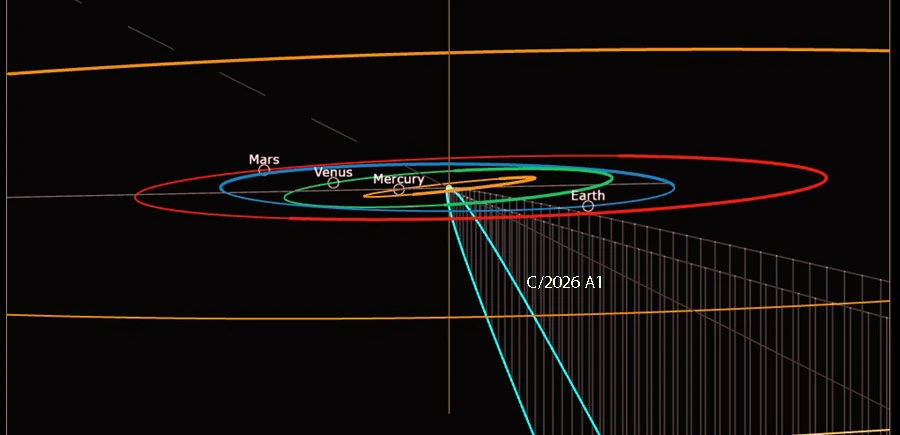 The orbit of comet MAPS is inclined by 144.5° to the plane of the ecliptic, and its orbital period is approximately 1,175 years. Source: MAPS 2026 / skyandtelescope.org
The fate of such “solar travelers” is usually tragic. For example, in October 2024, comet C/2024 S1 (ATLAS) could not withstand the close approach and disintegrated before it even reached its peak brightness. However, there are exceptions: in 2011, the famous comet C/2011 W3 Lovejoy survived its passage through the solar corona, treating Earthlings to an unforgettable blue-green glow.
Chances of a spectacular show: when and where to watch?
Does MAPS have a chance of surviving? Astronomers are cautiously optimistic. This comet’s main advantage is its size. With a diameter of about 2.4 km, it is larger than most typical Kreutz comets.
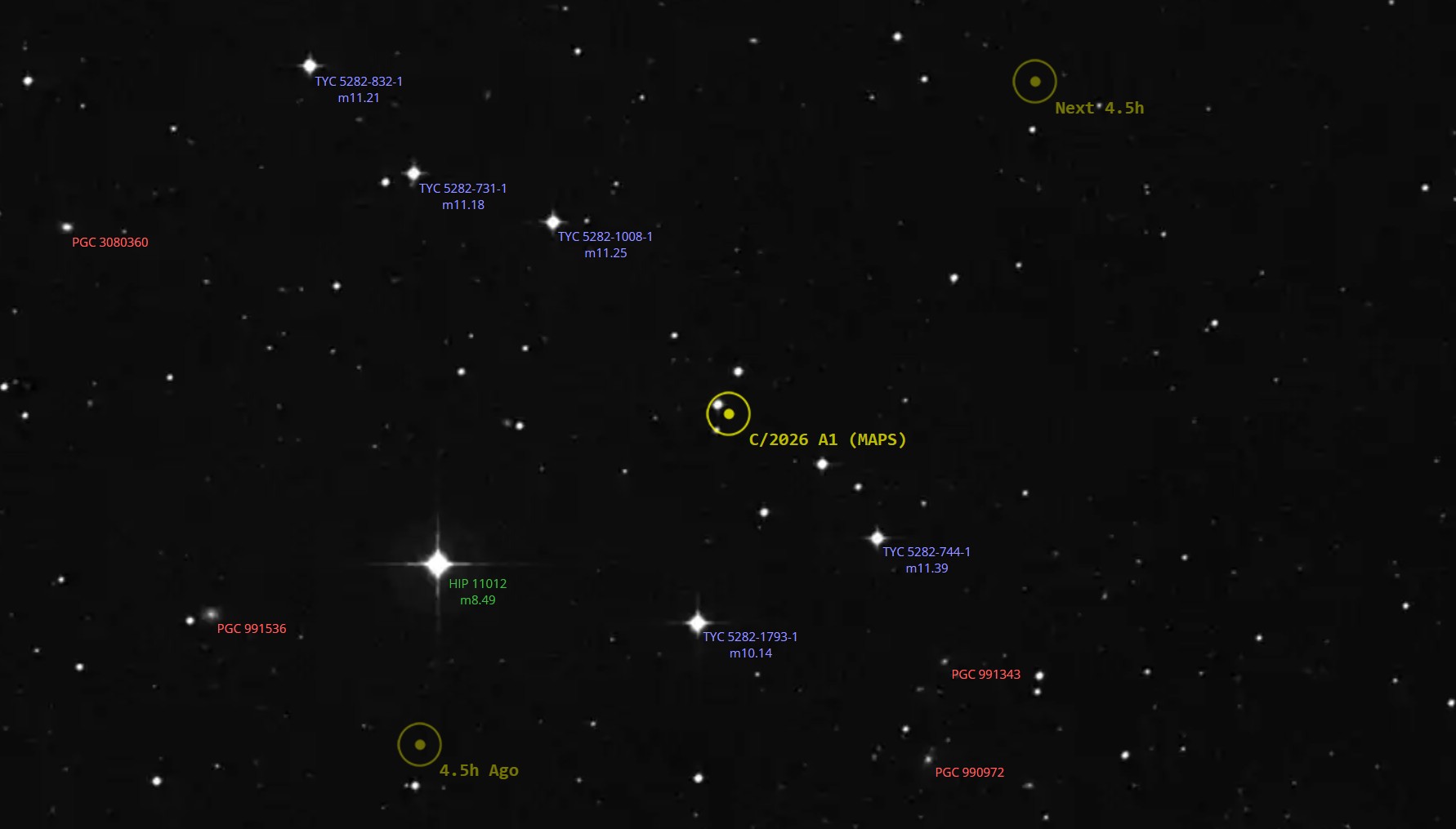 The comet’s position in the sky as of March 16, 2026. Illustration: theskylive.com
If the nucleus can withstand gravitational tides and extreme temperatures, the comet could reach a magnitude of -4, which is as bright as Venus.
Tips for observers:
Where to look: near the horizon, immediately after sunset.
When: The best time is about 30 minutes after sunset.
What to expect: The comet will most likely form a long, striking dust tail pointing east-southeast.
Residents of the Northern Hemisphere will find it difficult to observe the object due to its low position above the horizon and its proximity to the sun. However, if the comet “celebrates” its survival with a powerful outburst of material, its tail could grace the evening sky for several days in April.
We previously reported on the discovery of large amounts of alcohol on the interstellar comet 3I/ATLAS.
According to skyandtelescope.org