
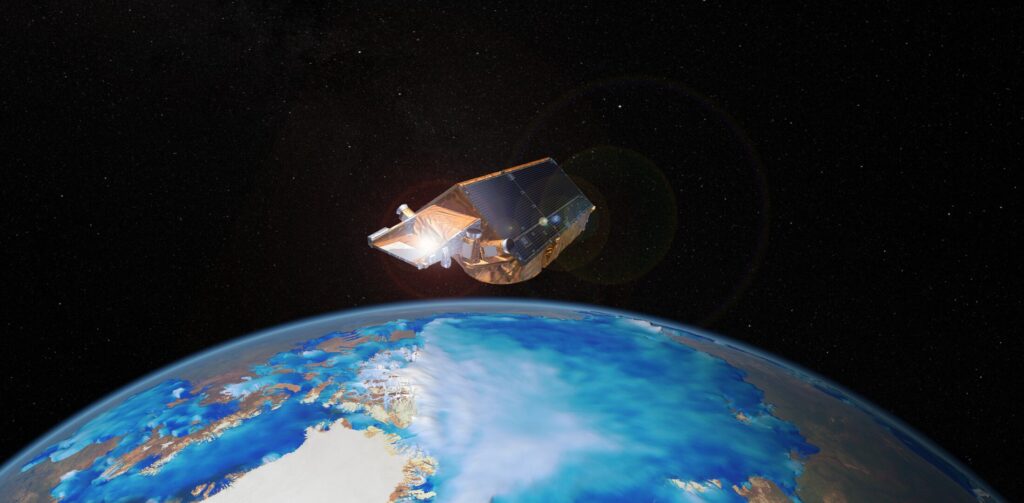
The European Space Agency’s (ESA) CryoSat mission recently demonstrated an unexpected capability: detecting a geomagnetic storm. This event highlights a notable technical advancement, as CryoSat was originally designed to monitor polar ice sheets and floating sea ice, not disturbances in Earth’s magnetic field.
CryoSat, operational for almost 16 years, primarily functions as an ice mission. It carries an advanced radar instrument capable of measuring minute changes in ice sheet and sea ice surfaces with millimetric precision. As a key component of ESA’s Earth Explorer satellite series, it has generated extensive scientific datasets that offer valuable insights into Earth’s polar oceans, subglacial lakes, and extensive ice formations.
A software update’s unexpected results
The mission’s expanded functionality stems from a remote software update applied to its platform magnetometer late last year. This instrument’s initial purpose was operational, ensuring the satellite maintained its correct orbital altitude and precisely directed its scientific instruments towards target areas on Earth’s surface. Consequently, it was not initially engineered to yield scientific data pertaining to Earth’s magnetic environment.
However, this upgrade has enabled CryoSat to measure variations within Earth’s magnetosphere with scientific accuracy. The data collected is subsequently calibrated using measurements from ESA’s dedicated magnetic field-observing Earth Explorer mission, Swarm. This newly acquired skill effectively means that two missions within ESA’s Earth Explorer family now contribute to magnetometry. Furthermore, another magnetic field-measuring Scout satellite, NanoMagSat, is currently under development to join Swarm.
While Swarm maintains its role as ESA’s primary mission for studying Earth’s magnetic field, CryoSat continues its central focus on ice sheet and polar ocean monitoring. The significant aspect is the innovative utilization of CryoSat’s platform magnetometer to measure pronounced external magnetic field variations. It provides high-quality data when compared to platform magnetometers on other non-magnetic missions, thereby offering a valuable complementary dataset to the geomagnetic research community.
This new capability to generate magnetometry datasets from CryoSat, complementing those from the Swarm mission, delivers unique scientific benefits without incurring additional costs.
 Published by James Hydzik
James Hydzik is a technology geek focused on the junction of engineering, writing, and coffee. He joined Orbital Today in 2020 to help make sense of the Johnson government’s decision to buy OneWeb. Since then, he has taken on interviewing and editor-in-chief roles. James learned the ropes of editing and writing with Financial Times magazines, The World Bank, PwC, and Ericsson. Thus far, interviewing New Space movers has put the biggest smile on his workaday face. The son of an Electrical Engineer, James understands the value of putting complex topics into clear language for those with a lay person’s understanding of the subject. James is a European transplant from the United States, and as ex-KA3LLL, he now holds European amateur radio licenses. His next radio project is a portable 10GHz EME (moonbounce) station, as it combines his childhood interests in antennas and space.