
Enabling & Support
16/03/2026
21 views
0 likes
Recent in‑orbit demonstrations supported by ESA‑developed technologies represent a significant advancement in deployable antenna systems for small satellites. Oxford Space Systems’ (OSS) successful deployment of a large Very High Frequency (VHF) isoflux helical antenna further underscores Europe’s growing leadership in compact, lightweight, and high‑performance antenna solutions. These accomplishments build upon several years of ESA‑led research and development, industrialisation, and advanced manufacturing activities conducted under the General Support Technology Programme (GSTP), with the Antenna and Sub‑Millimetre Wave Section (TEC‑EFA) providing technical leadership throughout these efforts.
Delivering a new capability for space-based air traffic management
The in‑space deployment of OSS’s large Very High Frequency (VHF) isoflux helical antenna on the IOD 2 mission marks a major milestone. Supporting the Startical ECHOES project, the nearly 4‑metre deployable antenna – designed to operate between 117 MHz and 138 MHz – plays a crucial role in enabling space‑based air traffic management (ATM). The unique isoflux radiation pattern ensures uniform gain across Earth’s surface, helping deliver consistent performance from low Earth orbit. This successful deployment represents a significant step toward enhancing the resilience and reach of ATM systems and demonstrates how miniaturised, reliable deployable antennas can support both institutional and commercial aviation services.
“The activity within the GSTP programme enabled a rapid development and in-orbit demonstration of a first deployable UHF antenna addressing a previously identified market gap, followed by batch production and scaling to lower VHF-band, with the concept further validated in orbit by the Startical ECHOES project”, says Benedikt Byrne, Antenna Engineer in ESA’s Antennae & Sub-mm Waves Section.
“This success story clearly illustrates the effectiveness and value of ESA-supported activities in enabling rapid technology development and successful in-orbit demonstration. It also highlights the strong collaboration between ESA and Oxford Space Systems in identifying technology gaps, recognising market opportunities, enabling development through programmes such as GSTP, and ultimately delivering very successful outcomes,” Benedikt continues.
Expanding global IoT coverage through deployable helical antennas
UHF batch production allowing 10/10 in-orbit success
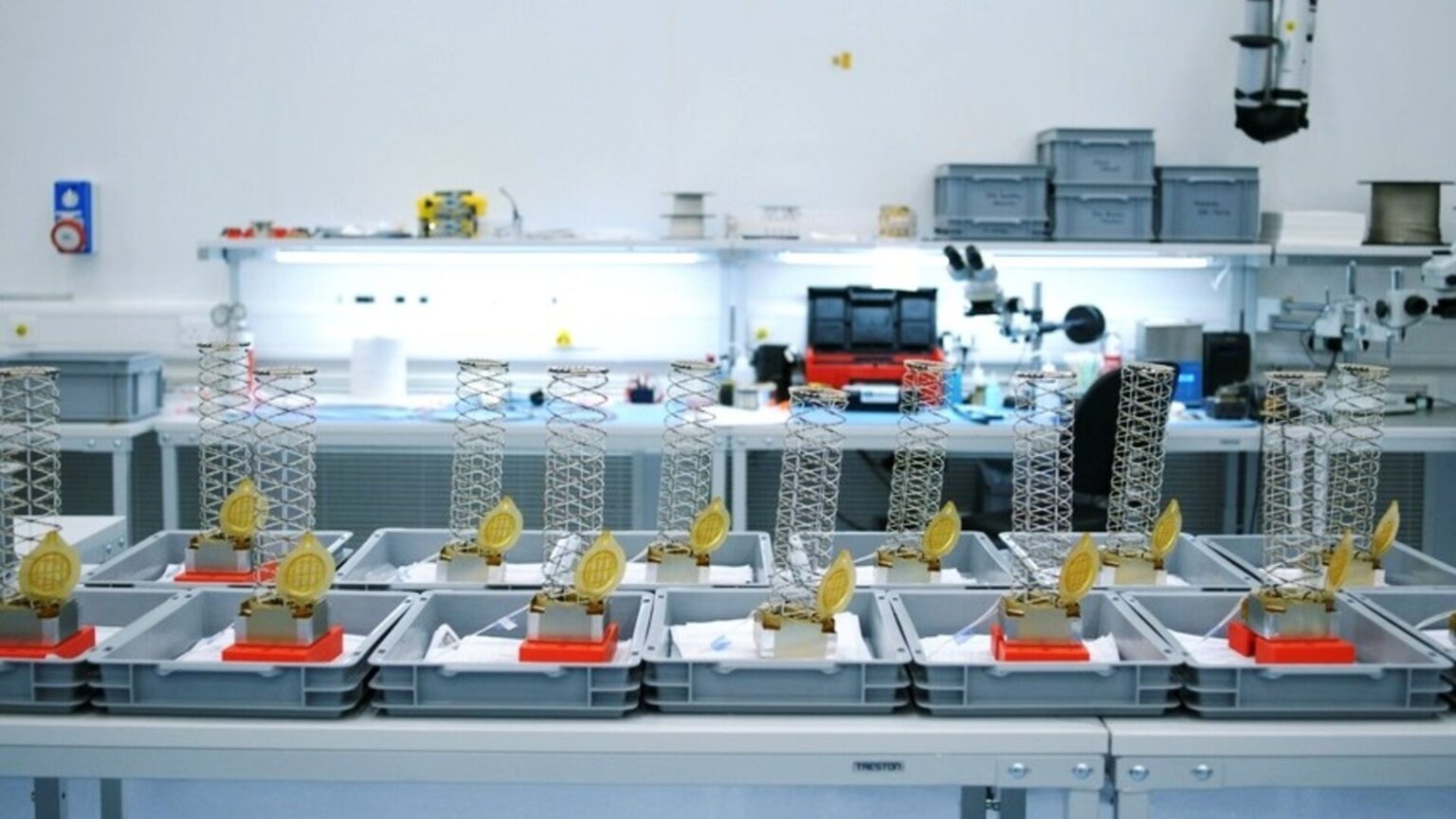
Alongside the ECHOES mission success, OSS and Lacuna Space announced the deployment of two additional OSS UHF helical antennas for Lacuna’s satellite Internet of Things (IoT) constellation. Lacuna’s mission is to provide low‑cost, low‑power connectivity to remote and underserved regions worldwide, supporting applications across environmental monitoring, agriculture, logistics, and humanitarian operations. In total, ten OSS UHF deployable antennas have now been successfully launched with Lacuna Space over the past five years, achieving a 100% in‑orbit success rate.
Deployable helical antennas are essential to achieving the required gain and bandwidth at low frequencies (VHF and UHF band) while remaining compatible with small‑satellite form factors. Their compact stowage, reliable deployment mechanisms, and robust RF performance make them ideal for growing constellations.
ESA’s role in enabling advanced helical antenna technology
These deployments illustrate how ESA‑backed early technology development can translate into real operational capability for European companies. Through GSTP, ESA initiated a structured development path, beginning with a nominal UHF helical design and later extending it to a lower‑frequency VHF variant. This progression allowed OSS to demonstrate:
the scalability of the antenna architecture
compatibility with small‑satellite stowage volumes
improvements in automated manufacturing
supplier consolidation
refined qualification and testing processes
Together, these efforts established a robust industrial baseline at a time when Europe lacked a supplier capable of batch‑producing deployable helical antennas for constellation‑class missions.
The UHF and VHF antennas deployed in orbit are a direct result of this development arc, showing how GSTP transforms early‑stage concepts into mission‑ready capabilities.
“Scaling the antenna to the VHF band required increasing its height to several meters, significantly raising the complexity of both the antenna design and deployment mechanism. Despite the enormous challenges associated with RF testing of such large antennas at very low frequencies, the measurements were successfully performed and later confirmed through successful in-orbit demonstration,” says Benedikt.
Developing low‑frequency antennas brings distinct challenges, including:
physically large structures driven by long wavelengths
the need to combine high gain with compact stowage
tight integration between RF performance and deployment mechanisms
Driving European competitiveness in space communications
Taken together, these activities reflect ESA’s commitment to strengthening Europe’s industrial autonomy in key space technologies. Deployable helical antennas, once limited to individual prototypes, are now on a clear path toward mass production, constellation deployment, and broader commercial uptake.
By supporting early R&D, de‑risking manufacturing processes, and fostering innovation across structural, RF, and thermal domains, ESA continues to shape the future of space communications and enable European industry to thrive in a rapidly expanding global market.
Like