
A massive rock from Mars, known as Black Beauty, has yielded new insights into the planet’s history. Scientists used advanced scanning techniques to examine this Martian meteorite. Despite the rock’s small size, the results are significant for both planetary science and the search for past life on Mars.
The meteorite, which likely originated from a massive impact on Mars, dates back over 4.48 billion years. Known for its striking appearance, Black Beauty is among the oldest pieces of Martian material ever found. This recent study, which involved non-destructive computed tomography (CT) scans, reveals surprising findings that support the theory of liquid water once being present on the Red Planet.
Advanced Techniques Unlock New Frontiers
Until recently, analyzing meteorites like Black Beauty (also called NWA 7034) often required cutting and crushing the material, which can damage valuable samples. However, a team of researchers has used advanced CT scanning technology to study the meteorite without altering it. This method allowed scientists to peer into the rock’s structure non-invasively.
“The region we identify as being the source of this unique Martian meteorite sample constitutes a true window into the earliest environment of the planets, including the Earth, which our planet lost because of plate tectonics and erosion,” explained Dr. Anthony Lagain, a researcher at Curtin University’s Space Science and Technology Center.
According to a paper from the Technical University of Denmark, available as a on pre-print on arXiv, the scans revealed hydrogen-rich iron oxyhydroxide clasts embedded within the meteorite. These small fragments account for about 0.4% of the sample’s volume, yet their importance is immense: they suggest that Black Beauty contains water, representing up to 11% of the sample’s total water content.
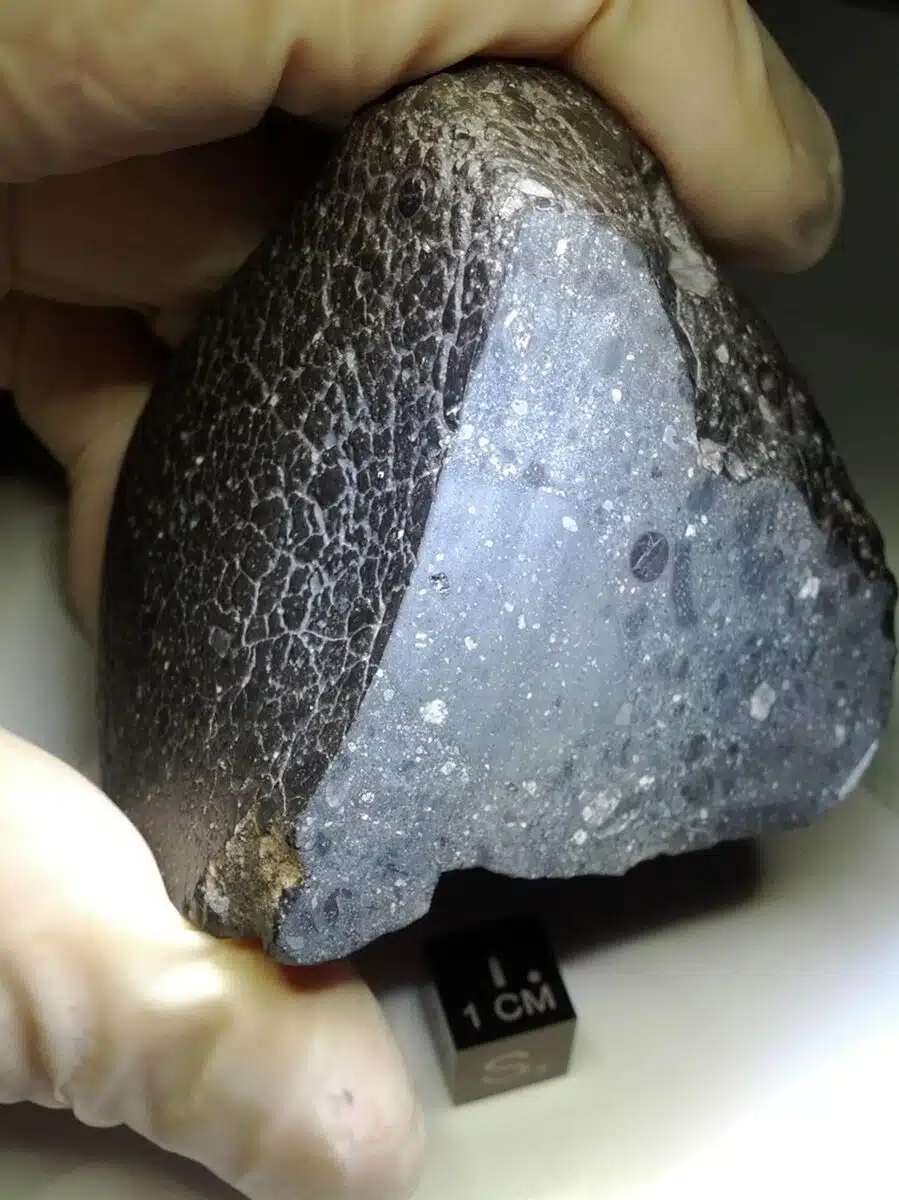 “Black Beauty” Mars meteorite. Credit: NASA
The Clasts That Know All the Secrets
While the presence of clasts isn’t surprising, these minerals, which form under certain conditions of heat and pressure, are indicative of processes involving liquid water. The researchers highlighted that:
“These alteration assemblages closely resemble those observed in samples collected by the Perseverance rover in Jezero crater, where hydrated iron oxyhydroxides are also present. This similarity suggests that such phases may represent a widespread near-surface water reservoir on early Mars.”
Black Beauty might be from a different area of Mars, but the water in both meteorites backs up the idea that the Earth’s neighboring planet had liquid water billions of years ago.
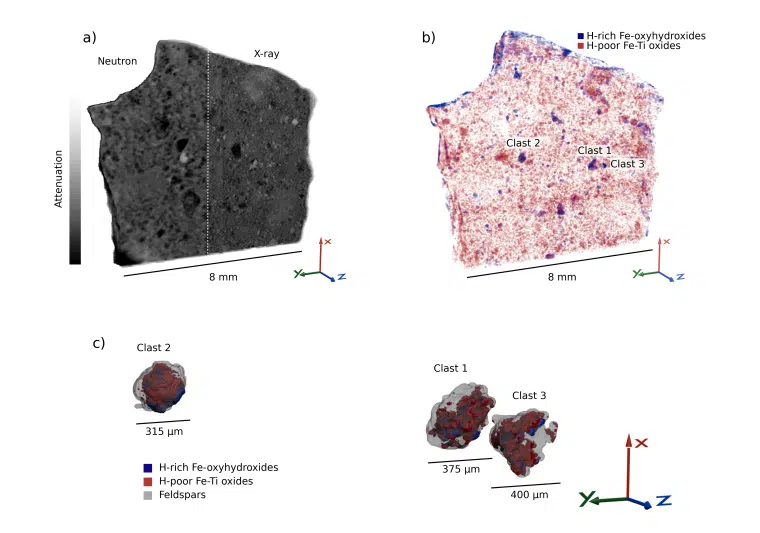 Scans of a Martian meteorite showing internal structure and mineral compositions. Credit: arXiv
Charting the Path to Mars
Black Beauty, in many ways, acts as a natural sample return mission. By studying meteorites like this, scientists are able to unlock secrets about Mars’ history without the expense and complexity of a surface mission.
“For the first time, we know the geological context of the only brecciated Martian sample available on Earth, 10 years before the NASA’s Mars Sample Return mission is set to send back samples collected by the Perseverance rover currently exploring the Jezero crater,” Dr. Lagain stated.
Although the Mars Sample Return program promises to bring Martian samples to Earth in the future, recent delays have thrown the program’s timeline into uncertainty. Until then, researchers are employing advanced technologies like CT scans to look inside the meteorite’s titanium casing, to peer through the meteorite’s titanium shell and uncover what Mars may have looked like millions of years ago.
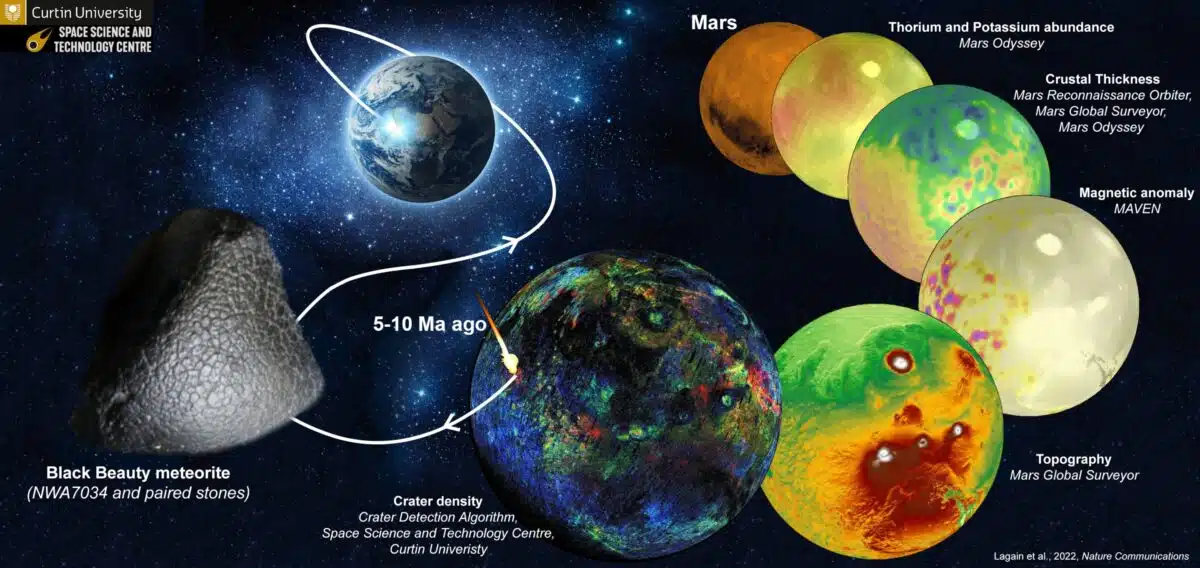 Illustration showing the journey of the Black Beauty meteorite (NWA 7034) from Mars to Earth. Credit: Credit: Anthony Lagain, Curtin University