
For astronauts on the ISS, exercise isn’t a hobby—it’s a matter of survival. To prevent their muscles from turning to jelly in microgravity, the station’s crew members are forced to push themselves on exercise machines for two hours every day. But will the situation change once we finally establish colonies on the Moon or Mars? Will the gravity there be sufficient to keep the body in shape without grueling exercise? A new study published in the journal Science Advances offers a disappointing but extremely important answer.
Experiment in orbit
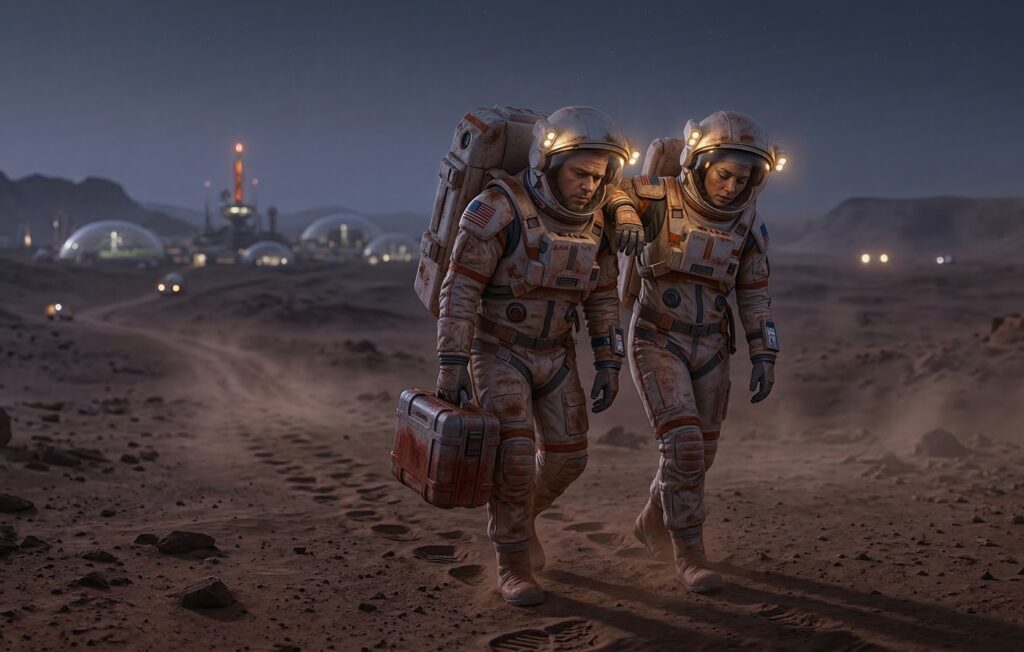
 Colonists won’t be able to survive long on the surface of Mars due to the low gravity, which causes the body’s muscles to atrophy without constant exercise. Illustration created by Gemini AI
It is not yet technically possible to study the effects of varying gravitational conditions on humans, so mice have once again taken on the role of pioneers. In March 2023, 24 rodents were sent to the ISS. There, a “space attraction” awaited them—the MARS centrifuge from the Japan Aerospace Exploration Agency (JAXA).
The scientists divided the mice into groups and exposed them to varying levels of artificial gravity, ranging from “lunar” to full Earth gravity. After 28 days, 23 mice returned to Earth for a thorough examination. The scientists were interested in everything from the grip strength of the mice’s paws to the molecular composition of their muscle fibers.
Survival threshold
The results were sensational. The researchers established a clear threshold: 0.67 g (67% of Earth’s gravity).
Under 1g gravity, as on Earth, the muscles remained in perfect condition.
At 0.67 g, no atrophy was observed either, and muscle structure remained stable.
But anything below that threshold triggered a process of muscle deterioration. Even at 0.33 g, muscle strength began to decline, and the composition of the muscle fibers started to change.
Bad news for those planning to colonize the Moon and Mars
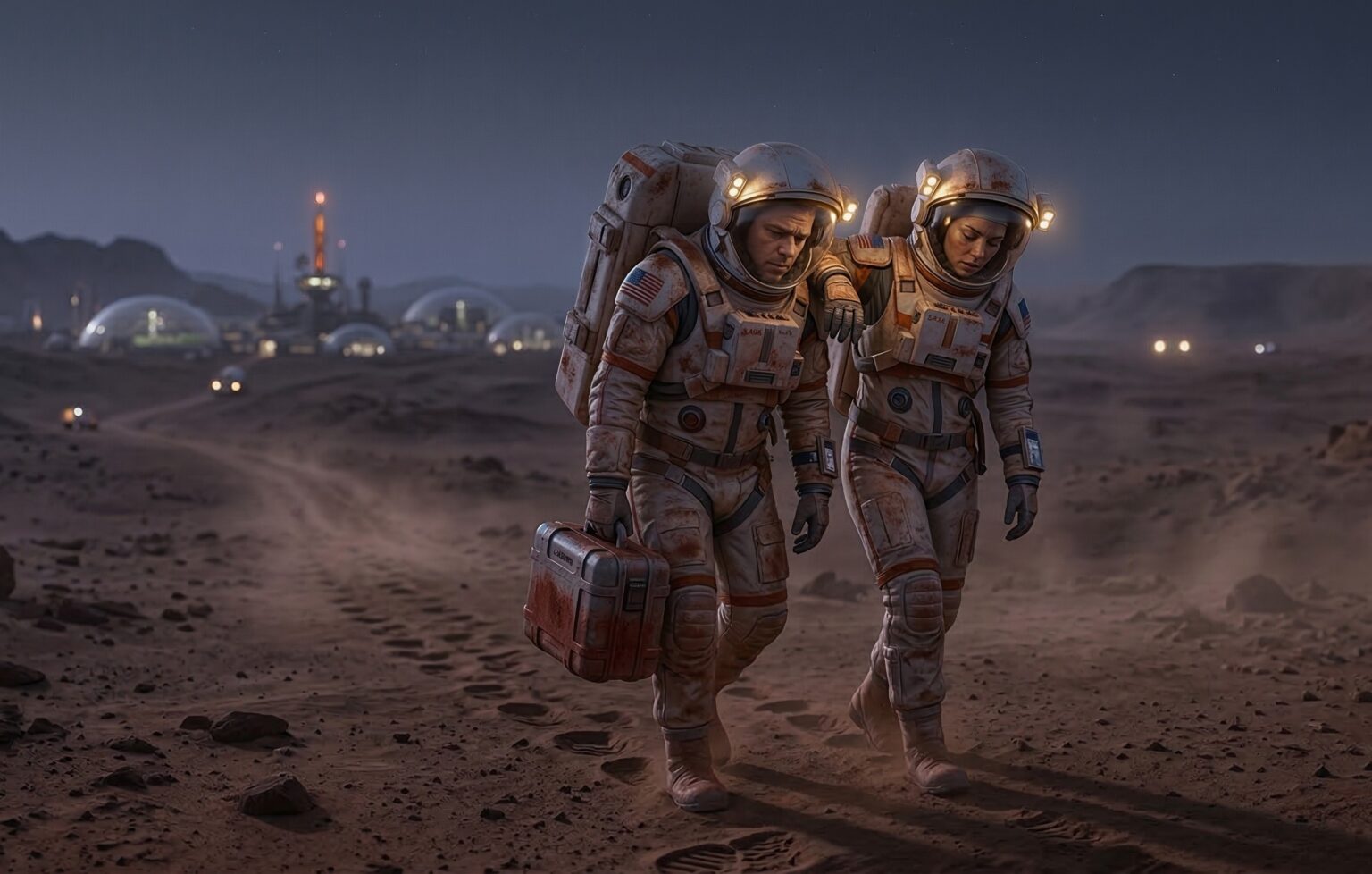
 Future colonists on Mars will have to find a way to keep their muscles toned so they don’t fall victim to low gravity. Illustration created by Gemini AI
Why does the figure of 0.67 g have scientists worried? The fact is that the planets we’re targeting are significantly “weaker” than this threshold.
Gravity on the Moon: approximately 0.17 g.
Gravity on Mars: approximately 0.38 g.
Both figures are well below the safe threshold. This means that future residents of the Artemis lunar base or the first colonists on Mars will likely still have to bring exercise equipment with them or build rotating living modules to create artificial, stronger gravity.
A step towards the stars
Although mice are not humans, NASA scientists Lori Ploutz-Snyder and Mark Shelhamer consider these findings a “golden benchmark.” Interestingly, previous human tests conducted during short parabolic flights revealed similar figures—a threshold somewhere between 0.5g and 0.75g.
Scientists now have a basis for planning long-duration missions. Understanding this threshold will help optimize exercise schedules for astronauts and, potentially, spare them from serious health problems upon their return home. Space remains a hostile environment, but now we know exactly whom to blame—and that number is 0.67.
We previously reported on which animals would live alongside the colonists on the Moon and Mars.
According to Gizmodo