
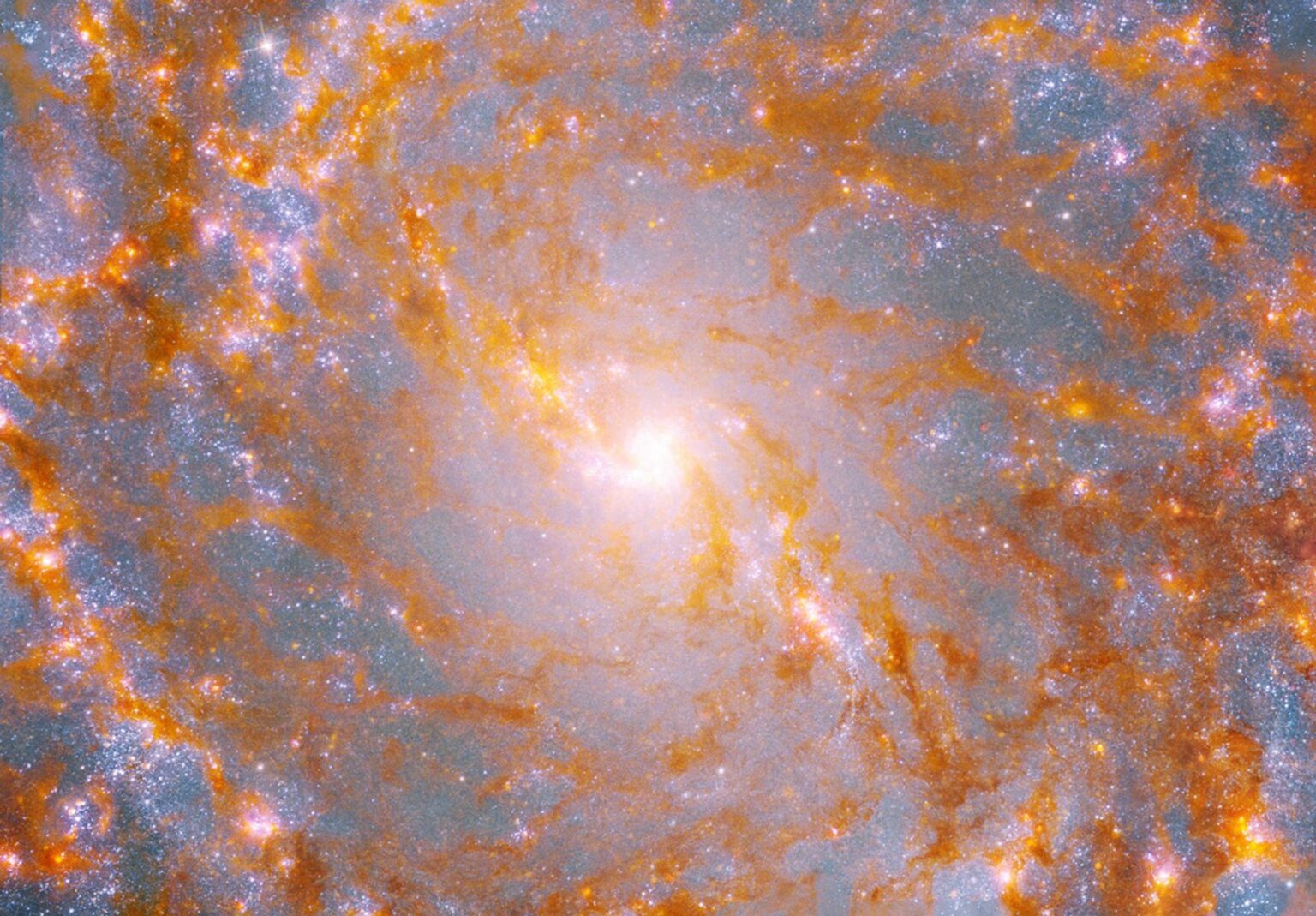
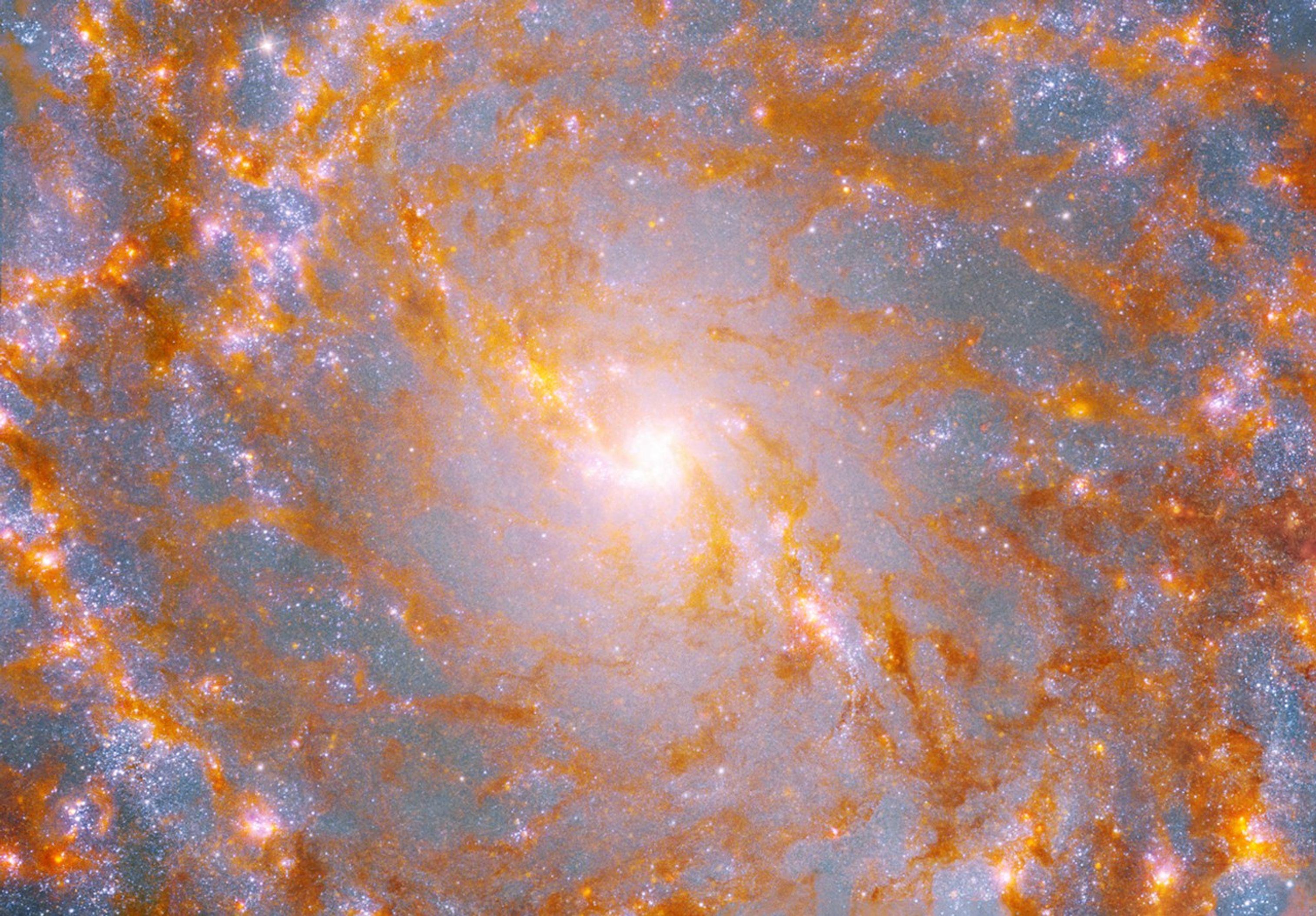
The heart of Messier 101, or the Pinwheel Galaxy, shines in this image that combines data from NASA’s Hubble Space Telescope and James Webb Space Telescope. At 25 million light-years away, M101 is one of the closest “face-on” spiral galaxies to us.
With that in mind, Hubble’s ultraviolet, visible, and near-infrared data were taken as part of studies to find out more about its stellar population and galactic structure. Webb’s near- and mid-infrared observations helped astronomers study the formation and evolution of polycyclic aromatic hydrocarbons – which are complex, carbon-based molecules, and the smallest dust grains that glow in infrared light.
Credit:
NASA, CSA, ESA, D. Calzetti (University of Massachusetts – Amherst), C. Clark (Space Telescope Science Institute – ESA – JWST), K. Kuntz (The John Hopkins University), and B. Shappee (University of Hawaii)
Processing: Gladys Kober (NASA/Catholic University of America)
by Busy_Yesterday9455
1 Comment
