
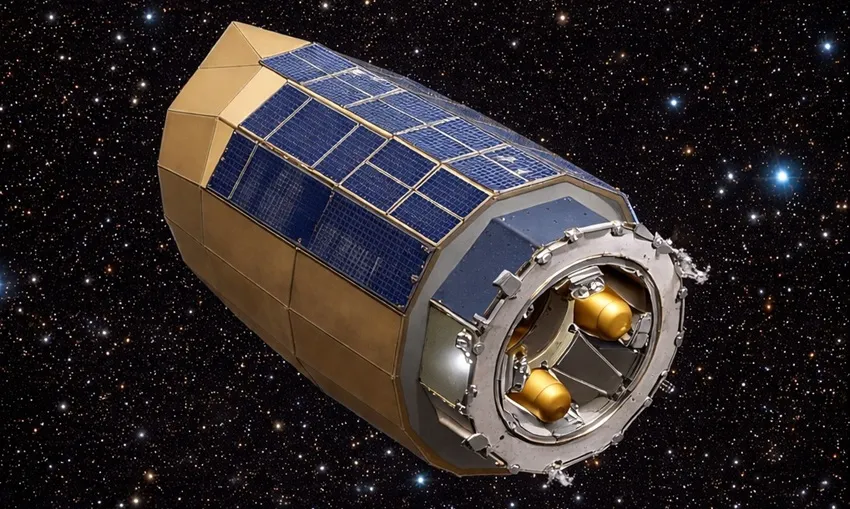
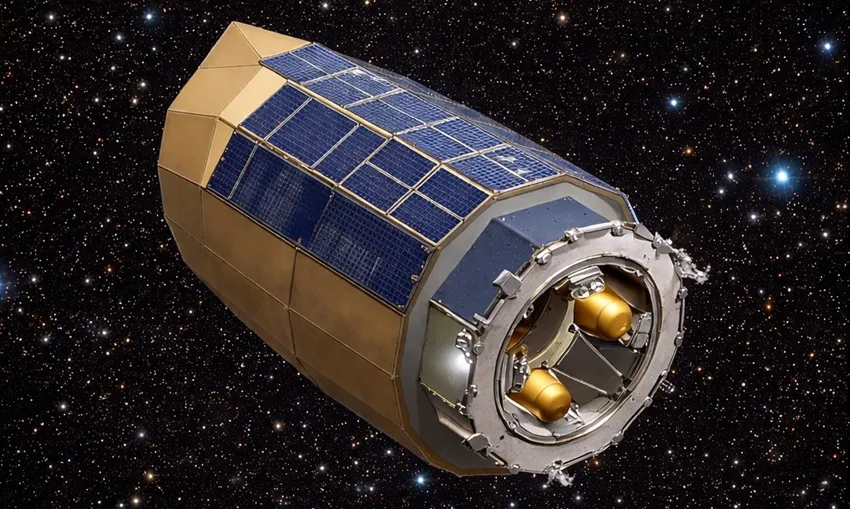
Working as an industrial collaborator on the programme, SSTL will develop the spacecraft platform for the mission, which will carry the Lazuli space observatory out into deep space.
Spectograph
The observatory will feature a suite of advanced instruments. For example, a wide-field camera, an integral-field spectrograph and a coronagraph. This will be for the study of exoplanets, supernovae and transient cosmic events.
“SSTL has a way of doing space differently,” said Andrew Cawthorne, Managing Director of SSTL. “Our heritage shows that you don’t need to rely on vast, exquisite systems to deliver extraordinary capability. Lazuli takes that same thinking into deep space.”
“While SSTL is known for small satellites, ‘small’ has always described our approach, not the size of the satellite – and certainly not our ambition. Lazuli is a powerful example of how that philosophy can scale to enable a new generation of deep-space science missions.”
Lazuli
The Lazuli initiative was unveiled by Schmidt Sciences – cofounded by Eric and Wendy Schmidt – at a meeting of the American Astronomical Society. The aim is to become the first full-scale privately funded space telescope. For context, the plan is to have a primary mirror larger than that of NASA’s iconic Hubble Space Telescope.
It forms part of the wider Schmidt Observatory System. This declares an ambition to combine development, open data access and collaboration to lower barriers to participation in “frontier astronomy”.
See also: Space Norway, SSTL partner for high-res maritime monitoring