
By Monsi A. Serrano
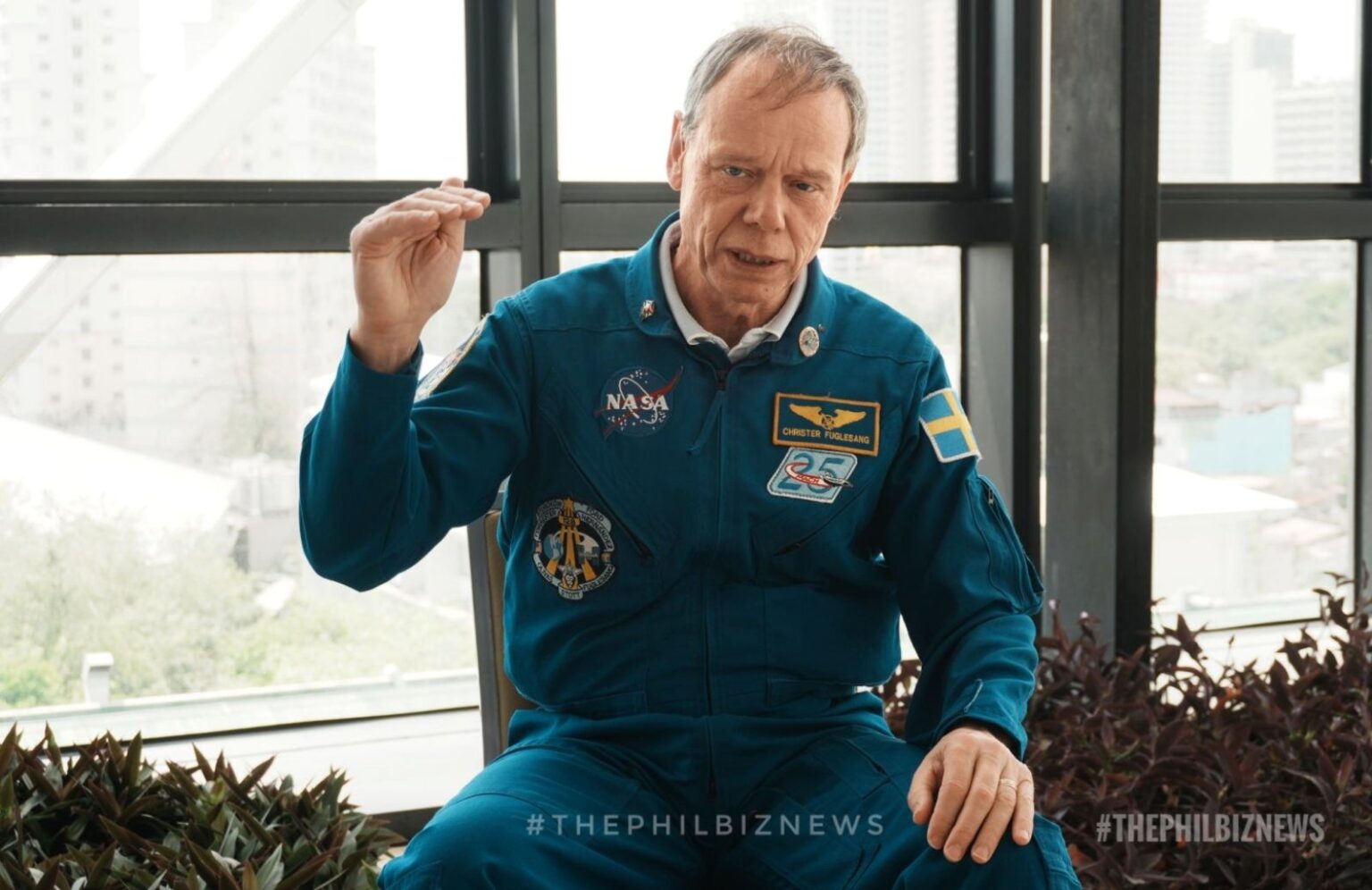
Curiosity about how the universe works led Dr. Christer Fuglesang to become Sweden’s first astronaut — a journey that eventually took him to space aboard the Space Shuttle Discovery and to the International Space Station.
In an exclusive interview with THEPHILBIZNEWS during his first visit to the Philippines, Fuglesang shared insights on science, humanity’s place in the universe, and the growing role of satellites and international cooperation in shaping the future.
For the veteran astronaut, the path to space began not with a childhood dream of becoming an astronaut, but with a fascination for physics.
“I’ve always liked to understand how the world works, particularly physics,” Fuglesang said.
Rather than aiming directly for space, he pursued what he enjoyed studying. That interest later opened an unexpected door when the European Space Agency announced it was searching for new astronauts.
“I thought, okay, I have to apply,” he recalled. “And I was lucky in the end to be selected.”
Advice to Filipino youth

Fuglesang encouraged Filipino students who aspire to reach space to focus on science, technology, engineering, and mathematics.
“Study STEM,” he said. “All professional astronauts have backgrounds in science, technology, engineering, or medicine.”
But academic excellence alone is not enough, he added.
“It’s also important to do other things. Be social, develop different interests, and enjoy what you’re doing,” he said. “Even if you don’t become an astronaut, you can still have a wonderful and exciting life.”
Seeing Earth from space
Having seen Earth from orbit, Fuglesang said astronauts often feel a responsibility to share a powerful message about the planet.
“When you look at Earth from space, you don’t see borders,” he explained.
According to Fuglesang, astronauts working together aboard the International Space Station demonstrate how international cooperation can transcend political boundaries.
“We work together in space to solve problems. We should do the same on Earth,” he said.
From orbit, the planet appears fragile — a thin atmosphere protecting the only known world capable of supporting life.
“Earth is like a spacecraft for all humanity in a huge universe,” he said. “It’s the only place we know that is alive, so we must take care of it.”
Per Aspera, Ad Astra: Waiting 14 years for spaceflight
Fuglesang’s journey to space required patience.
After being selected as an astronaut, he waited 14 and a half years before flying on his first mission.
Part of the delay was caused by the tragic Space Shuttle Columbia disaster, when the shuttle broke apart during re-entry in 2003, forcing the space program to pause operations.
Despite the long wait and the risks involved, Fuglesang said he never considered giving up.
“Not even my family ever tried to tell me to stop,” he said.
Satellites shaping everyday life
In photo from left, Swedish Embassy Deputy Head of Mission Danilo Dovgoborets, Ambassador, Swedish Astronaut Christer Fuglesang, and Athena Cartagena, Communication and Political Officer. (PHOTO BY MONSI A. SERRANO)
The astronaut also highlighted how space technology is already transforming life on Earth.
Today, around 15,000 operational satellites orbit the planet — about ten times more than two decades ago.
These satellites support communication systems, navigation, disaster monitoring, and climate research.
“In the future, you may even connect your mobile phone directly to satellites,” Fuglesang said, noting that such technology could allow communication even in remote areas or in the middle of the ocean.
Satellite data is also helping scientists better understand climate change, monitor agricultural production, and assess the impact of natural disasters.
He noted that much of this data is freely available, creating opportunities for entrepreneurs and businesses to develop innovative applications.
Opportunities for the Philippines
Fuglesang also pointed to the importance of international cooperation in space exploration.
Because space missions are expensive and technically demanding, countries often pool their resources to pursue ambitious projects such as the International Space Station and the U.S.-led Artemis Program, which aims to return humans to the Moon.
For the Philippines, he said the strategy of developing satellites through international partnerships is a positive step.
Over the past decade, the country has launched several satellites as part of collaborative programs with foreign partners.
Fuglesang advised Filipino scientists and policymakers to continue building their own satellites while participating in international projects.
“You have to learn by doing,” he said. “Building your own satellites, even student satellites, is a very good way to develop expertise.”
At the same time, he said collaboration with other countries ensures access to cutting-edge technology and scientific knowledge.
A lesson from space
Asked about the most important lesson space exploration has taught him about humanity, Fuglesang pointed to the iconic image of Earth rising above the lunar horizon during the Apollo 8 mission.
“When astronauts went to the Moon, they discovered the Earth,” he said.
From space, the planet appears as a small blue dot in an immense universe — a reminder of both humanity’s insignificance and its shared responsibility.
“It is our spacecraft,” Fuglesang said of Earth. “And we must take care of it.”
A warm welcome in the Philippines
Visiting the Philippines for the first time, Fuglesang said he has been impressed by the country’s people and natural beauty.
“I’ve met so many friendly people,” he said, noting the contrast between Sweden’s cold weather and the Philippines’ tropical climate.
An avid sailor, Fuglesang added that he hopes to return one day to explore the country’s thousands of islands by sea.
“With so many islands here,” he said with a smile, “I would love to come back and sail.”