
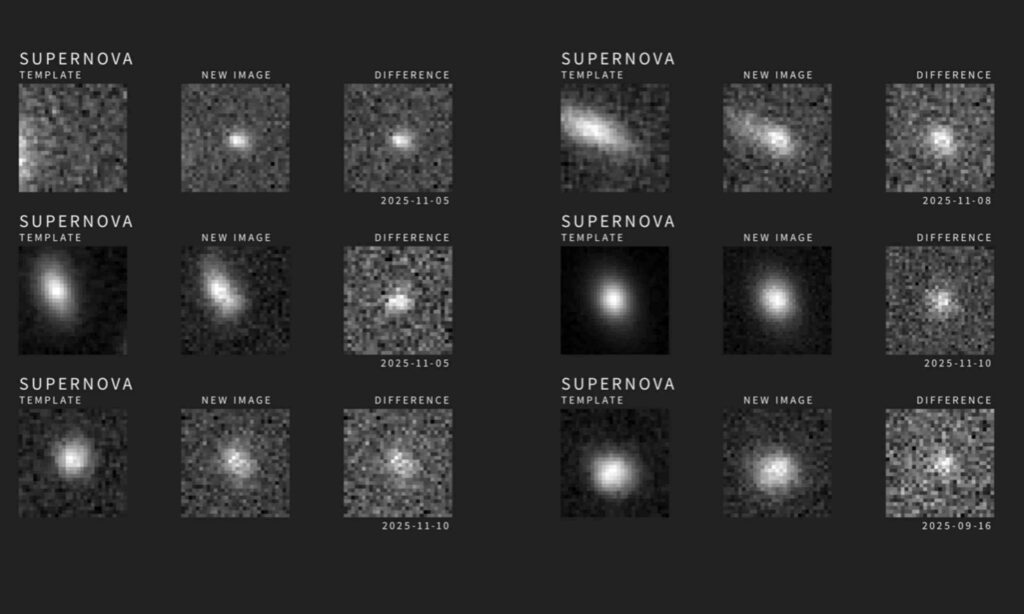
Scientists using the Rubin Observatory as a sky-monitoring system report detecting about 800,000 distinct changes across the night sky in a single observation period.
The discovery reveals how much of the universe is constantly flashing, brightening, or moving in ways that were previously too brief or faint to notice.
Rubin as a night sky monitor

High above the Andes on Cerro Pachon in northern Chile, a survey telescope has begun capturing the night sky as a continuous record of change rather than a static field of stars.
By analyzing those images, engineers and astronomers working with the Vera C. Rubin Observatory documented hundreds of thousands of flashes, movements, and brightness shifts during the system’s first full night of alert operations.
Each alert marks a location where something in the sky behaved differently from its earlier appearance, revealing a universe far more active than the naked eye suggests.
That enormous stream of changes signals both a new view of the dynamic sky and the need for systems that can keep pace with discoveries unfolding in real time.
How Rubin sees
Rubin works so fast because its camera captures a new part of the sky about every 40 seconds.
Each image packs 3,200 megapixels, enough sensitivity to record objects far dimmer than the human eye can catch.
After the data reaches California, software subtracts the older view from the new one, leaving only fresh motion or brightening.
That chain turns raw pictures into decisions within minutes, often determining whether a brief flare gets studied or disappears.
Why speed matters
A star can brighten and fade in hours, and a fast-moving asteroid can slip through a crowded field and vanish.
That urgency shaped the system, which was built to return to the same sky over and over again.
“Rubin’s alert system was designed to allow anyone to identify interesting astronomical events with enough notice to rapidly obtain time-critical follow-up observations,” said Eric Bellm, alert production pipeline group lead for Rubin Data Management at NSF NOIRLab.
Because other telescopes can react while an event is still active, the first alert often decides whether deeper science happens.
What showed up
Among the first signals were supernovae, exploding stars near the end of their lives, along with restless variable stars.
Rubin also caught active galactic nuclei, bright galactic cores powered by feeding black holes, plus asteroids cutting through our solar system.
Each category changes on its own clock, which makes one broad stream far more useful than a single-purpose survey.
That breadth means a night built for one project can still hand another team the exact event it needed.
Watching nearby rocks
Fast alerts also matter much closer to home, because early sightings give astronomers more time to map an asteroid’s path.
More observations tighten the orbit calculation, which reduces uncertainty by showing exactly how gravity is steering the object.
That same rapid tracking can reveal rare visitors from outside the solar system before they speed back into darkness.
Planetary defense will not depend on Rubin alone, but any warning system grows stronger when the sky gets checked this often.
Too much to read
A flood this large creates its own problem, because no human can scan millions of alerts one by one.
Rubin’s public alert stream is expected to grow to about seven million notices every night.
That volume contains valuable information, but it also hides the unusual event amid ordinary variability.
The observatory therefore needed software that could sort the stream before researchers lost the few events that mattered.
Sorting the alerts
Rubin sends alerts to brokers, software hubs that sort and enrich the stream for different teams.
Many of them use machine learning, software trained to find patterns in data, to flag exploding stars, solar system objects, or stranger outliers.
Others cross-check each alert against earlier catalogs, which helps scientists judge whether a source is genuinely new or merely familiar.
That extra layer turns a raw notice into a workable lead, and it makes follow-up time far less wasteful.
A public sky
Unlike many major scientific data sets, Rubin routes these notices to anyone willing to learn the tools.
Through data access, alerts reach broker systems within 60 seconds of each new image during the night.
Students, small observatories, and citizen scientists can then search the same moving sky that professionals are watching.
That openness widens the pool of eyes on the data and raises the odds that rare events get recognized fast.
Why Rubin sky monitoring matters
Over the next decade, the survey will revisit much of the southern sky about 800 times.
Repetition on that scale lets scientists trace slow change as well as sudden change, from young stars to distant structure.
Vera Rubin’s legacy also shapes the project, because full-sky motion maps may sharpen tests of dark matter, unseen mass detected through gravity.
That cadence gives the project both breadth and memory, letting each night feed a record that grows more useful every year.
Night sky monitoring with Rubin
Rubin has started building an ongoing record of things appearing, brightening, moving, and fading in the sky.
If the system keeps delivering speed, scale, and open access, astronomy may spend the next decade reacting faster to short-lived sky events.
—–
Like what you read? Subscribe to our newsletter for engaging articles, exclusive content, and the latest updates.
Check us out on EarthSnap, a free app brought to you by Eric Ralls and Earth.com.
—–