
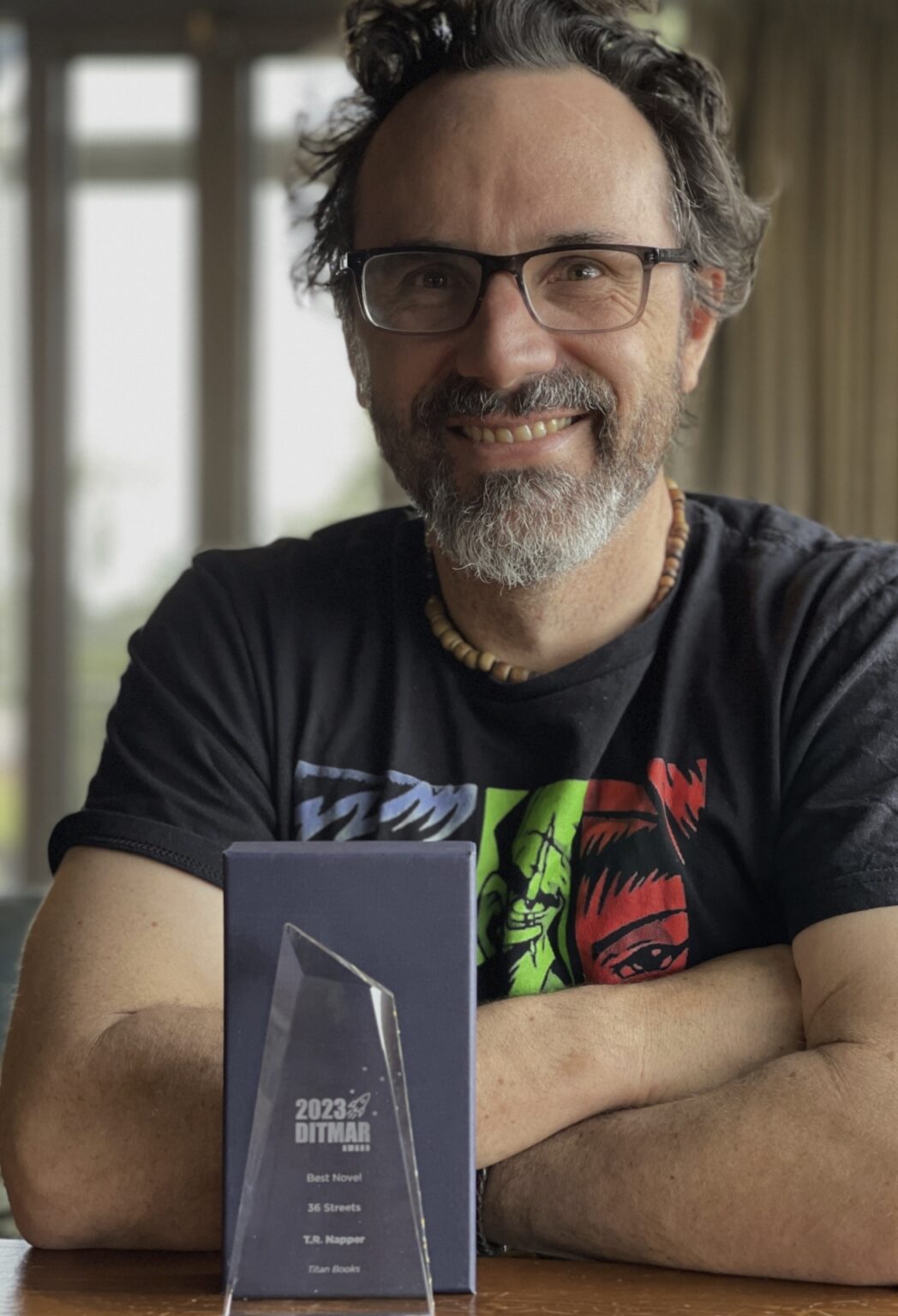
T.R. Napper is an award-winning Australian science fiction author, best known for his cyberpunk novel 36 Streets and the novella Ghost of the Neon God. Before turning to writing full-time, he spent a decade working as an aid worker in Southeast Asia—experiences that heavily influence the gritty, geopolitical world-building found in his stories.
Tim recently joined us on Episode 186 of the AvPGalaxy Podcast to talk about writing his 2023 tie-in novel, Aliens: Bishop. In this interview, we delve into the unique pressures of writing within an established, beloved canon with strict deadlines. We also discuss the philosophical appeal of synthetic characters like Bishop, how Tim expanded the geopolitical lore of the Alien universe (including the UPP and the Australia Wars), and how he navigated the treacherous waters of fan expectations when handling legacy characters.
You can watch the interview below and read on for a transcription. Please note that the accompanying transcript has been edited for clarity and brevity.
Discovering Alien & The Writing Process
T.R. Napper
Adam Zeller: Could you tell our audience about yourself outside of Alien? Who is T.R. Napper? What do you do, and what passions do you have outside of the Alien franchise?
T.R. Napper: Well, I came to writing a bit later than most of my peers. I was an aid worker living in Southeast Asia for about ten years, running poverty alleviation programmes. I was living in Vietnam at the time and taking a break from that, which is when I experimented with writing short stories. I was cursed with some early success, so it became a full-blown obsession. Now I write full-time. I work as well, but I write full-time.
For six years, I worked running Dungeons and Dragons for young people with autism. We have something in Australia called the National Disability Insurance Scheme, which is like universal healthcare for disability. You could fund them to play Dungeons and Dragons under this scheme because it’s therapeutic, and in some cases, life-changing. My experience doing that was enormously rewarding, but I stopped a couple of months ago because the disability sector here is not very well managed, so I got a bit burnt out.
Now I teach writing at university. I am also part of an intensive programme that runs full-time for a month, twice a year. We have military veterans and serving personnel who have trauma. They come in when they can’t function anymore and do art, music, visual arts, or writing for a month as a way to process their trauma and heal. I started doing that recently, and it is also enormously rewarding and amazingly effective.
Outside of work, like most writers, I read and I have kids. I don’t have much of a life outside of that. I do martial arts to help keep me sane.
Adam Zeller: What kind of martial arts, if you don’t mind me asking?
T.R. Napper: I do two. I do Taekwondo and Kumdo, which is Korean sword fighting. That may have slightly influenced one of the scenes in the book. I only started because I took my son when he was four or five, and I thought it would be a good idea for him to do some self-defence. I went to a family class and ended up loving it.
Aaron Percival: Do you remember experiencing the Alien franchise? Was it through one of the films or something else?
T.R. Napper: Absolutely. It’s burnt in. I actually put it in my dedication at the start of Aliens: Bishop. When I was very young, my uncle came over one Christmas and would not stop talking about Aliens, the Colonial Marines, the smart guns, and all that. I became obsessed, but I wasn’t allowed to see the film because I was too young. I would always ask him to tell me more about the movie, but he was never sufficiently forthcoming. As a compromise, my parents got me the Alan Dean Foster Aliens novelisation. So, my first encounter with the franchise was a tie-in novel, which makes it pretty awesome to write a sequel to it thirty years later.
I kept begging to watch the film, but they wouldn’t let me, so I read the novelisation. A couple of years later, I finally got to watch Aliens. Then I went in a weird order: I watched Aliens, Alien 3, Alien Resurrection, and then Alien.
Aaron Percival: It’s certainly a different pathway in, especially because the novel is a fair bit different. There is a lack of profanity, but you also get the extra scenes. Do you remember being aware of the differences when you actually got to sit down and watch the film?
T.R. Napper: The one difference I remember to this day is Burke in the cocoon. Ripley gives him a grenade, which was cut from the film, but I certainly remembered that.
Aaron Percival: For a lot of fans, that scene in particular was a huge curiosity because it wasn’t restored in the special edition. It wasn’t until the Alien Anthology box set that Fox actually let it see the light of day. They kept that one hidden because James Cameron didn’t like the quality of the scene.
Adam Zeller: It’s also interesting that your book has the Aliens branding because that’s becoming less common these days. The last time we got it in the books was with Aliens: Vasquez, because a lot of them are just Alien.
T.R. Napper: I assumed that if it’s just one or a handful of Xenomorphs, it’s Alien, but if there’s quite a few, it’s Aliens.
Adam Zeller: There have been Alien–branded books with hordes of them, right, Aaron?
Aaron Percival: You would assume that, Tim. We had Aliens: Phalanx specifically because the author asked for it to be branded Aliens, as he felt the tone of his book was more in line with Aliens than Alien. But otherwise, it’s just been the Aliens: Bug Hunt anthology and Aliens: Vasquez. Because, like Aliens: Bishop, it’s related to a character directly from Aliens. Most things have been Alien-branded. Even the comics, the majority of the Marvel stuff has been Alien.
T.R. Napper: Maybe it’s the Colonial Marine or movie connection. I guess you can’t have a Bishop novel called Alien. The same goes for Aliens: Vasquez, too.
Adam Zeller: What is it about the Alien franchise that you think makes it so enduring? Why does it keep publishers like Titan and authors like yourself wanting to play in that sandbox?
T.R. Napper: Because the first two films are masterpieces of sci-fi horror and military sci-fi, respectively. They are two truly exceptional films that constructed a universe that is credible, immersive, fascinating, and hard to look away from. It’s just deep enough to warrant more exploration. The Xenomorph is extraordinary, as are the facehugger and the ovomorph. It taps into something primal and grotesque in our lizard brains that is terrifying and fascinating to watch.
Then, of course, you have these ensemble casts in both films. Yes, you have Ripley, but there are so many characters you could really love, whether it’s Vasquez, Bishop, or even hate, like Burke. It spans so much because the world-building is so rich. The ideas are really cool, focusing not just on biological warfare, the “other”, and fear of the unknown, but also on artificial intelligence and what it means to be human. There are a lot of core science fiction ideas that can be explored using the instruments we have in the Alien universe. Plus, obviously, it has an incredibly passionate fan base to sustain it.

Aliens: Bishop
Aaron Percival: How did you come to write Aliens: Bishop? Was it a concept you had pitched to Titan?
T.R. Napper: No. Like a lot of things in publishing, it was part luck and being at the right place at the right time. My agent was pitching a cyberpunk novella of mine called Ghost of the Neon God to American publishers. One of them was Titan US. The editor said, “We don’t really want a novella, but he’s writing about artificial intelligence. Does he like Aliens?” And I said, “Hell yeah! I like Aliens. It’s awesome.” But then they asked if I wanted to write a Bishop novel, and my first response was actually “no”.
Partly because I just wanted to focus on my own work, but also because you only have five months to write one of these books, and I am not a fast writer. My debut took me five years. I have another book coming out later this year that I’ve been working on and off for ten years. I love those films, particularly Aliens, so I didn’t want to make a subpar contribution. But then I had my writer friends call me a moron and slap me upside the head, saying, “Are you insane? You could write an Aliens novel!”
Aaron Percival: I completely understand where you’re coming from, though. The tie-in world is notoriously short on time, low in pay, and high in stress. I find it really reassuring that you had that concern straight off the bat.
T.R. Napper: It was a pretty good deal for me, but you generally get a flat fee with these things. I just threw myself into it. You have to give the publisher and the studio a ten-page treatment outlining what you’re going to do, and then you have to stick to it. If I ever did this again, I would ask for more time because I worked seven days a week for five months and only took one day off, which was Christmas Day. It was just a blur of editing and writing to get it done and ensure it was good.
People have said to me since, “Now you know you can do it. You can write two books a year now.” I don’t know if I could do another book in five months. It’s not my pace. Some authors can do two or three books a year and they’re quite good, but it’s just not my pace.
Aaron Percival: Understanding your own pace and limitations is a treat in its own right, let’s be honest.
Adam Zeller: One of the things we really enjoyed about Aliens: Bishop was how it pulled in multiple elements from around the franchise’s very long and storied lore. We especially liked revisiting the concept of the Aliens being controlled by pheromones. Were you familiar with many of the older comics, novels, or games before you worked on the book, or did that come as part of the research process?
T.R. Napper: It came as part of the process. It’s fascinating because you think you’re a hardcore fan, and then you write an Aliens novel and realise you know nothing. There is so much out there! The pheromones idea came through research, and this was actually the only conflict I had with the studio. They were supportive the entire way, except regarding pheromones.
I did a bunch of research because the topic of Xenomorph senses is very confusing. There are competing theories: How do they see? Is it vibrations? Pheromones? Echolocation? So I included a bit where Michael Bishop created synthetic queen pheromones to explain how they worked in the universe. It was the only thing I was asked to change. My theory is they don’t want it too carefully explained because it gets too messy. If you explain a Xenomorph’s senses definitively, suddenly a whole bunch of canon doesn’t work anymore. So they asked me to keep it somewhat vague, and on reflection, I think it was a really good change.
Adam Zeller: What were the initial criteria when you got the gig? Was it just that they wanted a book about Bishop, or were there specific things they requested?
T.R. Napper: There were core things they wanted it to be about, but they gave me room to explore. The core focus was the relationship between Michael Bishop and Bishop, exploring artificial intelligence, and what it means to be human, classic science fiction ideas. And I thought, “Yes, please.” They also asked me to read several tie-in novels and think about linking them in. The second part was that there was a hesitancy to mention Alien 3. Alien 3 is canon, but some people hate it, so I was advised not to mention it.
Aaron Percival: Titan told you this?
T.R. Napper: It was communicated to me. I don’t know if they were just reflecting the studio’s stance. But I thought to myself, that’s stupid. I can’t have Michael Bishop in the book without acknowledging that he appears at the end of Alien 3. It’s insane not to have a connection with that film.

Michael Bishop
I read the tie-ins, and some were very good, but my thinking was that I didn’t want someone to have to read five tie-in books to understand Aliens: Bishop. I want them to watch Aliens and Alien 3, and that’s it. It’s a way to give the only plausible survivor from Aliens a third act. So I put that forward in my ten-page treatment. The studio came back and said it was fantastic. In all the advertising, they even say “a direct sequel to Aliens and Alien 3.” So whatever their thinking was beforehand, it changed.
Adam Zeller: Were the other tie-in novels you read where you got the idea of Australia being especially dystopian in the Alien universe?
T.R. Napper: Not the tie-ins, no. I wanted an Australian character, so I researched the lore. There’s a reference to the Australia War, a big rebellion against the Three World Empire where they nuke Canberra, which is where I live! I thought that was fascinating. There’s a YouTube channel called Project Acheron that does lore videos, and they had a ten-minute video on the Australia War. I used that as the background for the character.
Going back to your original question about why we keep getting these novels and films: the world-building is so rich. I did research into the UPP from William Gibson’s unproduced screenplay for Alien 3 because I needed to know the intergalactic geopolitics in the background. What’s China doing? What’s the UPP doing? What’s Australia doing?
Aaron Percival: So, the pheromones came specifically from research. Had you read any of the other comics or books before this, or was that literally your jumping-off point?
T.R. Napper: No, for me it was the films and the Alan Dean Foster novelisation. When I got the gig, I realised there was a role-playing game, read some comics, and hyper-focused on the time period. I also had the Colonial Marines Technical Manual, which is kind of like a bible.
I had to become an expert in Bishop. I needed to know everything there ever was to know about the two Bishops. There’s a short story in the Aliens: Bug Hunt anthology about the twenty minutes Bishop is in the pipe. It’s a genuinely good story, and even though I was told it wasn’t canon and didn’t need to read it, I read it anyway. It did a great job of getting into Bishop’s thought processes. Of course, I also rewatched the films.
Adam Zeller: So you weren’t really a fan of Alien 3 then?
T.R. Napper: I’ve come around a bit. If your entry point is Aliens, Alien 3 is brutal because in the opening scene, almost everyone you love is dead. At the time, it was a tough pill to swallow. Writing this book and rewatching it, I realised it does have redeeming qualities. But having Hicks and Newt dead, and Bishop as an animatronic puppet with his eye oozing out, it was tough.
Adam Zeller: Have you seen the Assembly Cut for Alien 3?
T.R. Napper: I haven’t. Should I?
Adam Zeller: I recommend it. I feel like it helps the film quite a bit. I think your initial experience is common among fans.
Aaron Percival: The Assembly Cut led to a bit of a mass re-evaluation of the film when it came out in 2003. It’s just an earlier cut with twenty or thirty minutes of extra footage, but a lot of fans appreciate Alien 3 a lot more now, generally because of it.