
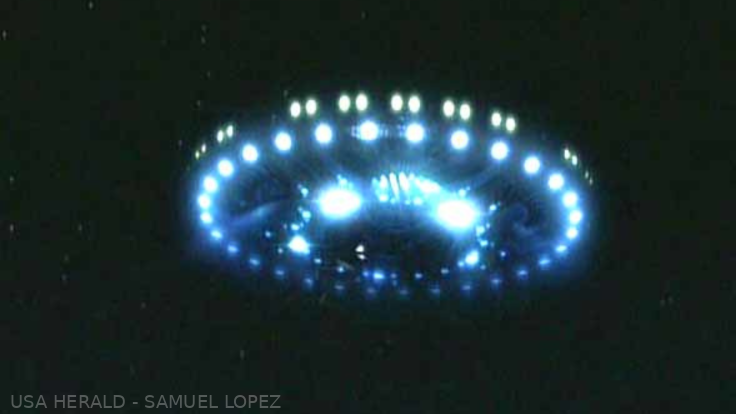
By Samuel A. Lopez | USA Herald – Something unusual is happening in Washington. President Donald Trump has ordered federal agencies to release long-classified UFO and unidentified aerial phenomena records. And depending on what emerges, the consequences could extend far beyond science or national security.
The potential impact may reach into something far deeper: human belief itself.
For decades, UFO debates largely revolved around radar anomalies, military sightings, and unexplained aerial craft. But the stakes are now changing. If credible evidence emerges showing that non-human intelligence exists—or has interacted with Earth—the implications could ripple through science, religion, politics, and even the way humanity understands consciousness and creation.
In other words, disclosure may not just reveal technology.
It could challenge our understanding of reality itself.
President Trump recently added fuel to speculation when he told reporters that the United States possesses weapons far more advanced than the public realizes. “We have weaponry that nobody has any idea what it is,” Trump said during a recent White House press interaction. “And the laser technology that we have now is incredible.”
Those statements have ignited renewed speculation across defense circles and aerospace communities. Some observers believe the president was referring to next-generation directed-energy weapons or classified aerospace platforms. Others believe the comment hints at something far more controversial.
Could the United States possess technology that did not originate on Earth?
This theory has circulated quietly in defense circles for decades. One of the most prominent voices to publicly acknowledge the possibility is aerospace billionaire Robert Bigelow, founder of Bigelow Aerospace and longtime supporter of UFO research.
Bigelow once suggested that the U.S. government may already possess the “Holy Grail” of UFO technology. The problem, he said, is that the technology may be so advanced that scientists cannot yet reverse engineer it. “It’s like owning a sliver of a cellphone case without knowing how the phone works,” Bigelow explained when discussing alleged recovered materials.
If such materials exist, some analysts believe breakthroughs in artificial intelligence and quantum computing could finally allow researchers to understand them. Military-grade AI systems can now process data patterns at speeds unimaginable just a decade ago. Quantum computing research is accelerating rapidly within both government and private sector labs. If those tools were applied to recovered materials or propulsion systems, it raises a question that once belonged only to science fiction.
Could humanity finally be learning how to operate technology far beyond its original design?
Yet the technological question may not be the most disruptive element of disclosure. The deeper shock may come from what these phenomena mean for human spirituality.
Throughout history, unexplained aerial phenomena have often been interpreted through religious frameworks. Ancient texts describe fiery chariots, heavenly visitors, and beings descending from the skies.
Some scholars have revisited passages from the Book of Enoch, an ancient text referenced in early Jewish and Christian tradition, which describes mysterious beings who descended to Earth and shared forbidden knowledge with humanity.
According to the text, one figure known as Azazel taught humans how to forge weapons such as swords, knives, and shields—knowledge that contributed to violence and corruption spreading across the earth.
Other passages describe rebellious angels who “did not keep their own domain,” language echoed later in the New Testament book of Jude. These beings were said to have been imprisoned in Tartarus, awaiting final judgment.
Whether viewed literally or symbolically, such narratives highlight a profound pattern in human history. When ancient civilizations encountered the unknown, they often interpreted it through the lens of the divine or the supernatural.
That raises a question modern society has largely avoided. If non-human intelligence exists, what exactly is it?
Extraterrestrial visitors from distant star systems?
Interdimensional entities interacting with reality in ways science cannot yet measure?
Or phenomena that ancient religious traditions may have described in spiritual terms long before modern technology existed?
Bigelow himself has shown interest not only in UFOs but also in the mysteries of consciousness. In 2020, he launched the Bigelow Institute for Consciousness Studies, offering a $1 million prize for research exploring whether human consciousness survives death. The institute ultimately awarded its top prize to researchers presenting evidence suggesting that consciousness may exist beyond the physical body.
Such research intersects with one of the most profound questions facing humanity. If consciousness is not confined to the brain, the implications extend far beyond neuroscience. It could reshape physics, philosophy, and religion simultaneously.
Some researchers now speculate that UFO phenomena themselves may involve consciousness-based interactions, meaning the intelligence behind them might operate in ways fundamentally different from biological life as humans understand it.
If that theory proves true, disclosure may not simply introduce humanity to visitors from another planet. It could reveal a universe where mind and matter are intertwined in ways science is only beginning to grasp.
For religious believers, such revelations may not necessarily weaken faith. In fact, some theologians argue the opposite could occur.
Throughout history, moments of scientific discovery—from heliocentrism to modern cosmology—initially appeared to challenge religious doctrine. Yet many faith traditions ultimately integrated those discoveries into broader understandings of creation.
If intelligent life exists elsewhere in the universe, it could reinforce the idea that creation itself is far vaster and more mysterious than previously imagined.
For others, however, disclosure could trigger existential shock. Entire belief systems might suddenly require re-examination.
Psychologists who study paradigm shifts warn that sudden worldview changes can create periods of intense cultural adjustment. That may be why governments historically approached UFO information cautiously. The issue was never just about national security.
It was about societal stability.
Today, however, the information landscape is very different. The internet has accelerated the spread of speculation, leaks, and citizen investigation. Researchers, journalists, and scientists across the world are already examining evidence once confined to classified files.
And as the U.S. government prepares to respond to Trump’s disclosure directive, the world may be approaching a moment that historians could one day describe as a turning point for human civilization.
About the Author
Samuel A. Lopez is an investigative journalist and legal analyst for USA Herald who has closely followed the emerging global debate surrounding UFO disclosure, advanced aerospace technologies, and government transparency. His reporting combines legal analysis, investigative research, and scientific inquiry to help readers understand complex issues shaping the future of humanity.