
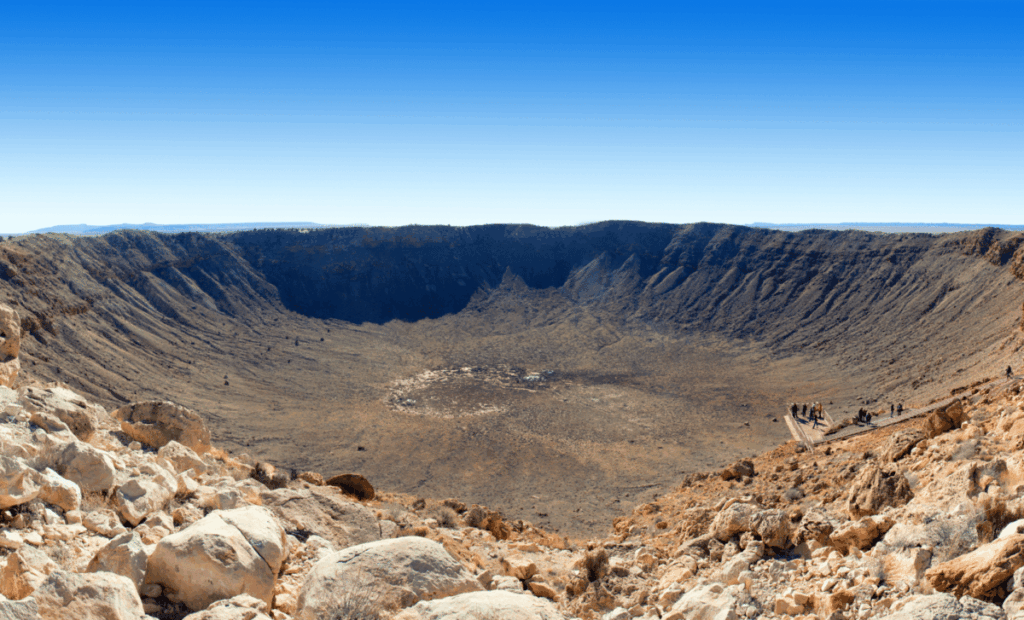
Arizona’s Meteor Crater, a timeless scar from a cosmic collision 50,000 years ago, continues to unveil its mysteries, reshaping our understanding of Earth’s geological past. Recent studies underscore its significance as the world’s best-preserved impact site, providing scientists with vital insights into the cataclysmic events that shaped our planet. According to Space.com, the crater’s remarkable preservation offers a rare natural laboratory where ongoing research reveals new revelations every year, emphasizing the crucial need for continued exploration.
A Glimpse into Meteor Crater’s Past
Formed by a meteorite crashing into Earth, Meteor Crater near Winslow, Arizona, has become a focal point for scientists seeking to understand impact events and their long-lasting effects on Earth. The crater spans over 4,000 feet in diameter and reaches a depth of 700 feet, standing as an undeniable testament to the catastrophic power of cosmic forces. Its preservation has allowed it to remain one of the clearest records of a hypervelocity impact, a condition so extreme that it can rival the force of nuclear explosions.
“Meteor Crater is the best-preserved and exposed impact crater on Earth,” explained Dan Durda, a research scientist at the Southwest Research Institute, to Space.com. “That makes it the perfect natural laboratory for impact crater studies. The crater is still providing new insights every year, so continued studies there are really important.”
This enduring relevance of the site highlights the significance of such natural laboratories in understanding the profound impacts these events have on Earth’s geology.
Meteor Crater’s unique status allows scientists to conduct studies on shock metamorphism, a process that occurs when materials experience extreme pressure from impacts. These studies are crucial for unraveling the mysteries behind the formation of similar craters around the world and understanding the historical impacts on Earth’s biosphere.
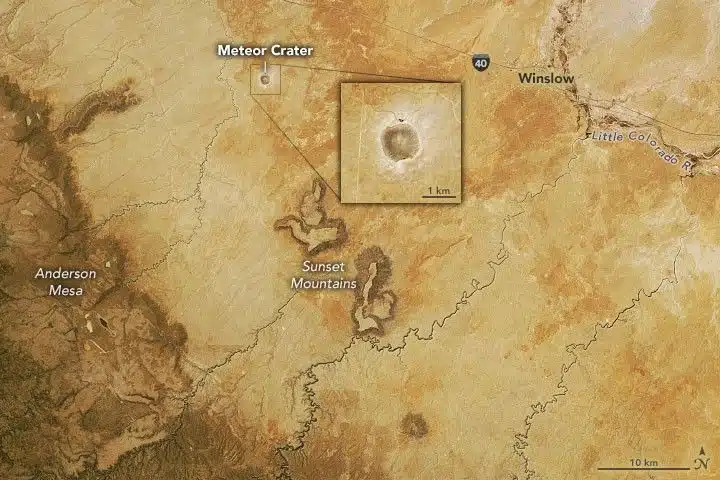 Arizona’s Meteor Crater
Credit: NASA Earth Observatory image by Joshua Stevens , using Landsat data from the U.S. Geological Survey
Unraveling Earth’s Impact History
The crater has become integral to ongoing studies about Earth’s impact history, particularly because it marks one of the few well-preserved craters that have not been significantly altered by weathering or geological activity. In fact, Meteor Crater was one of the first impact craters identified in the early 20th century, an acknowledgment that reshaped scientific understanding.
“Barringer Crater—also known as Meteor Crater—was one of the first, if not the first, crater recognized on Earth as being of impact origin,” says Christian Koeberl, a professor at the University of Vienna and an expert in impact cratering studies.
The identification of Meteor Crater as an impact site, however, was no easy task. Throughout history, craters like these were often mistaken for volcanic formations, with scientists initially unsure about their true origins. But the discovery of Meteor Crater led to a breakthrough that would change the way we view Earth’s relationship with space. It set the stage for recognizing the far-reaching effects of cosmic impacts on the planet’s surface.
Despite its age, the crater’s geological features continue to provide rich data. The study of minerals within the site reveals “shock metamorphic effects,” a signature feature of hypervelocity impacts. These effects are observable in the mineral structures of rocks and can only form under the extreme conditions caused by meteoric strikes. This is critical for scientists studying craters and planetary surfaces across the solar system, where similar processes might occur.
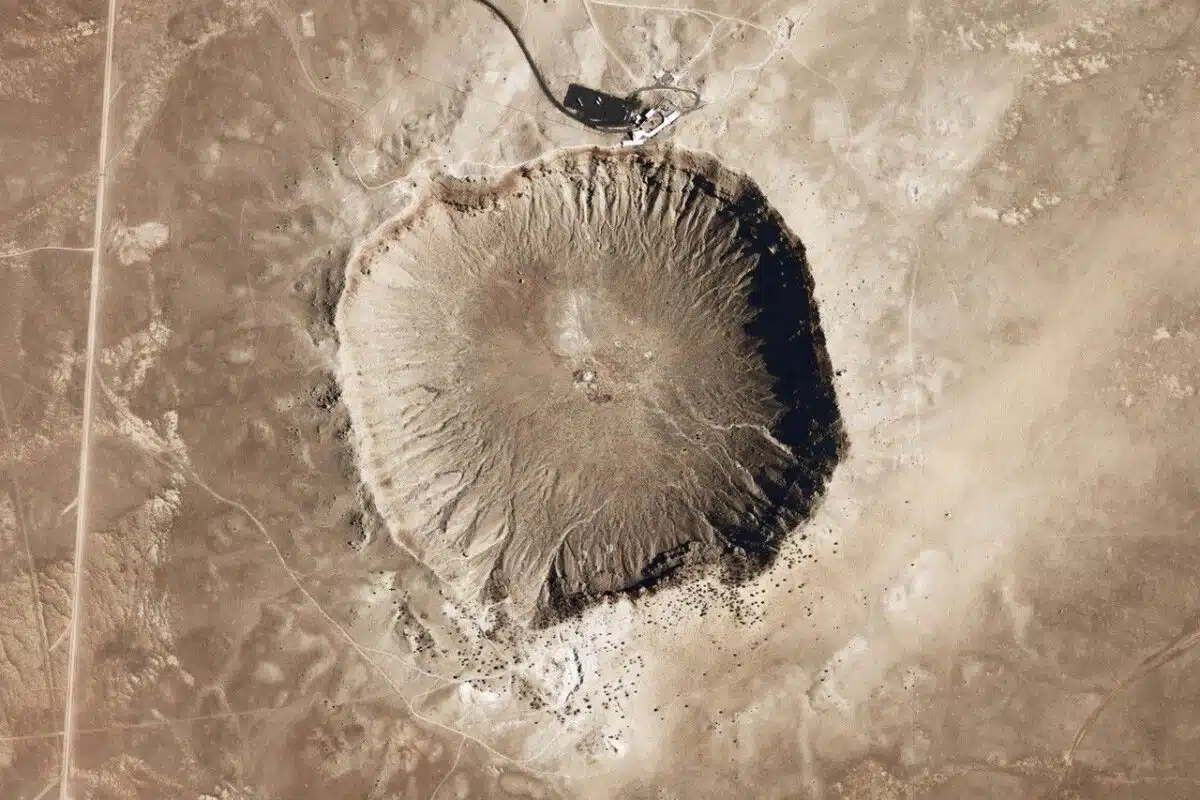 Meteor Crater, Arizona, USA
Credit: USGS National Map Data Download and Visualization Services. Caption by Robert Simmon.
The Crater’s Global Significance
Meteor Crater is not only a site of scientific interest for those studying Earth but also a critical location for understanding planetary impacts at large. The information gleaned from studies at Meteor Crater is applicable to our understanding of other planets in the solar system, making this site an essential point of reference for future space exploration.
Koeberl elaborates on the broader implications of impact studies, noting the profound effects that large impacts have had on Earth’s geological and biological evolution.
“Despite limited information about the early impact record we know that impacts had severe effects on the geological and biological evolution on Earth,” he says.
He points to the mass extinction event that occurred about 66 million years ago, when a large asteroid impact is widely believed to have wiped out the dinosaurs.
“The most iconic species that has fallen victim to an impact, the dinosaurs, literally had no chance,” Koeberl adds. These insights not only provide valuable lessons on Earth’s ancient past but also warn of the potential dangers that future impacts could pose to our world. The study of Meteor Crater offers a glimpse into how these events could reshape ecosystems and alter the course of life.