
Sign up to see the future, today
Can’t-miss innovations from the bleeding edge of science and tech
Late last month, NASA administrator Jared Isaacman announced during a livestreamed press conference that the space agency would be making major changes to its Artemis program, downgrading its third mission from a human landing attempt to a test of its Human Landing Systems partners’ SpaceX and Blue Origin’s spacecraft sometime next year.
“We need to chunk it into achievable objectives,” Isaacman told reporters during the announcement, to increase “reliability and standardization” over several missions instead of jumping straight from a crewed trip around the Moon to a landing attempt.
That’s easier said than done. According to a new report about the human landing systems by the agency’s watchdog, the NASA Office of Inspector General — which, per Spaceflight Now, was completed before the latest changes to the Artemis program were announced — the missions will still suffer from the risks associated with extreme exploration.
For instance, while it’s “taking steps to prevent catastrophic events from occurring,” NASA “does not have the capability to rescue the stranded crew” from the lunar surface in case astronauts were to “encounter a life-threatening emergency.”
There’s historical precedent as well. In a document dated July 18, 1969, presidential speechwriter and columnist William Safire drafted a speech for president Richard Nixon, which was intended to be read on TV “in the event of a Moon disaster.”
“Fate has ordained that the men who went to the Moon to explore in peace will stay on the Moon to rest in peace,” he wrote. “These brave men, Neil Armstrong and Edwin Aldrin, know that there is no hope for their recovery. But they also know that there is hope for mankind in their sacrifice.”
Fortunately, of course, both men made it back safely making it a notable “speech that never was” — but the letter goes to show that NASA had no backup plan in case the astronauts were stranded.
In all, despite the agency’s efforts to “mitigate and prevent hazards associated with the landers,” the report reads, “gaps still exist in the Agency’s risk reduction methodology.”
The OIG also noted that questions remain over SpaceX and Blue Origin’s manual control design, allowing crew members to take over in case of an emergency, which it framed as a “key element of HLS’s human-rating certification and part of an essential crew survival strategy.”
While NASA paints its new approach to getting back to the Moon as a more careful and iterative approach, it remains ambitious. The agency is planning to launch not one but two lunar landing missions in 2028, using one or both landers, depending on whether they’re ready.
In a letter appended to the report, NASA’s acting associate administrator for exploration systems development, Lori Glaze, admitted that its partners “have experienced delays.” She argued that NASA is “actively implementing mitigation measures, such as increased collaboration with experts to monitor and manage the partners’ lander development while implementing lessons learned to minimize further impact.”
Whether SpaceX and Blue Origin can deliver remains a contentious issue. According to the OIG, getting SpaceX’s enormous 171-foot Starship to the Moon will need copious amounts of fuel, requiring the use of a “Starship tanker” that will “deliver propellant to low Earth orbit where it will be stored in the Starship storage depot before being distributed to the Starship lander.”
It will take a minimum of a staggering ten Starship tankers to fill the depot, at least 200 days ahead of NASA’s planned mission to the Moon. A lander will then launch from the Kennedy Space Center, rendezvous, refuel, and finally leave for the Moon.
It’s an enormous ask. SpaceX has yet to successfully launch its Starship into space and land it, let alone enter a stable orbit or be refueled once there.
Meanwhile, Blue Origin is planning to similarly launch a propellant depot for its lander before traveling to the Moon.
Well before any astronauts’ lives are put on the line, NASA is planning to run both landers through extensive tests in lunar orbit.
Touching down on the surface will pose additional challenges, with the OIG explaining that the agency requires a “tilt tolerance” of just eight degrees at the landing spot on the Moon to ensure that a Starship, which is the same height as a “14-story tall commercial building,” won’t “tip over.”
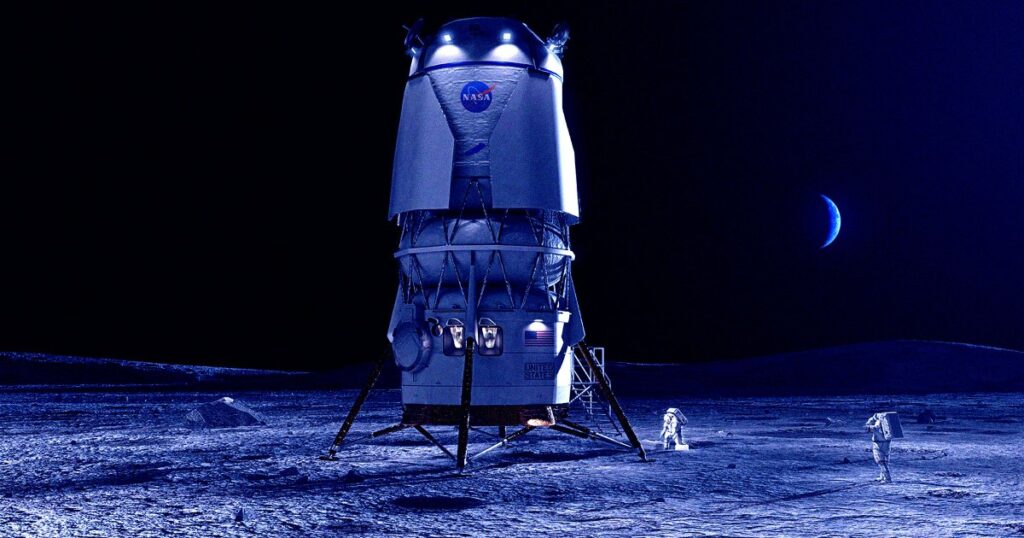
While shorter at just 53 feet, the Blue Moon lander still “faces landing risks,” the OIG noted, “including exceeding the lander’s tilt tolerance for safe and effective execution of critical crew functions.”
To put that into perspective, the tallest lunar module NASA sent to the Moon as part of its Apollo program was less than half the height of the Blue Moon lander — and a fraction of Starship’s towering spacecraft — at just 23 feet.
Even NASA’s much shorter 14-foot lunar lander, which was built and operated by Houston-based company Intuitive Machines, toppled over after attempting to land in February 2024, highlighting a very real risk.
Finally, Starship will need to provide an elevator to get the crew down to the surface — which could make for both an awkward and extremely dangerous conundrum.
“Currently, there is no other method for the crew to enter the vehicle from the lunar surface in the event of an elevator failure,” the OIG noted in its report.
More on lunar landing: After Nixing Its Artemis 3 Moon Landing, NASA Is Starting to Seriously Lose the Moon Race to China