

Published
14/03/2026 às 12:44
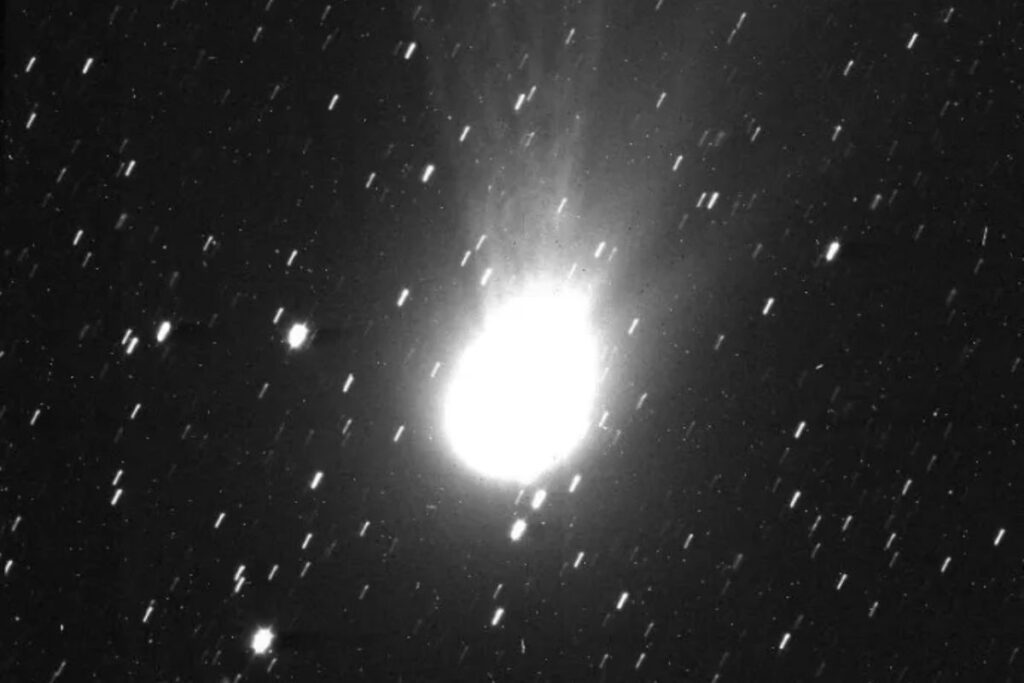
The interstellar comet 3I/Atlas caught the attention of the scientific community after analyses revealed an unusual chemical composition with high concentrations of methanol, an organic compound that can help researchers understand how celestial bodies form outside the Solar System and in other star systems.
O interstellar comet 3I/Atlas It has become one of the most intriguing objects ever observed crossing the Solar System. Detected by telescopes and studied by international teams, the cosmic visitor revealed an unexpected chemical characteristic: methanol concentrations far exceeding those normally found in local comets..
The discovery about interstellar comet 3I/Atlas This has opened up new discussions among astronomers about how celestial bodies form in other star systems. For scientists, these objects function as true time capsules., carrying primordial material that may reveal clues about chemistry and the history of distant regions of the galaxy.
O interstellar comet 3I/Atlas It belongs to an extremely rare category of astronomical objects.
Recommended for you

Fairs and events
A major event for the oil, gas, and energy sector will take place in Brazil: Macaé Energy will bring together Petrobras, Equinor, Prio, and other suppliers and executives from the energy sector for business, networking, and job opportunities.
The technical agenda and trade fair in the city of Macaé should boost discussions about investments, energy transition, and the development of the oil, gas, and energy supply chain in the national context. The city…
He is just the Third interstellar object identified passing through our Solar System., which means that its origin is not linked to the Sun, but to another star system.
Bodies of this type form in distant regions of the galaxy and, due to complex gravitational reasons, end up being ejected from their original systems.
After that, they wander through interstellar space for millions or even billions of years.
When one of these objects crosses the Solar System, scientists have a unique opportunity to study materials formed in cosmic environments completely different from our own.
The chemical discovery that surprised researchers.
Scientific interest in interstellar comet 3I/Atlas This increased even further after detailed analyses of its composition.
Using observations made with the Atacama Large Millimeter/submillimeter Array (ALMA)In the Atacama Desert in Chile, researchers were able to identify several chemical compounds released by the comet.
Among them, one element stood out: the methanol.
This compound, a simple type of organic alcohol, appeared in quantities far superior to those normally recorded in comets of the Solar System.
This unusual concentration has raised new hypotheses about the environment in which the comet may have formed.
The methanol found in interstellar comet 3I/Atlas It’s not just a chemical curiosity.
It may represent an important clue about the primordial chemistry present in other planetary systems.
Simple organic molecules like methanol are considered fundamental building blocks in the formation of more complex compounds.
Therefore, its presence in large quantities suggests that the comet may have originated in a region rich in ice and organic compounds.
For astronomers, each detected molecule functions as a kind of “fingerprint” of the environment where the object was born.
This information helps to reconstruct the physical and chemical conditions present in distant star systems.
O interstellar comet 3I/Atlas It was first identified in July of last year.
In December, it reached its closest point to Earth during its passage through the Solar System.
Even at that moment, the object remained about 270 million kilometers from the planet, a distance considered safe and without any risk of collision.
Despite the distance, telescopes were able to observe its activity.
As the comet approached the Sun, the heat released frozen gases and dust, creating the characteristic… commentary hair, a cloud of particles surrounding the nucleus.
It was precisely in this released material that the scientists identified the chemical compounds analyzed.
The scientific debate about the origin of the object.
The passage of the interstellar comet 3I/Atlas It also generated a lot of speculation.
Some bolder theories have even suggested that the object could have an artificial origin.
These ideas were widely disseminated by some researchers, including astronomer Avi Loeb of Harvard University.
However, the consensus among scientists is quite clear.
The scientific community considers the interstellar comet 3I/Atlas to be a natural object, formed by astronomical processes common in planetary systems.
Analysis of its chemical composition reinforces this interpretation.
The study of interstellar comet 3I/Atlas It shows how rare cosmic visitors can reveal important details about distant regions of the galaxy.
By identifying unusual levels of methanol in its composition, scientists have opened a new window into understanding how organic materials They form in other star systems.
Each interstellar object that passes through the Solar System offers a rare opportunity to study the chemistry of the universe beyond our own planetary system.
And you, do you believe that discoveries like those of interstellar comet 3I/Atlas Could they reveal clues about the formation of life in other star systems?