
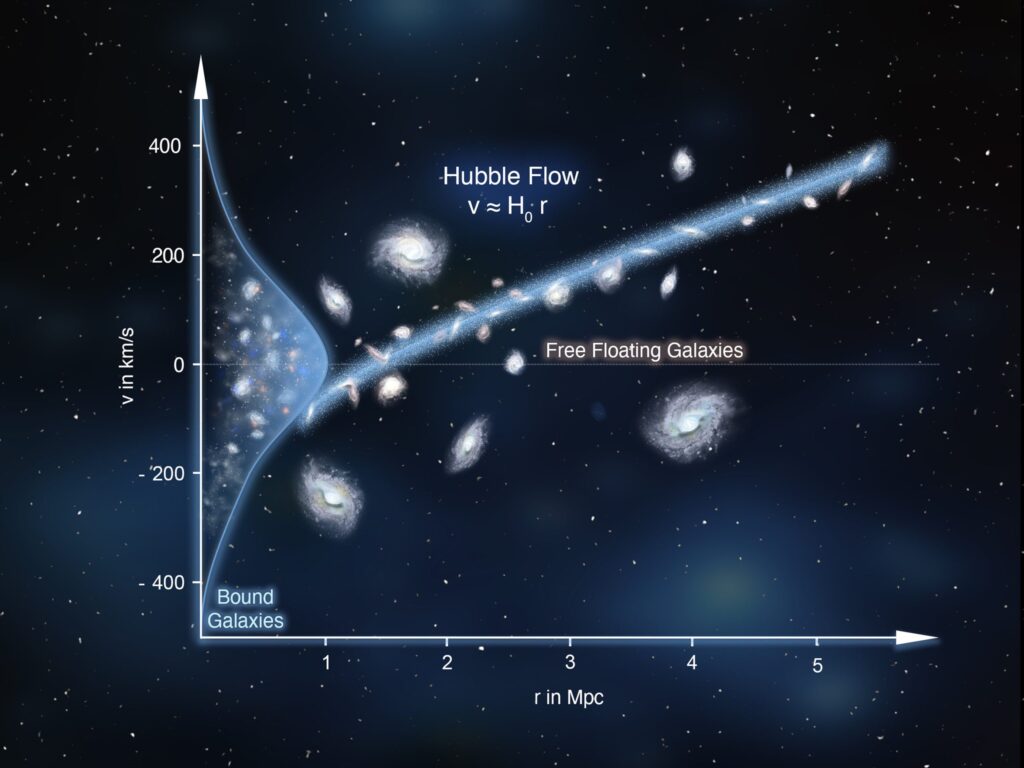
Scientists studied the movement of several groups of galaxies around the Milky Way. Thanks to this, they determined that our local environment is expanding at the same speed as that indicated by relic radiation. This helps resolve some old issues and raises many new ones.
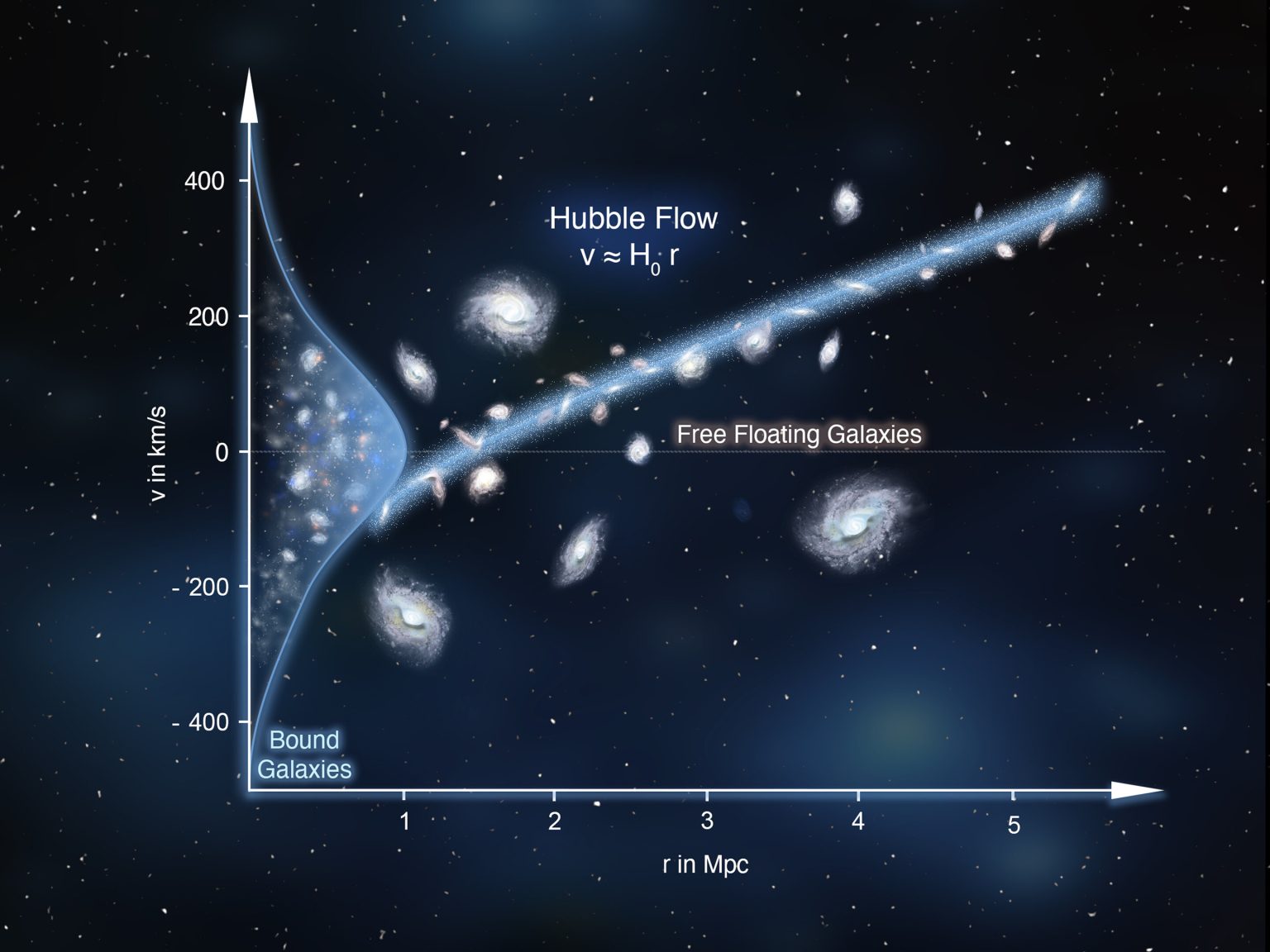 The Expansion of the Universe. Source: phys.org
The Expansion of the Universe
A study of the motion of certain galactic groups, such as M81 and Centaurus A, was recently published in the journal Astronomy & Astrophysics. It allows us to determine the expansion rate of the Universe directly next to the Milky Way, and the figure obtained by scientists turned out to be very interesting.
No one doubts that our Universe is expanding. However, there has been debate for more than a decade about the speed at which this is happening. You can read more about this in this article.
Simply put, it all depends on a value called the Hubble constant. In fact, this observation does not follow from any other physical theories, and no one knows whether it is constant in space and time. It is measured by the dispersion of galaxies, and usually attempts are made to take a large sample of them, particularly those that are far from Earth.
But the constant of Hubble can also be measured using relic microwave radiation. The problem is that its value differs significantly depending on the method used: 73 km/s/Mpc versus 68 km/s/Mpc.
Hubble tension and local groups of galaxies
The situation described above is called Hubble tension. And scientists are doing everything they can to overcome it. One approach involves conducting highly precise studies of the galaxy clusters closest to us. However, this is not as simple a task as one might think.
The thing is, the expansion of the Universe is trying to tear apart galactic groups. Gravity, on the other hand, pulls them together. And any velocity values obtained from observations will be the result of the interaction of these two forces.
However, the value of gravity can still be determined based on the apparent size of star systems. And this can be used to determine the value of the Hubble constant. In this case, it was found to be 64 km/s/pc for local groups.
This is closer to the value derived from the cosmic microwave background than to the values observed in other galaxy clusters. In fact, this means that the expansion of the Universe around the Milky Way is occurring more slowly than in the rest of the Universe.
Interestingly, if the new value is correct, then the Universe is not expanding fast enough to consist mostly of dark energy. This means that the problem of this mysterious substance, which no one knows how to search for, is not so acute.
According to phys.org