
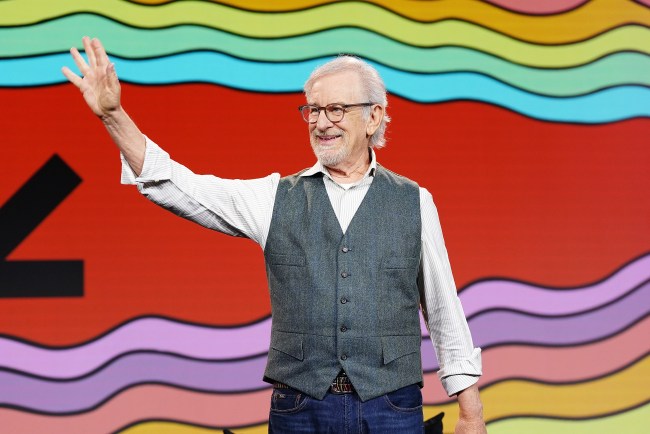
On the second day of SXSW, director Steven Spielberg made a few disclosures about modern cinema and modern art in his keynote conversation panel. The legendary Oscar-winning filmmaker packed the Hilton Austin Downtown out to a full-blown crowd and sat down with moderator Sean Fennessey for a live episode of the Big Picture podcast. In their discussion, the Oscar-winning filmmaker reflected on his career, teased the conspiratorial inspirations behind his upcoming sci-fi epic Disclosure Day, and revealed he’s developing a Western — “with horses,” in his words. He also discussed how the digital age compromised the way the viewer watches movies, while praising Best Picture nominees Train Dreams, One Battle After Another, and Sinners for their patience and craft, even slipping in a bit of playful shade toward Timothée Chalamet over the recent “ballet-gate” chatter.

Here are some of the other stories Spielberg shared during the panel.
From Fantasia Nightmares to UFO Fascination
The chat started with Spielberg revealing that his main bursting love for cinema stemmed from being freaked out by Disney’s Fantasia when his parents showed it to him at a young age. “It just destroyed me for the next year. I couldn’t sleep,” Spielberg said. “But what I wanted to do, my impulse was when something scares me, I want to create some kind of tablets and protect myself. So I would do things to my sisters to scare them. That’s kind of how the whole thing started with me wanting to find some kind of an outlet to be able to exercise the demons of fear and put it on someone else.”
When Fennessey asked about his reaction to UFO theories in the past several years, including remarks from President Obama about the existence of UAVs, Spielberg revealed how some of that was utilized for Disclosure Day’s conceit. “When President Obama made that comment, I thought, ‘Oh my God, this is so great for Disclosure Day!’” Spielberg excitedly recalled. “And then two years later, he backtracked and said what he believed was life in the cosmos, which of course, everybody should believe in because no one should ever think that we are the only intelligent civilization in the entire universe.” He went on and shared how Disclosure marks not only the first UFO movie he’s made in 50 years — since Close Encounters of the Third Kind in 1977 — but also how he hasn’t done many contemporary movies up until now.
Before helming many of his renowned films, Spielberg shared that Close Encounters was the dream project he wanted to make even before Jaws, but studios were not interested until after the success of Jaws. Today, he’s more mindful about the various types of projects he decides to tackle. “I get a little bit bored when I do a heavy VFX film,” he said. “When I know what the day’s going to be like, it’s already mapped out. Everybody knows what we’re doing. It’s so much better getting out there like I did with a movie like The Fabelmans, which was my own story where I could actually go into a deep union with my younger self to figure out how to tell that story in a way that I made.” Spielberg also cheekily added, “It was 40 million dollars of therapy that DreamWorks paid for.”
Spielberg Warns the Digital Age Is Shrinking Cinema
Despite his admiration for many contemporary films, Spielberg has voiced his worries about the lack of interest in classic films among contemporary audiences. “Some of the best stories were told a long time ago,” Spielberg said. “There were great stories still being told today by far, like Sinners and One Battle After Another. I always say to film students, ‘Yes, learn from your peers, learn from your heroes today, but don’t forget to learn from my heroes, our heroes that taught me my stuff, and all of my heroes made movies in the 30s, 40s, 50s, and 60s.’” He then implored the audience to see the movies that influenced their new heroes’ heroes, with direction to TCM. The audience applauded as he yelled, “Watch TCM!”
On the note of modern tech affecting our entertainment, Spielberg is apprehensive, particularly about how films now speed up following the viewer’s attention span thanks to apps. He used a comparison of how MTV and commercials broken up by them used to be the metric, but now with accessible apps like TikTok and Instagram, time has been so speedy. “Not that I have any kind of a personal thing to it, it’s just that it eats up the clock,” he said. “I mean, I put Instagram on my phone for two weeks, and I have been missing time as if I had it abducted. Where did that time go?” Spielberg related this to his appreciation for the Best Picture nominee Train Dreams, particularly the film’s ability to meditate on an entire life of 75 years in under two hours. He happily remarks, “It just made me so happy to have that film in the realm this year.”
Spielberg Jabs Timothée While Defending Communal Art
As Fennessey brought up how Spielberg’s legacy lies in experiencing his storytelling in large groups of cinema in the theatrical space, Spielberg began to advocate for the importance of the theatrical experience. “There is something there that is about putting community and communication and getting along with each other,” he said. “And that happens in full theaters, not sitting around living rooms, watching on television something that is up there on the screen to watch.” But to add nuance, he did compliment Netflix, with which he worked as a producer on Bradley Cooper’s Maestro. “I mean, we make Netflix movies, and I like working at Netflix. They’re a great company to work with, but it’s just for me; the real experience comes when we can fluoridate the community to congregate in a strange, dark space, all of the strangers and at the end of a really good movie experience, we are all united with a whole bunch of feelings that we walk into the daylight with or into the nighttime with, and there’s nothing like that.”
Spielberg gestured to the plethora of art forms that usher in communal gatherings with a little nod to Timothée Chalamet’s “ballet-gate” comment that went viral this time last week. “It happens in movies, it happens at concerts, and it happens in ballet and opera, by the way.” The comment was met with thunderous applause. “We want that to be sustained, and we want that to go on forever.”
On the conversation of increasing AI use within the film industry, the filmmaker behind A.I.: Artificial Intelligence stood firmly in his disapproval, in preference for human-made productions. “I’ve never used AI on any of my films yet. We have a writer’s room. All the seats are occupied,” Spielberg said. “I am not for AI that replaces a creative individual.”