
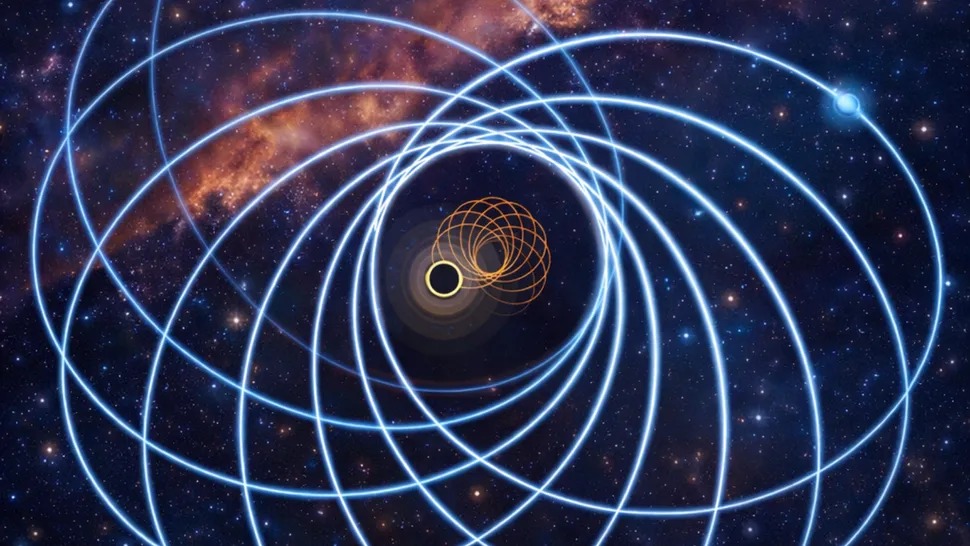
The Universe is not only a silent void, but also a giant canvas on which the most powerful events leave their scars. In January 2020, sensitive sensors at ground-based observatories recorded a barely perceptible tremor in space-time. These were gravitational waves, predicted by Albert Einstein a century ago. However, this time they brought news of an event that does not fit into any of the standard models.
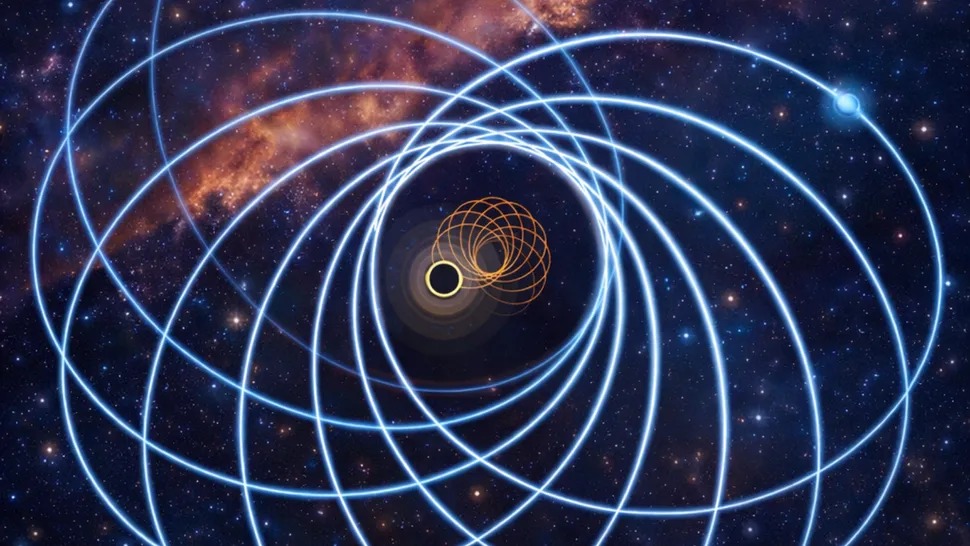 Illustration of the “oval” orbit of a black hole-neutron star binary system. The strange orbit points to a gap in our understanding of how these systems can form. Image: University of Birmingham
Astronomers focused their attention on the collision of two of the most extreme objects in space: a black hole and a neutron star. This act of cosmic cannibalism took place about a billion light-years from Earth, but its consequences forced the scientific community to rethink the basic principles of star system formation. The signal detected by the LIGO (Laser Interferometer Gravitational-Wave Observatory) facility was designated GW200105. It became irrefutable proof that the black hole had swallowed the superdense core of a collapsing star, forming a new giant with a mass 13 times greater than that of the Sun.
Anomalous orbit
The biggest surprise for researchers was not the merger itself, but what preceded the final chord. According to classical theories, when two massive objects approach each other over millions of years, their mutual orbit should gradually “round out” under the influence of gravitational radiation. By the moment of direct collision, the trajectory should be practically a perfect circle.
However, analysis of GW200105 revealed a completely different picture. Before disappearing into the black hole, the neutron star moved along a highly elongated, elliptical trajectory. This movement resembled the whimsical patterns of a child’s Spirograph toy. As Patricia Schmidt, associate professor at the University of Birmingham, noted, the fact that such an eccentric orbit has been preserved in the final stages of the system’s existence is a real “smoke gun” — proof that the standard theory of stellar evolution did not work here.
This discovery refutes the assumption of a circular orbit for this particular pair with 99% certainty. This means that we are dealing with objects whose life history has been much more turbulent than textbooks suggest.
Gap in canonical theory
To understand the scale of the scientific problem, it is worth remembering how, according to scientists, such pairs usually arise. The traditional scenario is the so-called isolated binary evolution. This is the story of two massive neighboring stars that are born together, age together, explode one after the other as supernovae, and turn into a black hole and a neutron star. Over billions of years, they “grind” against each other, losing energy and aligning their orbits into perfect circles.
However, the elliptical shape of GW200105’s orbit indicates that this system did not evolve in silence and solitude. “The orbit gives away the secret,” says Geraint Pratten of the University of Birmingham.
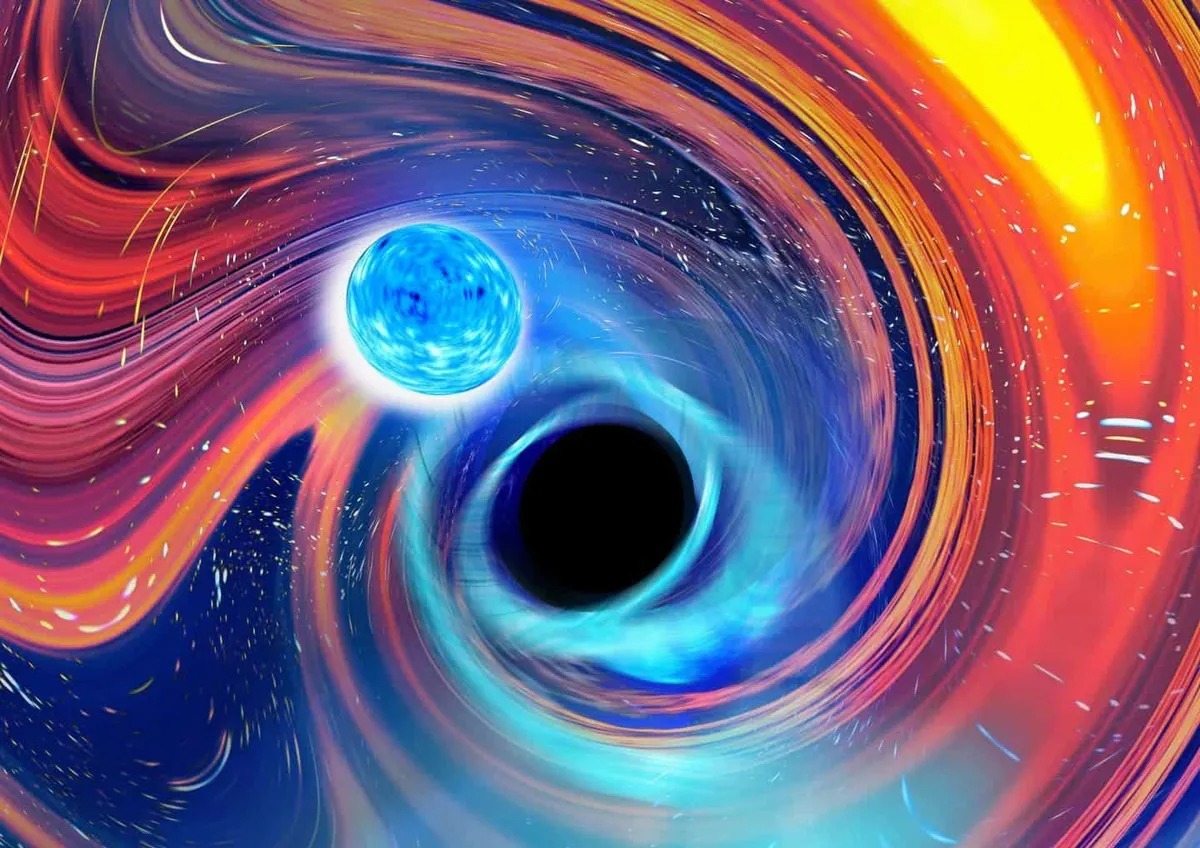 Illustration of a neutron star and black hole merger. Image: Swinburne University
The presence of eccentricity immediately prior to the merger indicates a “dynamic” origin. These two probably met in a densely populated “stellar metropolis” — for example, in the center of a galaxy or inside a globular star cluster. There, gravitational interference from third stars or even the influence of a nearby massive black hole could have “nudged” them onto such a strange trajectory, causing them to collide much faster than would have happened naturally.
Eccentricity versus precession
In their new study, published in The Astrophysical Journal Letters, scientists have taken a comprehensive approach for the first time, analyzing two key parameters simultaneously: eccentricity (the degree of elongation of the orbit) and precession (the oscillation of the axis of rotation of objects). This allowed us to rule out unnecessary hypotheses.
As it turned out, despite their strange egg-shaped orbit, the objects showed almost no precession. This means that their convergence was not caused by a simple change in the orientation of the axes. The trajectory was set by external forces long before the disaster. Each such nuance in the gravitational wave signal is like a fingerprint at a crime scene, allowing astrophysicists to reconstruct events that happened billions of years ago.
A new era of space observation
Case GW200105 is just the first sign of a whole class of “incorrect” space systems. The discovery of such anomalies presents science with a new challenge: to develop more complex models that take into account chaotic interactions in dense star clusters.
Today’s detectors, such as LIGO and Virgo, are operating at their limits, capturing the loudest events in the Universe. However, the future promises even more discoveries. Next in line is the launch of the LISA (Laser Interferometer Space Antenna) space antenna. This device, free from terrestrial noise and vibrations, will be able to “hear” much weaker and longer gravitational waves.
Thanks to such instruments, humanity will have the opportunity to peer into the darkest corners of space, where black holes and neutron stars perform their unpredictable dance. “We are opening a completely new window onto the Universe,” concludes Patricia Schmidt. What previously seemed like a single error in calculations may turn out to be a new rule that will radically change our understanding of the life and death of stars.
Earlier, we reported on how scientists calculated the date of the universe’s death.
According to space.com