
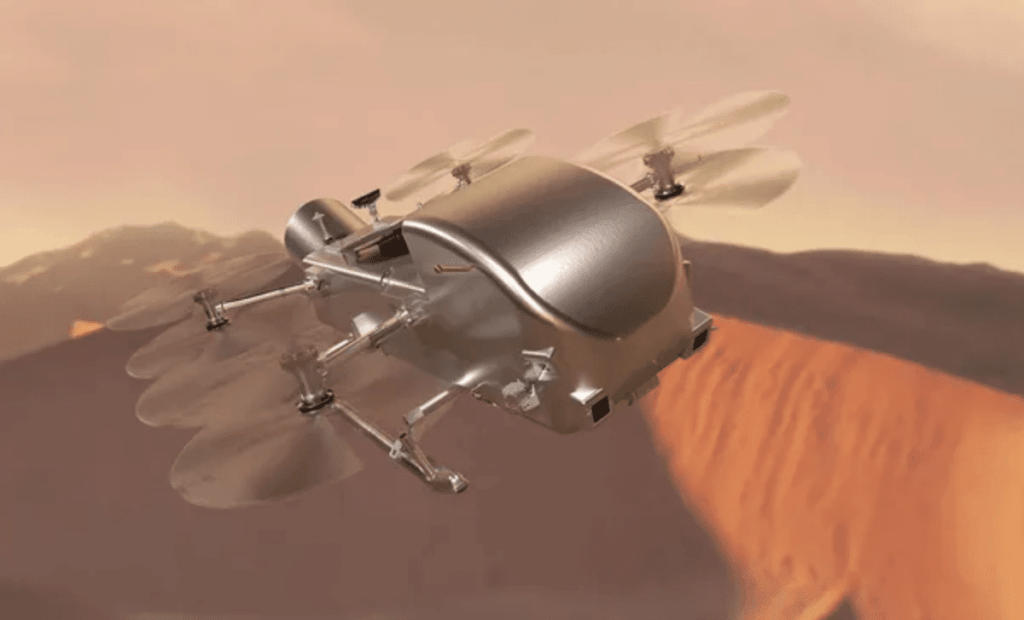
NASA has officially begun testing the nuclear-powered Dragonfly drone, a spacecraft designed to soar across the skies of Saturn’s largest moon, Titan. The mission, set to launch in 2028, promises to be a groundbreaking journey to one of the most intriguing bodies in our solar system. As scientists strive to uncover the mysteries of Titan, this milestone marks a significant leap toward an unprecedented exploration of an alien world.
The Birth of a New Era in Space Exploration
NASA’s ambitious Dragonfly mission has reached a pivotal moment: the testing and integration of its core systems. Built to be the first-ever rotorcraft to explore Titan’s dense atmosphere, Dragonfly is more than just a technological marvel, it represents a daring leap into the unknown.
Titan, with its thick, nitrogen-rich atmosphere and lakes of liquid methane, is an ideal candidate for scientists to study potential chemical precursors to life. The Dragonfly drone will explore this alien world, gathering data to answer questions about the origins of life and the possibility of habitability in extreme environments.
“This milestone essentially marks the birth of our flight system,” said Elizabeth Turtle, Dragonfly’s principal investigator from the Johns Hopkins Applied Physics Laboratory (APL). “Building a first-of-its-kind vehicle to fly across another ocean world in our solar system pushes us to the edge of what’s possible, but that’s exactly why this stage is so exciting.”
The team is racing against time, with every test and installation bringing them closer to launching the vehicle into space in 2028.
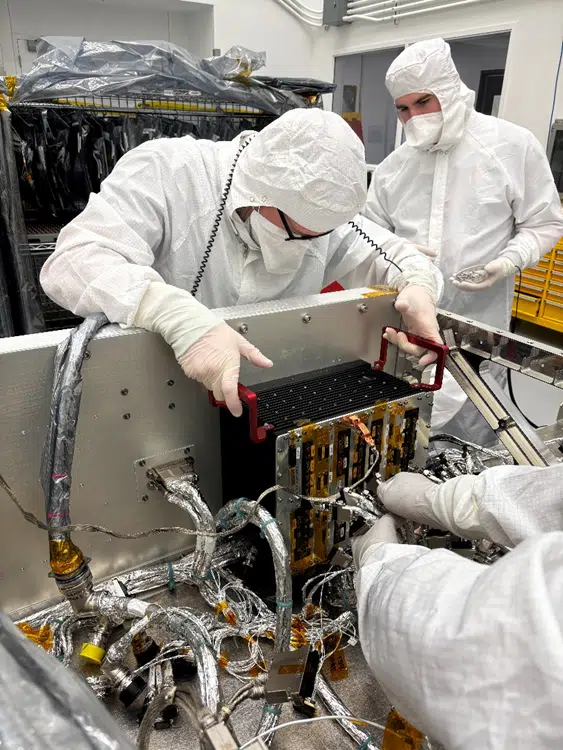 In the cleanroom at APL, Emory Toomey (left) and Hunter Reeling integrate the engineering model of Dragonfly’s IEM, which contains the spacecraft’s core avionics, with the lander’s electrical harness, which is the bundled assembly of wires, cables and connectors that will transmit power and data throughout the rotorcraft.
NASA/Johns Hopkins APL
Dragonfly’s Technological Edge
Unlike NASA’s previous rotorcraft, the Mars helicopter Ingenuity, Dragonfly will be powered by nuclear energy instead of solar power. This is crucial for operating in the extreme conditions of Titan, where sunlight is scarce and the temperatures are far colder than anything Earth-bound technology can withstand. Titan’s frigid, nitrogen-dominated atmosphere presents unique challenges, and Dragonfly’s design has been adapted to address these obstacles.
To ensure that Dragonfly survives the harsh conditions, NASA has focused on creating systems that can handle not only the freezing cold but also the thick, opaque atmosphere. The craft’s integrated electronics module, which functions as its “brain,” controls guidance, navigation, and data handling, ensuring that Dragonfly will remain stable and functional as it explores Titan’s alien terrain.
“This isn’t just a mission—it’s an opportunity to expand our reach and explore the skies of another world,” said Annette Dolbow, the integration and test lead at APL. “We’ve spent years designing and refining this amazing rotorcraft on computer screens and in laboratories, and now we get to bring all those elements together and transform Dragonfly into an actual flight system.”
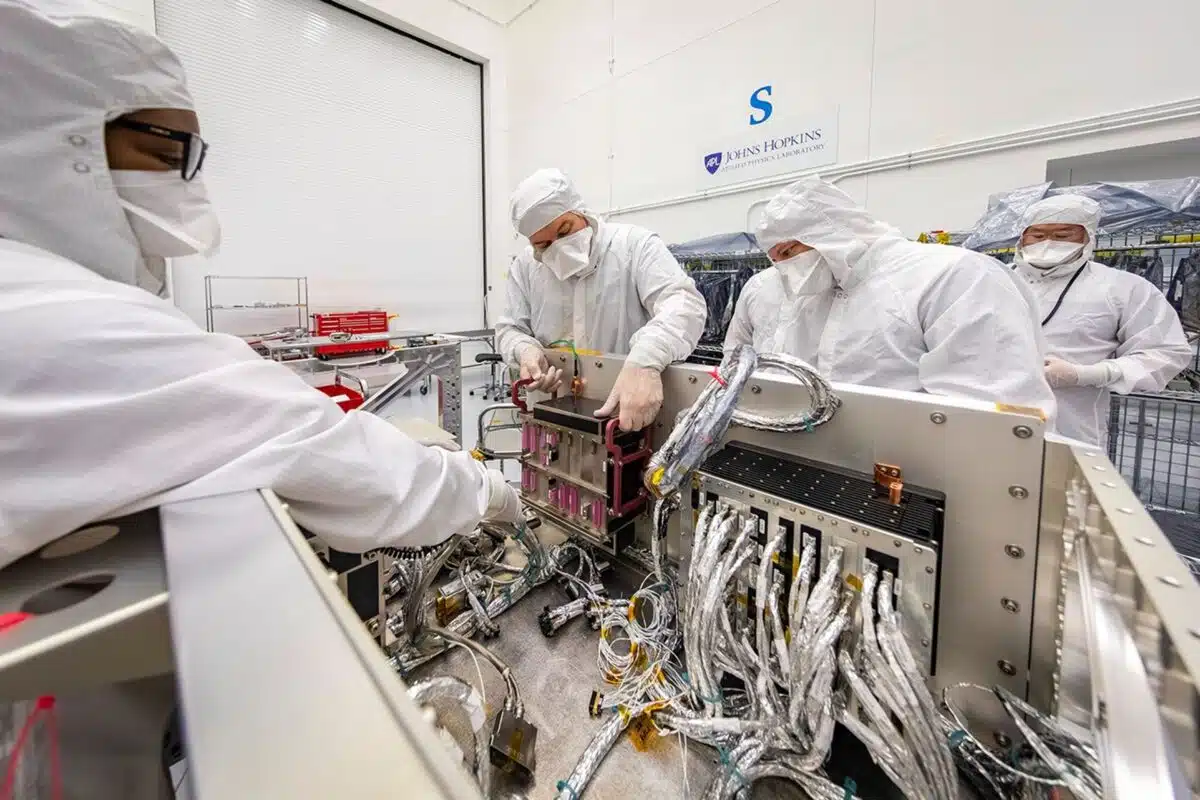 From left, Carlisa Drew, Seth Harvey, Anthony Fanelli, Emory Toomey and TJ Lee conduct power and functional testing on Dragonfly’s Integrated Electronics Module (IEM) and Power Switching Unit (PSU) in the cleanroom at the Johns Hopkins Applied Physics Laboratory (APL) in Laurel, Maryland. The IEM is Dragonfly’s “brain,” containing the spacecraft’s core avionics; the PSUs control the flow of power to Dragonfly’s instruments and systems.
NASA/Johns Hopkins APL/Ed Whitman
Titan: A World of Chemical Wonders
Titan has long intrigued scientists due to its potential for harboring the building blocks of life. With its thick atmosphere, lakes and rivers of liquid methane and ethane, and the presence of complex organic molecules, Titan offers a unique environment that could offer insights into the origins of life itself.
The Dragonfly mission will visit multiple locations on Titan’s surface to study its diverse geological features, atmospheric conditions, and chemical processes. By examining these factors, scientists hope to learn more about the potential for life in environments radically different from our own.
 Image credit: NASA/JPL/University of Arizona
The Testing Phase: Challenges and Triumphs
As the Dragonfly project moves forward, each phase of testing brings both progress and obstacles. The APL team in Maryland is currently conducting the first critical tests on the craft’s integrated systems, which include power-switching units and the electronics module. These tests ensure that Dragonfly’s systems function harmoniously together and can withstand the harsh space environment.
With the spacecraft’s protective shell now undergoing aerodynamic assessments in NASA’s wind tunnels, Dragonfly is moving closer to being ready for the launch vehicle. Over the next few years, additional testing will assess how Dragonfly performs under the extreme conditions of space, including its journey to Titan and its operations on the moon itself.