
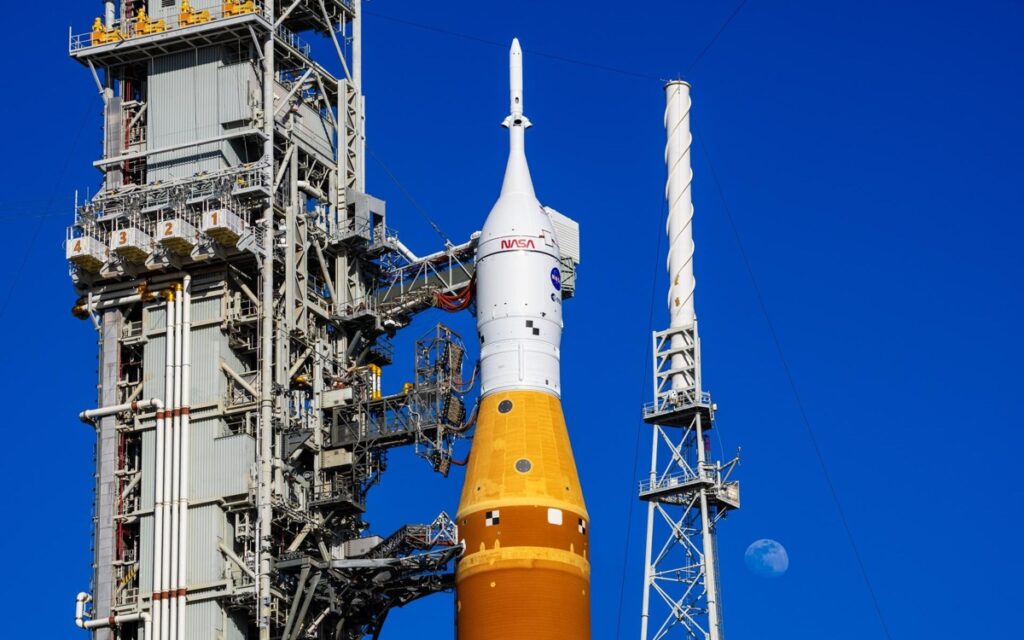
The mission is scheduled to lift off from Kennedy Space Center in Florida aboard the Space Launch System rocket with four astronauts onboard.
“I am comfortable and the agency is comfortable with targeting April 1 as our first opportunity, just keep in mind we still have work to go,” said Lori Glaze, acting associate administrator for Exploration Systems Development Mission Directorate. “There are still things that need to be done within the Vehicle Assembly Building and out at the pad, and as always, we’ll always be guided by what the hardware is telling us, and we will launch when we’re ready.”
The Artemis II mission will send astronauts around the far side of the Moon and back during a 10-day journey without a lunar landing. The crew includes US astronauts Reid Wiseman, Victor Glover and Christina Koch, as well as Canadian astronaut Jeremy Hansen.
The launch has already been delayed several times. It was initially scheduled for earlier launch windows but slipped from February to March and then again after a helium leak and fuel system issues were discovered during testing. Ground crews recently returned the rocket and the Orion spacecraft to the Vehicle Assembly Building to complete repairs.
“We want to be sure that we’re thinking about everything that can possibly go wrong, and have we assessed and adjudicated all the risks to put us in the best posture to be successful,” said John Honeycutt, chair of the Artemis II Mission Management Team.
The mission will become the first crewed lunar flyby mission since the Apollo program more than 50 years ago and a major step in NASA’s plan to return astronauts to the Moon and eventually send humans to Mars.
NASA officials also confirmed that teams will not conduct another “wet dress rehearsal,” which is a full pre-launch fueling and countdown test, once the rocket returns to the launchpad, saying there is little additional data to gain before the actual launch attempt.
As Qazinform reported earlier, the agency already set plans for Artemis III, a 2027 low-Earth-orbit test mission, while the first crewed lunar landing is now planned for Artemis IV in 2028.