
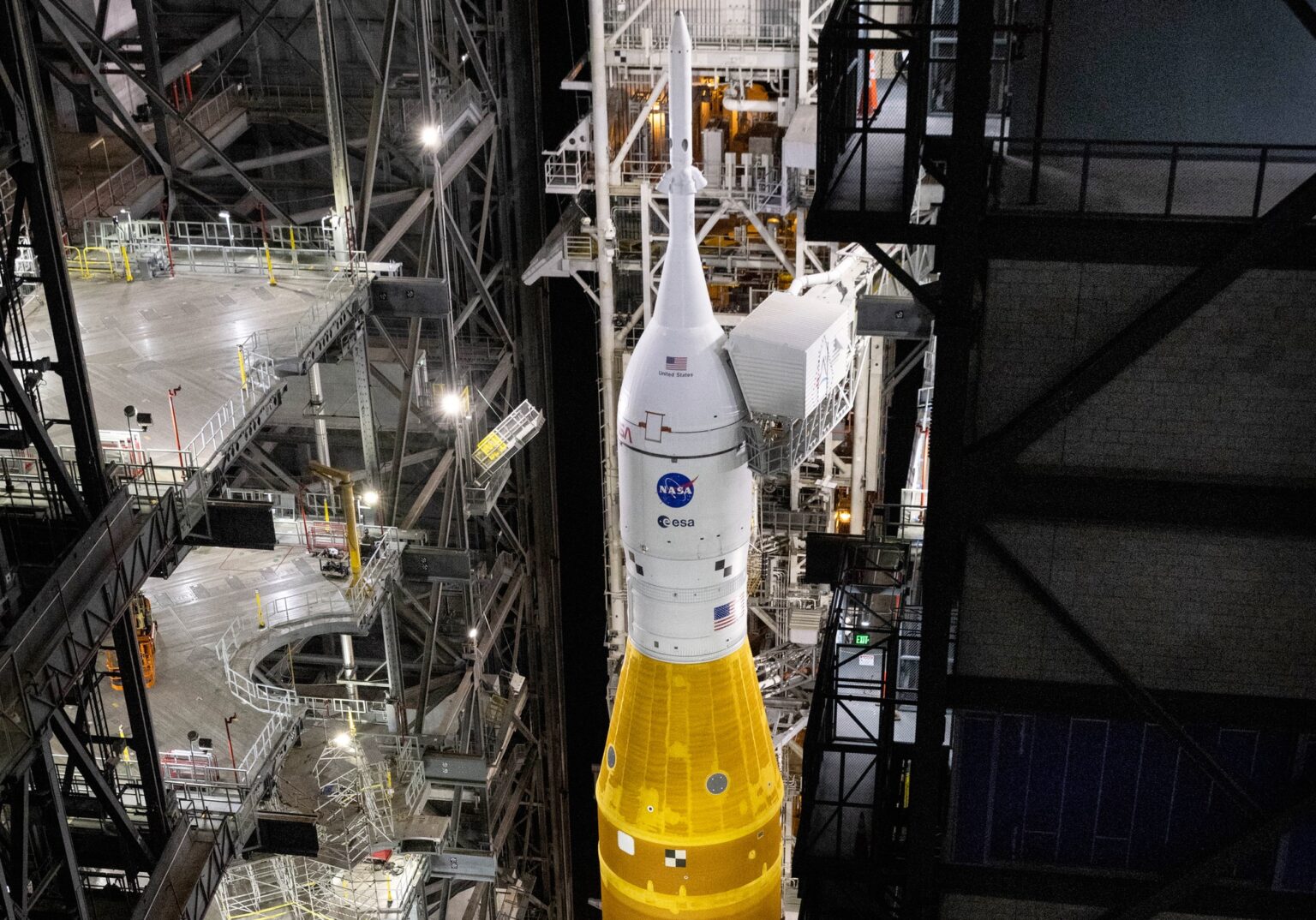
WASHINGTON — NASA is pushing ahead with an Artemis 2 launch as soon as April 1 after completing repairs to a helium line that required rolling the rocket back from the pad.
At a March 12 briefing, agency officials said they completed a two-day flight readiness review for the Artemis 2 mission and agreed to proceed with launch preparations.
NASA currently plans to roll the Space Launch System rocket and Orion spacecraft from the Vehicle Assembly Building, or VAB, back to Launch Complex 39B on March 19. That would set up a launch as soon as April 1, the opening of the next launch period for the mission, which runs through April 6.
The vehicle, which originally rolled out to the pad in mid-January, returned to the VAB on Feb. 25 after helium flow into the SLS upper stage stopped. An investigation found that a seal in a quick-disconnect, or QD, line between ground equipment and the stage had come loose, blocking the flow of helium in the line.
Shawn Quinn, manager of NASA’s Exploration Ground Systems Program, said the seal was dislodged by a buildup of high-pressure gas. “We actually ended up removing that seal and reinforcing another seal that would be less susceptible to that phenomenon,” he said.
That revised line has been tested and qualified for use for the launch. “The modified QD is already on the upper stage,” he said. “We’re very proud of the team and the work they did to quickly understand the root cause and come up with a corrective action.”
Teams are finishing other work on the vehicle while it remains in the VAB, including retesting the rocket’s flight termination system after replacing batteries. That work is slightly ahead of schedule, said Lori Glaze, acting associate administrator for exploration systems development at NASA.
A return to the pad on March 19 would put the mission on schedule for its next opportunity, April 1 at 6:24 p.m. Eastern, with a two-hour launch window. Additional launch opportunities are available daily through April 6.
Earlier launch schedules released by NASA did not include a launch window on April 2, but Glaze said at the briefing that the agency had added that day.
“We’ve done enough analyses to believe that is a viable date,” she said, but did not state why the date had previously been ruled out.
While there are six days of launch windows, operational requirements would prevent NASA from attempting a launch each day. She estimated NASA would have about four opportunities to launch during that period.
Officials added they do not plan another wet dress rehearsal, or WDR, where the SLS is loaded with liquid oxygen and liquid hydrogen propellants, or other smaller-scale tanking tests.
They said they felt confident in the seals in liquid hydrogen lines that leaked during the first WDR in early February and were replaced. Those seals worked during the second WDR later in the month, with no significant leakage. Crews also replaced seals in liquid oxygen lines while the SLS was in the VAB for the helium line repairs.
John Honeycutt, chair of the Artemis 2 Mission Management Team, said it appeared that seals can “flow and set” when in the lines for an extended time, causing the leaks. He said that, with new seals in place, the mission was in a “good posture” for launch.
“We’ve demonstrated that the seals that we have are the best seals that we’ve ever seen on the SLS,” Glaze said, ruling out another WDR. “In our opinion, there’s not a lot more to be gained from that.”
“From my perspective, when we tank the vehicle the very next time, I would like it to be on a day we could actually launch,” she said. “If we are able to successfully fully tank the vehicle, I want to be able to poll ‘go’ to launch.”
Assessing risk
Part of the briefing focused on the risks of the mission, the first crewed flight beyond low Earth orbit since Apollo 17 in 1972.
“We spent a lot of time with the senior executives and the leadership throughout the enterprise talking about my risk posture,” Honeycutt said, including how to communicate risk.
Over decades of flight experience in low Earth orbit, NASA has developed tools and techniques for what it calls probabilistic risk assessments, quantitative estimates of the risk of mission failure or loss of crew. But Honeycutt and others suggested a lack of experience with missions beyond Earth orbit makes such tools less effective.
“Sometimes we get tricked into believing that those numbers are somehow really telling us something critically important,” Glaze said of those probabilistic risk assessments.
“We’ve grappled with this overall number for a while,” Honeycutt said about the estimated risk of the mission. “We’re looking at this rather qualitatively.”
At one end, he noted the risk of mission failure for a new rocket has historically been about one in two. At the other end, he suggested the risk might be closer to 1 in 50 if the vehicle were flying at a higher cadence than it is now, with a gap of more than three years between the first and second SLS launches.
“With this gap that we’ve got, it’s probably not 1 in 50,” he said. “It’s probably closer to 1 in 2.”
He clarified that he did not believe there was a 50% chance the Artemis 2 mission would fail.
“I think we’re in a much better position than that, and the only way I can put us in a better place than the one-in-two is to do what we’ve done: uncover all the risks and make sure we’ve done everything to buy down risk and give us options to work through challenges we’ve got.”
Related