
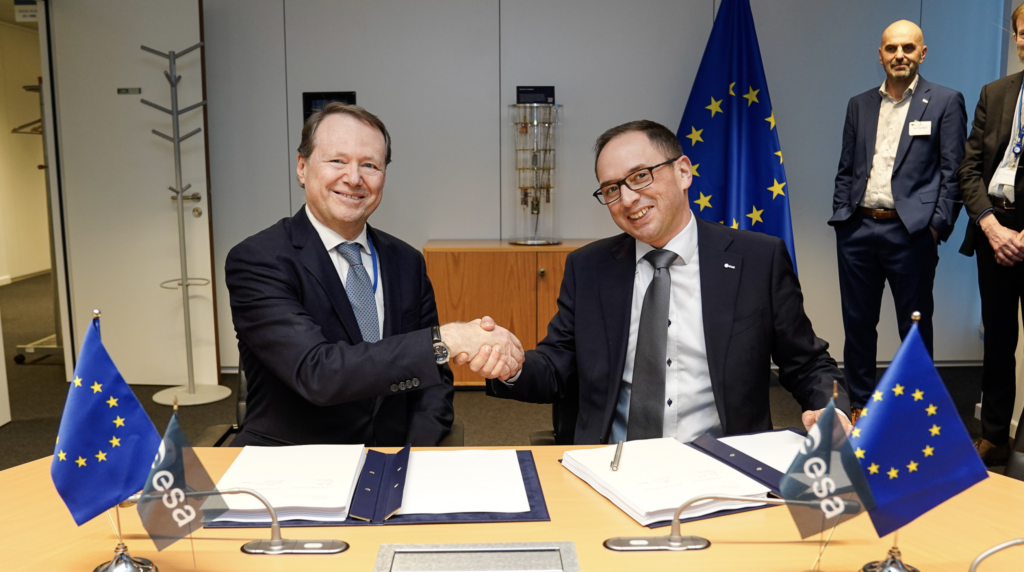
Last year’s ESA ministerial conference represented a landmark moment for the European space ecosystem, and not just because the agency raised the most money in its history (€22.3B).
The conference saw member states take an unprecedented stance on the use of space for defense, and ESA came away with a new mandate—€1.2B+ in funds toward defensive projects.
Enter the new ESA Directorate for Resilience, Navigation and Connectivity (RNC) led by Laurent Jaffart, formerly ESA’s Director of Connectivity and Secure Communications.
Jaffart brings decades of A&D experience working for Airbus, on projects such as Eurofighter Typhoon and a secure network used by NATO partners known as Link 16. After joining the agency in 2024, Jaffart worked on ESA’s portfolio of satcom projects. Now he’s leading the charge to build up ESA’s defensive posture. Payload chatted with Jaffart to hear his plans for the new role.
This interview has been edited for length and clarity.
What are the milestones that you’re looking to achieve with this new directorate?
The first one is a program, which we called ERS: European Resilience from Space. ERS is an integrated system of systems that will address gaps in Europe’s strategic capabilities from space.
What we are looking at is a seamless integration of existing assets. We’re going to work on interoperability, which is the concept of pooling and sharing of capabilities. The ambition is to reduce fragmentation, to improve the governance, to allow member states who have capabilities to share those capabilities with others who don’t, and to define standards to [promote] this sharing of critical services.
[For] Earth observation, PNT, and secure connectivity, we have ambitious goals to have a response time of less than 30 minutes. The target will be to work close to near real time [connectivity].
What we want is to look also at the evolution of IRIS² as a telecommunication backbone that would provide services to the different satellites in different domains. In concrete terms, what it means is that you would be able to task a satellite that is doing Earth observation through this telecommunication backbone, and you will be able to disseminate the data that this Earth observation satellite has acquired—and all of this without having to wait for the satellite to go above a tasking or receiving station.
It sounds like there’s two modes of work to be done: the next-gen technologies, and the backward-looking interoperability of existing assets. Is that really how we should understand the work of this new directorate?
I think it’s only one part of the story. What we have is, indeed, the question of pushing technologies in Europe so that we have autonomy, sovereignty, and we’re not dependent on third party nations. But the directorate is also working on navigation. The ability to synchronize timing is essential for any assets, civilian, military, and anything in between uses timing to be able to make sure that everything works in sync.
We’re also going to support the European Commission on the definition of what they call the Space Shield. It’s today something that needs to be defined between the concept of space for defense. So how resilient connectivity, resilient PNT, [and] resilient ISR provides data intelligence to governments and to member states. On the other side, the question of protection in space—we will work on space situational awareness and space domain awareness, [and] understanding how to potentially anticipate threats.
I’m curious about the decision-making process in ESA and the Directorate when it comes to working with established primes versus new startups, is there an appetite for working with both on future projects?
I really think that we will work with the best. If it’s a legacy player, or if it’s a new player, we will work with the same criteria to assess their offers. We want a competitive industry. We want an industry that is capable of taking some risk, but getting some reward for the risk taken. We want an industry that is capable of using competencies that they have acquired over time, or that they just come up with a disruption.
What does success look like for the new directorate?
For me, the KPI is delivering value to our member states, and our stakeholders. You could say it’s hard to quantify, but the best KPI is if they are satisfied. What we’re going to be working on in the months to come is the rollout of our organization, how we’re going to be working. So right now my KPI is to deliver what we promised in ’25.
Related Stories
European space startup AIRMO closed a €5M ($5.8M) seed round to launch its first greenhouse-gas-monitoring satellite no earlier than next year, and to expand its drone and airplane monitoring into the Middle East market.

Planet Labs just proved that dual use doesn’t necessarily mean equal priority.
The Pittsburgh, PA-based space firm won a contract of undisclosed value from Thales Alenia Space to contribute the wheels for Italy’s Multi-Purpose Habitation.
Seraphim Space Investment Trust ($SSIT) announced its financial results for H2 2025, revealing a successful portfolio of global space businesses that have seen valuations buoyed by geopolitical trends.
More Stories
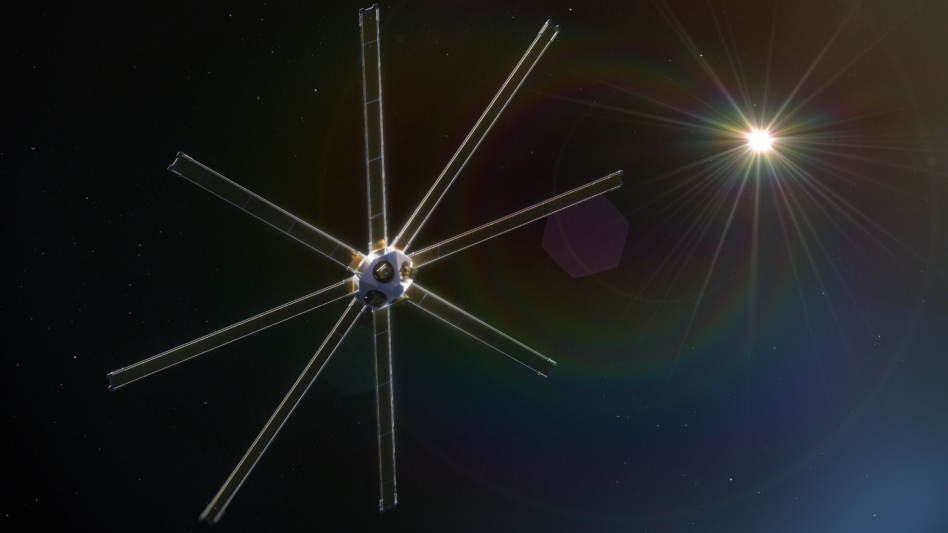 Image: Mantis Space
Mantis Space is aiming to bring power into the light—and now it has the money to do so.
The startup, which is building tech to beam solar power from one satellite to another, formally exited stealth today with the announcement of $10M in seed financing. Mantis will use the funds to complete development of its prototype payload and to grow its workforce.
Rule 1 Ventures led the round, which included funds from Mantis incubator Montauk Capital. Mantis has also received ~$25M in support—as a combination of cash and tax incentives—from New Mexico and the city of Albuquerque, according to CEO Eric Truitt.
Load More