
Applications
12/03/2026
20 views
1 likes
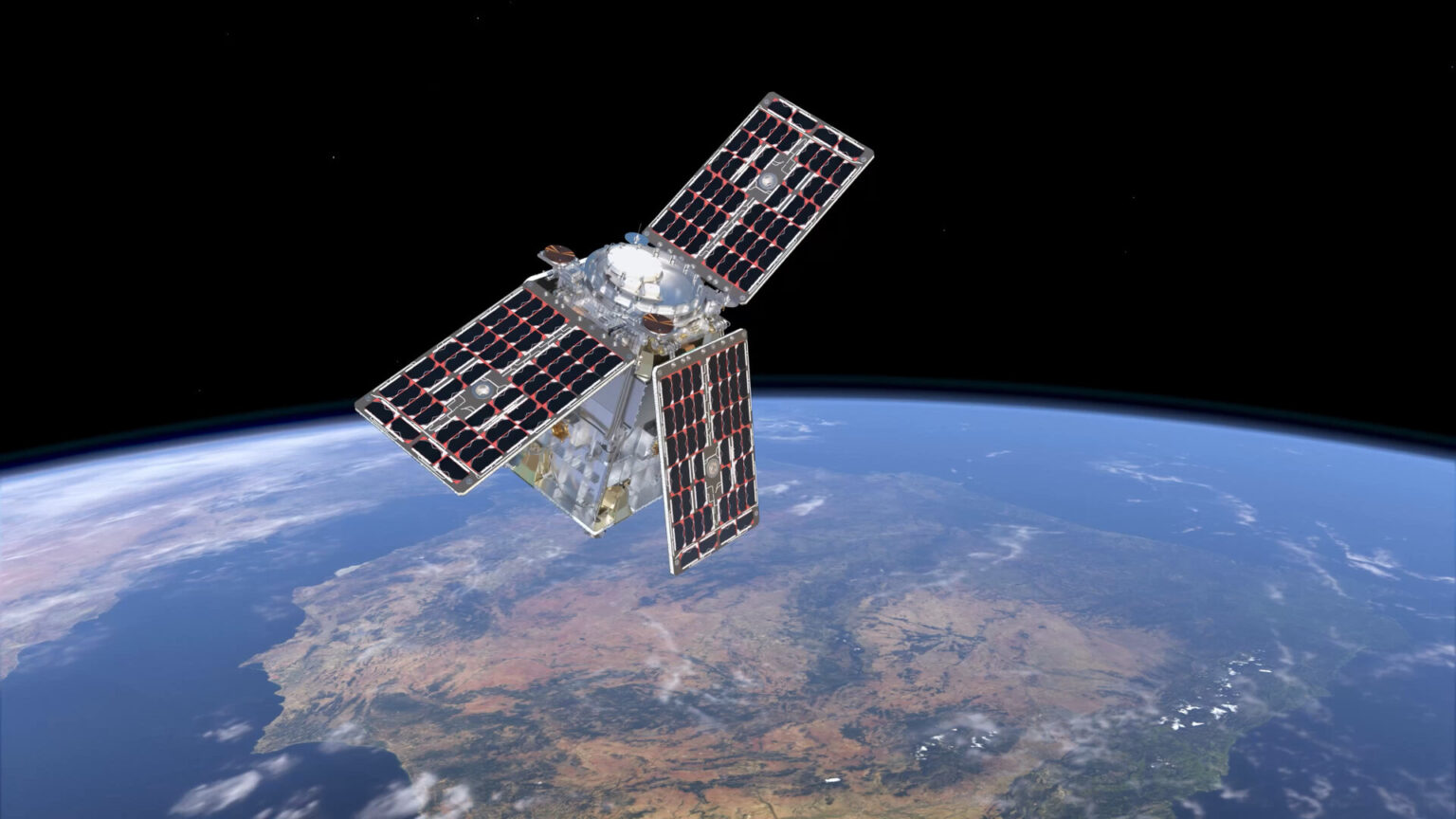
Just three months after launch, the European Space Agency’s twin HydroGNSS satellites are already proving their capabilities in orbit. By exploiting reflected signals from navigation satellites – the sophisticated technique they use to generate Delay Doppler Maps in order to ‘scout’ for water across Earth’s surface – these compact satellites are beginning to reveal the scientific potential they were built to unlock, even while still in their commissioning phase.
Embodying the New Space approach, HydroGNSS is ESA’s first Scout mission, developed under the Earth Observation FutureEO programme. Scout missions prioritise speed and innovation, enabling new ideas and satellite technologies to be developed rapidly and at low cost.
At the heart of HydroGNSS lies an innovative method known as Global Navigation Satellite System (GNSS) reflectometry. Navigation satellites such as GPS and Galileo continuously transmit L-band microwave signals that subtly change after reflecting off Earth’s surface.
HydroGNSS compares these reflected signals with the direct GNSS signals to extract valuable information on geophysical parameters linked to the water cycle.
HydroGNSS uses GNSS reflectometry to ‘scout’ for water
Key to this process involves producing Delay Doppler Maps, which show how a GNSS signal changes after bouncing off Earth’s surface. One axis represents delay (how long the signal takes to return), and the other shows Doppler frequency (how motion affects the signal).
When the signal reflects off a smooth, mirror-like surface – such as calm water or flat sea ice – it produces a strong, sharp peak. But over a rough ocean, the reflection spreads out into a weaker, curved ‘horseshoe’ shape. A helpful comparison is sunlight reflecting off the sea when viewed from an airplane: a perfectly smooth surface gives a bright point, while waves stretch the reflection into a wide glistening area.
The strength and shape of this reflection depends on surface conditions. Roughness matters, but so do factors like soil moisture, whether the ground is frozen, and the presence of vegetation.
By understanding these patterns, scientists can use Delay Doppler Maps to measure soil moisture, floods, forest biomass and freeze–thaw cycles. Over oceans, these maps can also reveal wind speed and sea-ice extent.
HydroGNSS enhances this approach by generating maps at a second frequency and in two polarisations, adding extra layers of information that improve hydrological measurements worldwide.
Delay Doppler Map from HydroGNSS
The two HydroGNSS satellites are still in their planned commissioning phase. The team at Surrey Satellite Technology Ltd (SSTL) in the UK is busy refining calibration, validating processor chains, and characterising the satellites’ in-orbit behaviour. SSTL is consulting closely regarding results with its science team partners at Sapienza and Tor Vergata Universities in Rome, CSIC/IEEC in Spain, IFAC in Italy, FMI in Finland, TUW in Austria, National Oceanography Centre and University of Nottingham in the UK.
Nevertheless, even at this early stage the satellites are already generating promising early measurements, showing that the mission is well on track and moving confidently toward its full operational phase.
Martin Unwin, HydroGNSS Principal Investigator at SSTL, said, “Both of the HydroGNSS Scouts are collecting Delay Doppler Maps of reflected GNSS signals.
“The image above is an early example of two captured simultaneously by HydroGNSS-2 over Central Africa within two weeks of launch.
“The left part of the image is a reflection from E1 navigation signals generated by Galileo satellite ID27, and the right is from GPS satellite ID21. The strength of these reflections is related to a number of factors on the surface one of which is the soil moisture, and this parameter will be recovered using processors developed by science partners.”
HydroGNSS generates first Delay Doppler Maps
The video shows recent tracks from HydroGNSS-2 developing over France, the Mediterranean Sea and North Africa with orange and red sections indicating stronger reflections. On the right are shown the instantaneous Delay Doppler Maps at dual polarisation and dual frequency at each second for each reflection. Then HydroGNSS-1 tracks are shown over Tanzania to Malawi with the corresponding maps highlighting rivers and lakes.
Pete Garner, HydroGNSS Project Manager at SSTL, added, “Seeing the first datasets from this exciting mission is a fantastic reward for the SSTL–ESA–scientific partners collaborative team, which has worked so hard to overcome the many challenges you would expect from a complex satellite project like HydroGNSS. The whole team is looking forward to what else the mission can show us about our planet.”
All eyes on screen for HydroGNSS
ESA’s Project Manager for the Scout missions, Jean-Pascal Lejault, said, “We are extremely pleased with these initial results. The first show that the satellites are in good health and working as they should. This is a great achievement and my thanks go to everyone who has been involved.
“We look forward to finalising the mission’s commissioning phase and moving to operations, and seeing how this first ESA Scout mission will indeed ‘scout’ for water, yielding new information about the properties related to Earth’s water cycle, and more.”
Like