
Editor’s note: We are delighted to offer this excerpt from Chapter 3 of Winston Ewert’s new book, The Heavens, the Waters, and the Partridge: The Historical Interaction of Faith and Science Before Modern Science. Dr. Ewert is a Center for Science and Culture Senior Fellow, a software engineer, and an intelligent design research scientist.
There are few issues on which the Christian response has been as consistent as that of creation ex nihilo. It may be that some very early theologians in the Church did not hold to the doctrine, but it has been the consistent position of the Christian Church since around the second century. Even among the diverse theological controversies of the early Church, this point was nearly universally accepted. As Origen stated on the subject:
Even the heretics, although widely opposed on many other things, yet on this appear to be at one, yielding to the authority of Scripture.
Christians accepted that the principle, nothing comes from nothing, was true for processes in nature. God, however, was not bound by this limitation. He could and did create matter from nothing. Chrysostom is a possible exception. He points out that the philosophers of his time could not explain even the ordinary transformation of bread into bodily fluids. He does not outright reject the principle that nothing comes from nothing in nature, but arguably seeks to undermine confidence in it.
 Image source: Inkwell Press.
The First Step of Creation
The most common argument against creation from prior material was a citation of Genesis 1:1. This was widely taken as declaring that God created matter as the first step of creation. Another common argument was that God’s almightiness implied that he could create matter out of nothing. To declare otherwise was to make God weak in the same way that man was weak.
There is a similarity between the general response to the conservation of matter and Aquinas’ response to the immutability of the heavens. In both cases, the response accepts the principle as true for nature but insists that God is not bound by the same rules. However, while most of the authors rejected the immutability of the heavens even under natural processes, most accepted the conservation of matter under natural processes. Indeed, some of the same authors rejected the immutability of the heavens while accepting the conservation of matter.
Why the Difference?
In many cases, these authors explicitly point to Biblical passages that conflict with the immutability of the heavens. On the other hand, there are no Biblical passages that indicate that matter is not conserved under natural processes. Indeed, it may be argued that these passages imply the conservation of matter by claiming miraculous contravention of it. The difference is thus simple: according to the assessment of most historical Christians, the immutability of the heavens contradicted Scripture, but the conservation of matter did not.
Modern Science
Modern science inherited the idea of the conservation of matter but took some time to formalize it. The difficulty was that many processes involve either absorbing or releasing gases. It was not until techniques were developed to accurately weigh gases that it could be determined that all processes, even seemingly destructive ones like fire, did not change the total weight of those substances. Thus, it was determined that the total amount of matter, called “mass,” in a closed system does not change. This is called the conservation of matter.
Einstein’s theory of relativity refined the idea of the conservation of mass. He discovered that matter can be converted into energy and vice versa. This is the meaning of the equation E = mc2, which states that a small amount of matter is equivalent to a large amount of energy. Some common processes, like fire, do lose matter by converting it into energy, but the amount is so small that it cannot be measured. Nevertheless, while the conservation of matter is not strictly followed, the combination of mass and energy is conserved. As far as natural processes are concerned, nothing comes from nothing.
The Origin of Matter
What does this mean for the origin of matter? The 18th century saw widespread acceptance of an eternal universe. On this understanding, the universe has always existed and has always looked essentially as it does today. Over time, stars and planets were formed and destroyed, but on a large scale, the universe fundamentally has always been approximately the same and always will be.
However, a couple of discoveries would overturn this theory. The first was the development of thermodynamics in the 19th century. Over time, entropy, essentially the amount of disorganization, of a closed system always increases. If matter and energy are not created, destroyed, or otherwise enter or leave the universe, it must be a closed system. Thus, if the universe were infinitely old, it would have infinite entropy and be maximally disorganized. If true, that would imply that stars, let alone life, could not exist.
The 20th century saw the discovery of other galaxies. Furthermore, these galaxies appear to be moving away from us. Today, we understand this to be the universe expanding. However, if the universe had been expanding for an infinite amount of time, these galaxies ought to be infinitely far away.
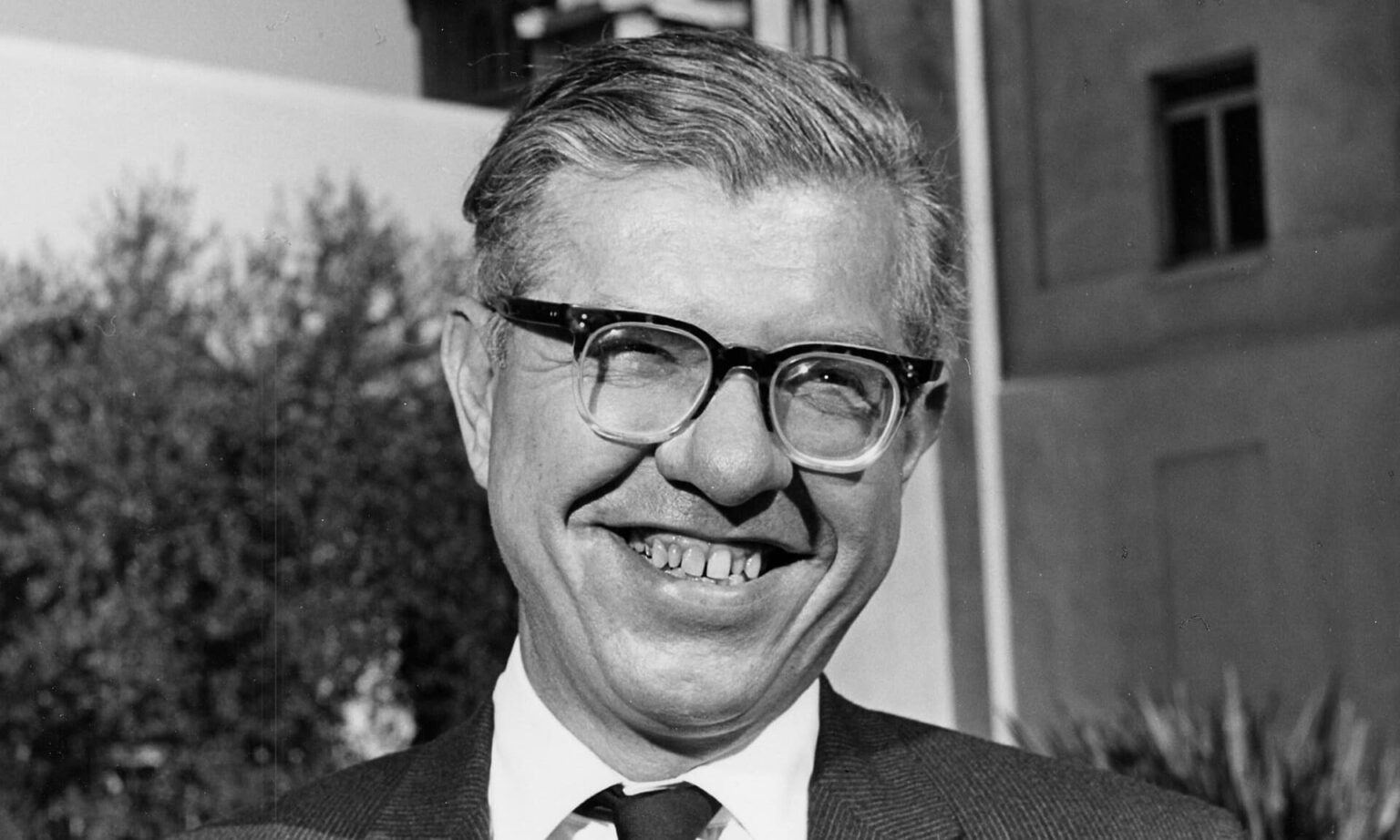
The combination of these two discoveries suggested that the universe had a finite history and not an eternal one. The most famous attempt to avoid this conclusion was the steady-state model most often associated with Fred Hoyle (pictured at the top). This theory postulated the continual creation of matter. This allowed it to avoid the problem of entropy because the universe is no longer closed. It also resolved the problem of the expanding universe because it allowed new galaxies to continually form to replace those that have moved further away. The theory only required sacrificing the principle of the conservation of matter in order to save an eternal universe.
The Big Bang Theory
Today, almost all cosmologists accept the Big Bang theory. This theory postulates that the universe as we know it expanded from a hot, dense state around 14 billion years ago. The universe, as we know it, has a finite history or age. It has not existed eternally and has changed in significant ways over time.
The Big Bang is highly suggestive of an ex nihilo creation event that created our universe. However, it is still possible to avoid this implication by postulating a history prior to the Big Bang. The Big Bang theory only involves the development of the universe from the “singularity” (the point where the equations break down), not the origin of that singularity. For example, oscillating theories postulate that the singularity resulted from the termination of the last one in an eternal sequence of universes. The chief difficulty for any such theory is entropy; any theory postulating an eternal history of the universe has to explain why the universe is not already at maximal entropy.
Two Important Laws
Modern science has established two important laws with seemingly opposite implications for the eternality of the universe. On the one hand, modern science has confirmed the conservation of matter and energy; matter is not created or destroyed but only changes forms. But if matter cannot be created or destroyed, this implies that it must have simply always existed. The universe must then be eternal. On the other hand, science has established the principle of increasing entropy. Over time, the entropy of the universe is increasing, and if it were eternal, it ought to be at maximal entropy. Since the universe is not at maximum entropy, this implies that it cannot be eternal. Thus, these two laws, while well established scientifically, have conflicting implications.
Read the rest in Dr. Ewert’s new book, The Heavens, the Waters, and the Partridge: The Historical Interaction of Faith and Science Before Modern Science. Listen to “Science Before the Scientific Revolution: What Can We Learn from It?” on ID the Future.