
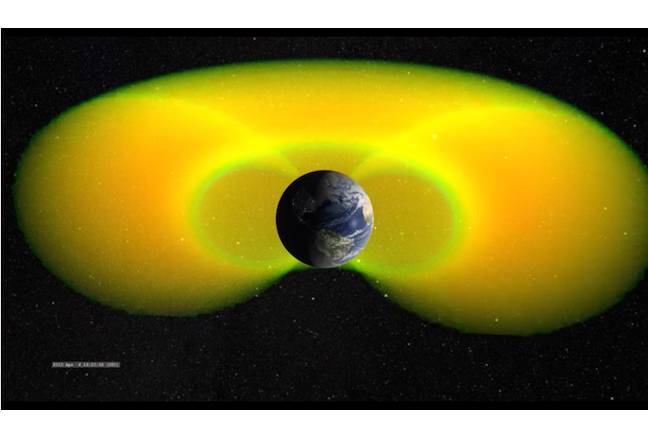
NASA’s Van Allen Probe A has re-entered Earth’s atmosphere eight years earlier than expected, with a 1 in 4,200 chance that its components could cause injury.
The spacecraft, part of a pair, was launched in 2012 on a planned two-year mission to study the Van Allen radiation belts surrounding Earth. The mission lasted seven years before the spacecraft ran out of fuel in 2019 and was unable to keep its solar panels angled toward the Sun.
In 2019, planners estimated that the spacecraft would re-enter the Earth’s atmosphere in 2034, but those calculations were made before the current solar cycle, which, according to NASA, “has proven far more active than expected.”
The result is that some satellites are encountering higher-than-expected atmospheric drag, resulting in earlier-than-expected re-entry. Other examples of spacecraft experiencing orbit decay faster than planned include NASA’s Swift observatory, for which the agency is planning a rescue mission. The orbit of the Hubble Space Telescope is also decaying, although there is no immediate danger of the observatory making an uncontrolled re-entry.
In NASA’s original post, the agency wrote: “The risk of harm coming to anyone on Earth is low – approximately 1 in 4,200.” The estimate for the approximately 1,323-pound spacecraft’s re-entry was 1945 EDT on March 10, with a 24-hour uncertainty window.
As it turned out, Van Allen Probe A re-entered at 0637 EDT on March 11. The US Space Force confirmed the spacecraft re-entered the atmosphere over the eastern Pacific Ocean region, at approximately 2° south latitude and 255.3 degrees east longitude. NASA said it “expected most of the spacecraft to burn up as it traveled through the atmosphere, but some components may have survived re-entry.”
While no injuries were reported, the chances were greater than documented in US government guidelines [PDF], which state: “If a space structure is to be disposed of by reentry into the Earth’s atmosphere, the risk of human casualty will be less than 1 in 10,000”.
The Van Allen Probe A spacecraft is the latest in a long line of space junk that has re-entered the Earth’s atmosphere. For example, in 2024, a pallet of batteries jettisoned from the International Space Station re-entered the atmosphere, and China is no stranger to letting the odd piece of debris re-enter in an uncontrolled fashion.
The spacecraft’s twin, Van Allen Probe B, is not expected to return before 2030. ®