
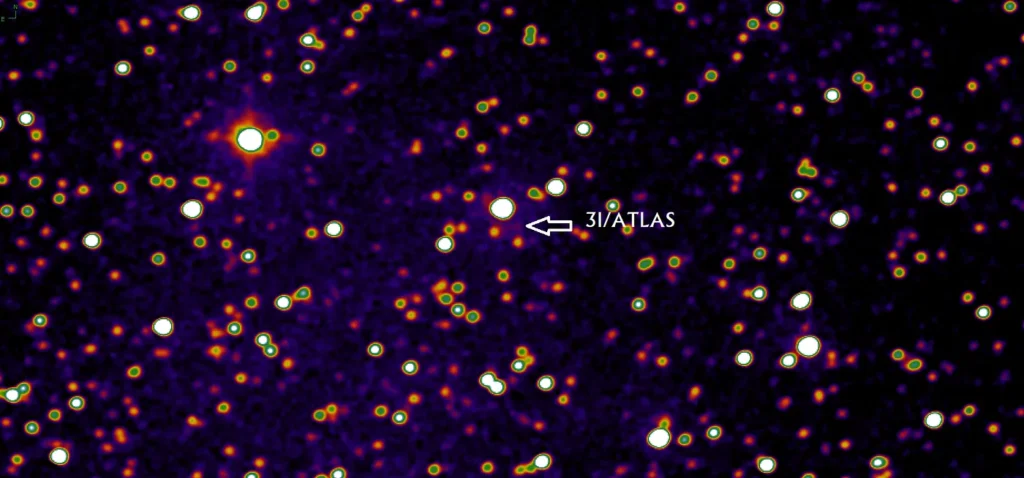
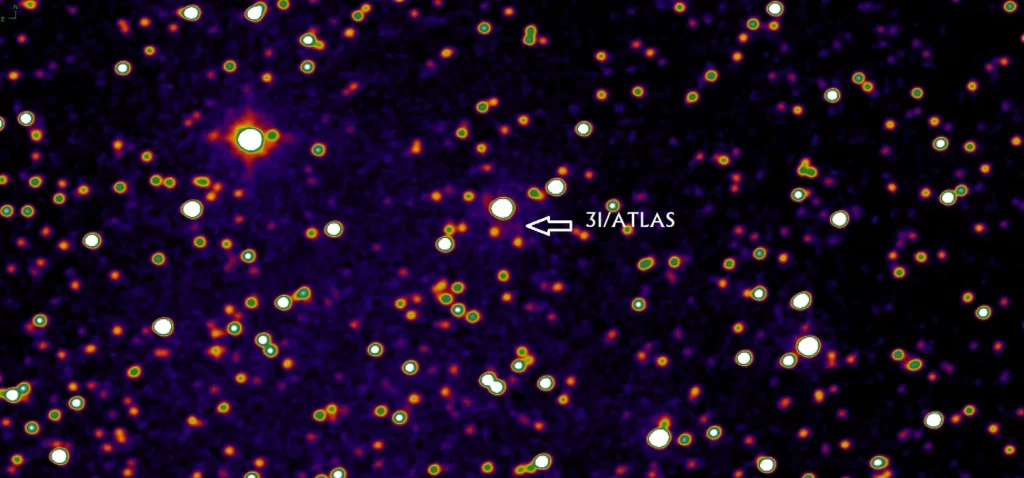
By Samuel A. Lopez | USA Herald – The interstellar object 3I/ATLAS is now fading from view, heading back into deep space after an extraordinary passage through our Solar System. Astronomers spent months studying the object after its discovery in July 2025, making it only the third confirmed interstellar visitor ever detected, following 1I/ʻOumuamua and 2I/Borisov.
The object will make its closest approach to Jupiter on March 16, 2026, before exiting the Solar System on a trajectory that roughly mirrors its incoming path.
While most astronomers believe the object is a natural comet, a growing body of observations has produced a list of unusual characteristics that continue to fuel scientific debate. Harvard astrophysicist Avi Loeb recently outlined twenty-two anomalies associated with the object.
Even so, Loeb himself stopped short of declaring the object technological. On his proposed “Loeb Scale,” which ranks the likelihood that an interstellar object may represent artificial technology, 3I/ATLAS was assigned a level four out of ten. Critics argue that despite highlighting numerous unusual observations, the scale itself has not evolved alongside the growing list of anomalies.
1. Mass Budget Discrepancy
The estimated nucleus diameter of roughly 2.6 kilometers implies a parent population of similar objects that would require far more mass than current models predict for planetary systems around low-metallicity stars.
2. Retrograde Orbital Alignment
3I/ATLAS entered the Solar System on a retrograde trajectory aligned within about five degrees of the ecliptic plane, the flat orbital disk where the planets travel. Statistical estimates suggest the probability of such alignment occurring randomly is extremely small.
3. Arrival Timing
The timing of the object’s path brought it relatively close to both Mars and Jupiter while simultaneously placing it in a position that made it difficult to observe from Earth during perihelion.
4. Jupiter Hill Radius Encounter
During its March 2026 passage, the object will pass approximately 53.6 million kilometers from Jupiter, a distance strikingly close to the planet’s Hill radius, the region where Jupiter’s gravity dominates.
5. Sunward Anti-Tail Jet
Analysis of imagery from the Hubble Space Telescope suggests the prominent anti-tail observed before perihelion may be produced by a highly collimated jet directed toward the Sun rather than a typical comet dust tail.
6. Initial Rotation Alignment
Observations suggest the object’s rotation axis was aligned within roughly eight degrees of the Sun-facing direction when it first entered the Solar System.