
Summary:
Scientists studying Mars may have uncovered a brand-new mineral hidden in the planet’s ancient sulfate deposits. By combining laboratory experiments with orbital data, researchers identified an unusual iron sulfate—ferric hydroxysulfate—forming in layered deposits near the massive Valles Marineris canyon system. The mineral likely formed when sulfate-rich deposits left behind by ancient water were later heated by volcanic or geothermal activity, transforming their chemistry.
Researchers have identified an unusual iron sulfate on Mars that may represent a completely new mineral.
Paper
https://www.nature.com/articles/s41467-025-61801-2
Articles
https://www.sciencedaily.com/releases/2026/03/260309225228.htm
twww.seti.org/news/a-unique-martian-mineral-offers-fresh-clues-about-planet-s-past/
by Neaterntal
1 Comment
Image:
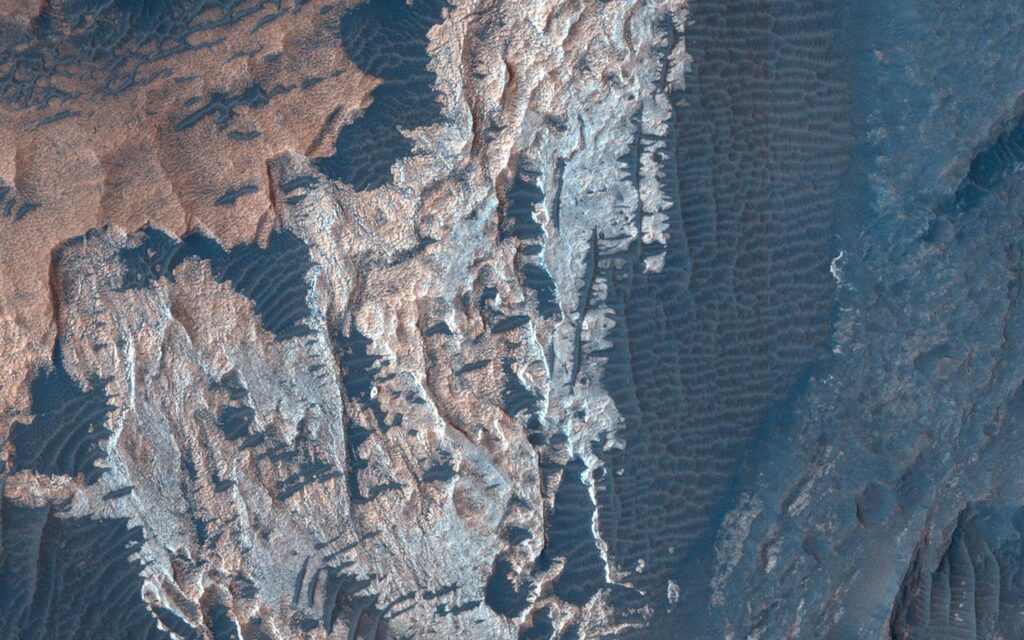
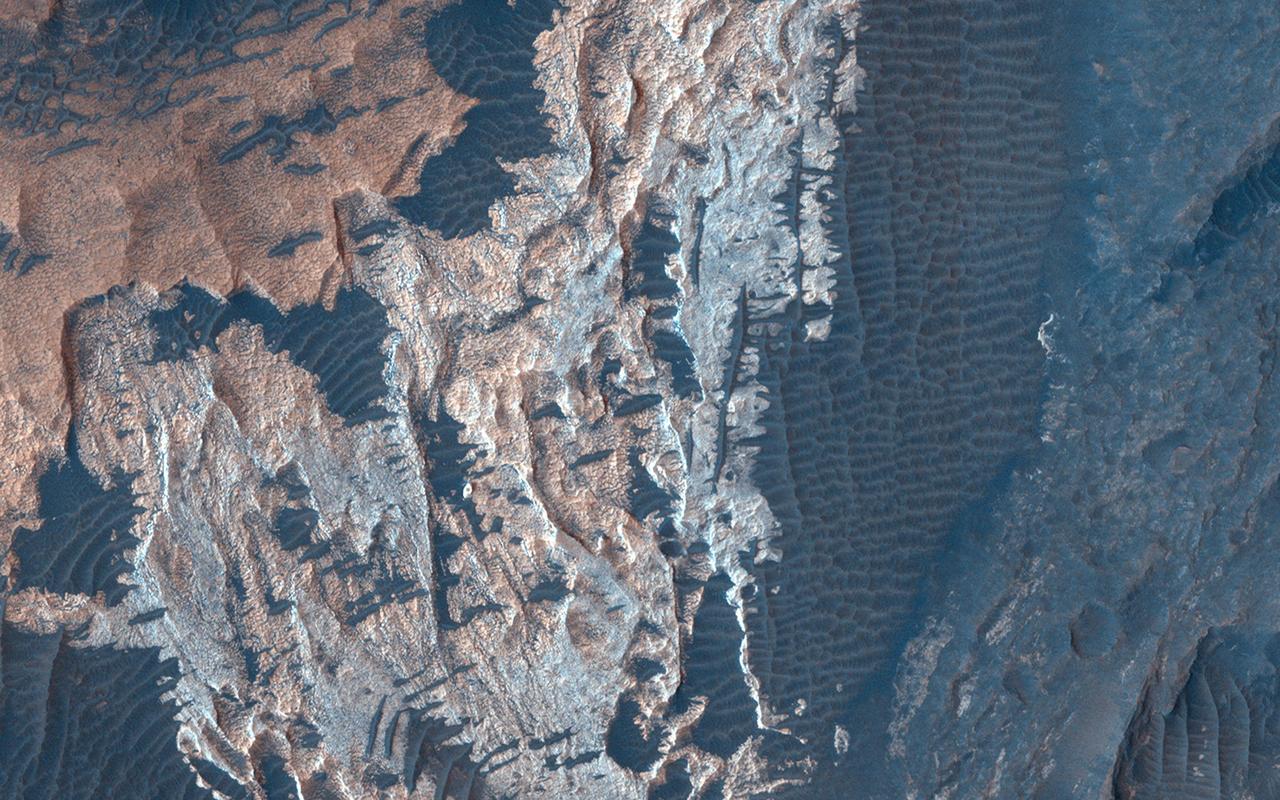
Aram Chaos. Image Credit: NASA/JPL-Caltech/University of Arizona.
.
A new study published in Nature Communications reports the detection of an iron sulfate on Mars that may represent a previously unknown mineral. Sulfur is abundant on Mars and commonly combines with other elements to create sulfate minerals. On Earth, most sulfates dissolve easily in rainwater. Mars, however, is extremely dry, allowing these minerals to persist for billions of years and preserve evidence of ancient environmental conditions.
Each mineral has its own crystal structure and physical properties. Familiar examples include gypsum and hematite. Scientists analyze data from orbiting spacecraft to identify minerals on the Martian surface and reconstruct the environmental conditions that produced them. For nearly two decades, researchers have been puzzled by layered iron sulfates on Mars that show unusual spectral signals. A new investigation led by Dr. Janice Bishop, senior research scientist at the SETI Institute and NASA’s Ames Research Center in California’s Silicon Valley, has now identified and characterized an uncommon ferric hydroxysulfate phase. The team combined laboratory experiments with orbital observations of Mars to better understand these materials. Their results provide new clues about the roles of heat, water, and chemical reactions in shaping the Martian landscape.