
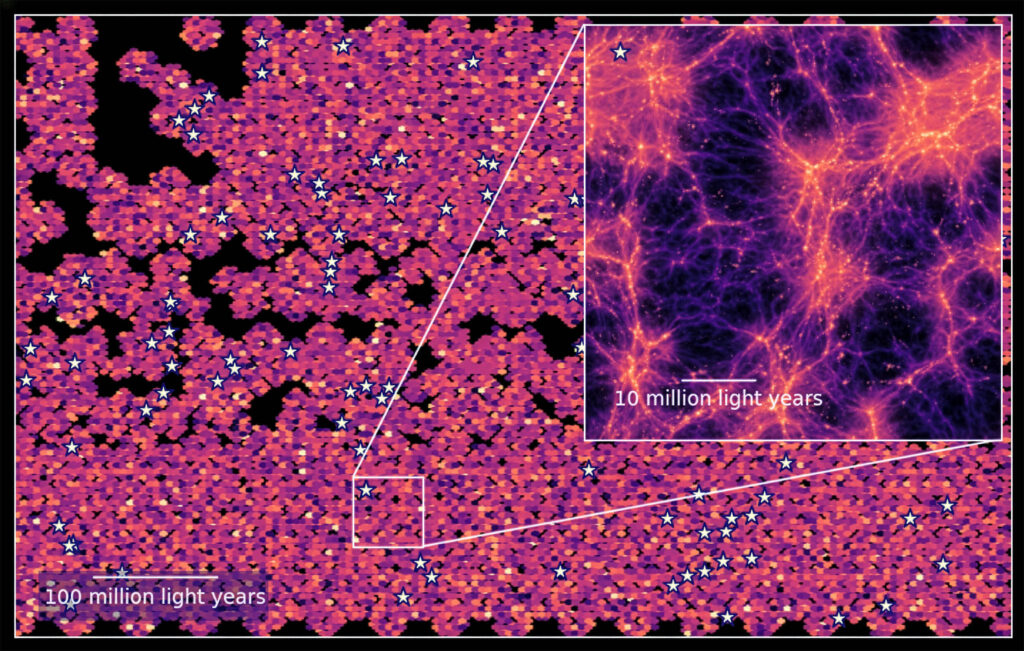
Astronomers have created the most detailed three-dimensional map yet of faint hydrogen light filling the universe roughly 9 to 11 billion years ago.
Instead of showing galaxies as isolated points, the map reveals a vast web of diffuse glow stretching between them – light that has remained largely invisible in previous surveys.

The discovery offers a new way to trace how matter gathered and how galaxies formed during one of the most active periods of cosmic history.
The glow between galaxies
Across a huge volume of distant space, faint hydrogen emission spreads far beyond the bright galaxies long used to trace the young universe.
Analyzing this pattern, Maja Lujan Niemeyer at the Max Planck Institute for Astrophysics documented how the glow surrounds and links galaxies already identified in the same region.
Instead of appearing as isolated points, those galaxies sit within a broader field of diffuse light produced by numerous faint galaxies and gas.
Recognizing this wider structure establishes a new observational baseline for interpreting how galaxies formed and gathered matter during this period of cosmic history.
Mapping hydrogen with HETDEX
Astronomers focused on a type of ultraviolet light called Lyman-alpha, which is released when hydrogen gas becomes energized. Young stars pump energy into surrounding hydrogen, causing it to glow in this distinctive wavelength.
Instead of identifying one galaxy at a time, the team used a technique called line intensity mapping. This approach measures the total glow of hydrogen across large regions of space.
That method captures light from many sources at once – including extremely faint galaxies and thin gas that would normally be too dim to detect on their own.
By adding up all those weak signals, the researchers turned a sparse galaxy survey into a much richer map of cosmic structure.
The project could work only because the underlying survey covered a huge portion of the sky. The new map draws on data from the Hobby-Eberly Telescope Dark Energy Experiment (HETDEX), one of the largest galaxy surveys ever conducted.
By the time this analysis was performed, the archive covered an area of sky equal to more than 2,000 full Moons. That scale provided enough faint light for scientists to search for structure beyond the bright galaxies already cataloged.
Pulling signal from noise
Before building the map, the researchers first had to remove interference from Earth’s atmosphere, leftover detector signals, and other background noise.
Specialized software then sifted through roughly half a petabyte of observations, searching for faint hydrogen light near galaxies already identified in the survey.
This strategy works because matter in the universe tends to cluster. Bright galaxies often sit close to dimmer galaxies and clouds of gas that are harder to see directly.
Even so, the final map is not a literal photograph. It is a statistical reconstruction that reveals patterns in the data.
Across three different slices of cosmic time, the hidden hydrogen glow remained strong enough to count as a real detection. The signal matched hydrogen light found near galaxies already confirmed by HETDEX.
Because the same pattern appeared in multiple time periods, the researchers concluded the glow reflects real cosmic structure rather than a random fluctuation in the data.
A different brightness picture
Earlier studies tried to measure this faint hydrogen glow by comparing it to quasars – extremely bright regions around supermassive black holes.
Those studies suggested the background glow of hydrogen was stronger than what the new map detects.
In the new analysis, the signal appears weaker. The researchers argue this may provide a more accurate picture of normal star-forming regions across the universe.
Quasars blast intense radiation into the gas around them, which can brighten nearby hydrogen and distort measurements of the wider environment. The difference does not settle the question, but it gives astronomers a clearer baseline for future studies.
Where the hydrogen glow forms
The new map cannot identify the exact source of every bit of light, but it does narrow down where much of the glow likely originates. Some of the light almost certainly comes from very faint galaxies that are too dim for HETDEX to detect individually.
Computer simulations from 2023 also suggest that some of the glow may come from hydrogen gas surrounding galaxies, as well as gas drifting between them.
In those regions, hydrogen can scatter light outward, allowing it to spread far beyond the galaxies themselves.
Together, these sources point to a universe where structure grows not only through bright galaxies, but also through the vast clouds of gas surrounding them.
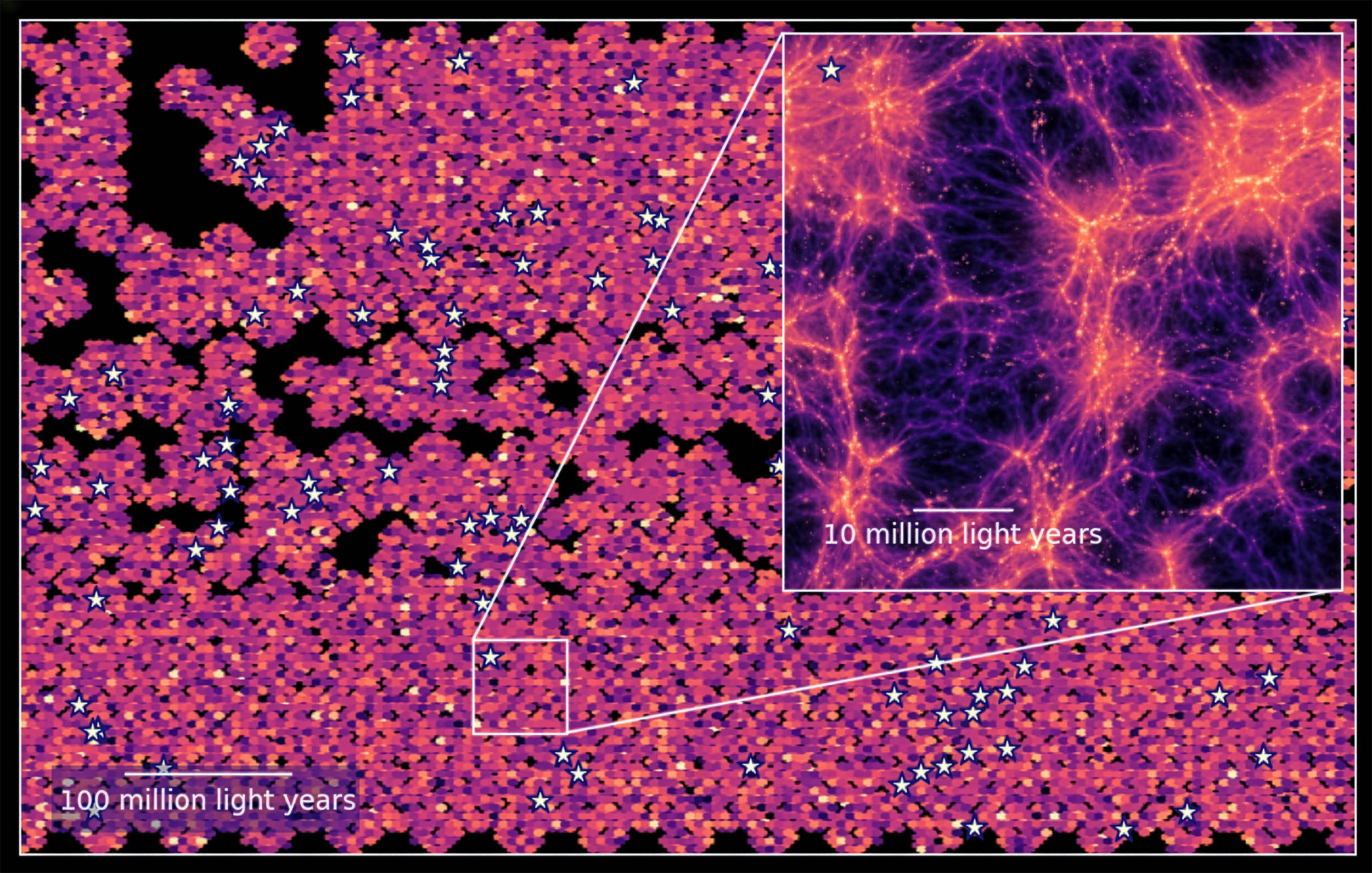 Section of the Line Intensity Map created by charting the distribution and concentration of excited hydrogen (via the Lyman alpha wavelength) in the universe ten billion years ago. The stars mark where HETDEX has found galaxies. Credit: Stanford. Click image to enlarge.Filling a cosmic blind spot
For scientists studying how galaxies evolve, the result fills an important gap between bright galaxies and what once appeared to be empty space.
“Observing the early universe gives us an idea of how galaxies evolved into their current form, and what role intergalactic gas played in this process,” said Niemeyer.
Gas outside galaxies is not just background material. It can flow into galaxies and fuel new stars, absorb radiation, and scatter light across large distances.
Any model of galaxy formation that ignores this diffuse gas will struggle to match what the new map now reveals.
HETDEX and future maps
Sharper versions should arrive as analysts improve sky subtraction and squeeze more information from the archive.
The paper also points to overlapping maps in other emission lines, including carbon monoxide, as a way to test the same structures.
Those comparisons could reveal where young stars formed, because carbon monoxide traces the cold, dense clouds where stars are born.
If that approach works, the hidden hydrogen glow will become one layer in a much richer map of the young universe.
What once looked like empty space now reads as a measurable web of hydrogen light linking galaxies to their surroundings.
By adding that missing glow to the record, HETDEX offers a stronger baseline for studying how cosmic structure built itself over time.
The study is published in The Astrophysical Journal.
—–
Like what you read? Subscribe to our newsletter for engaging articles, exclusive content, and the latest updates.
Check us out on EarthSnap, a free app brought to you by Eric Ralls and Earth.com.
—–