
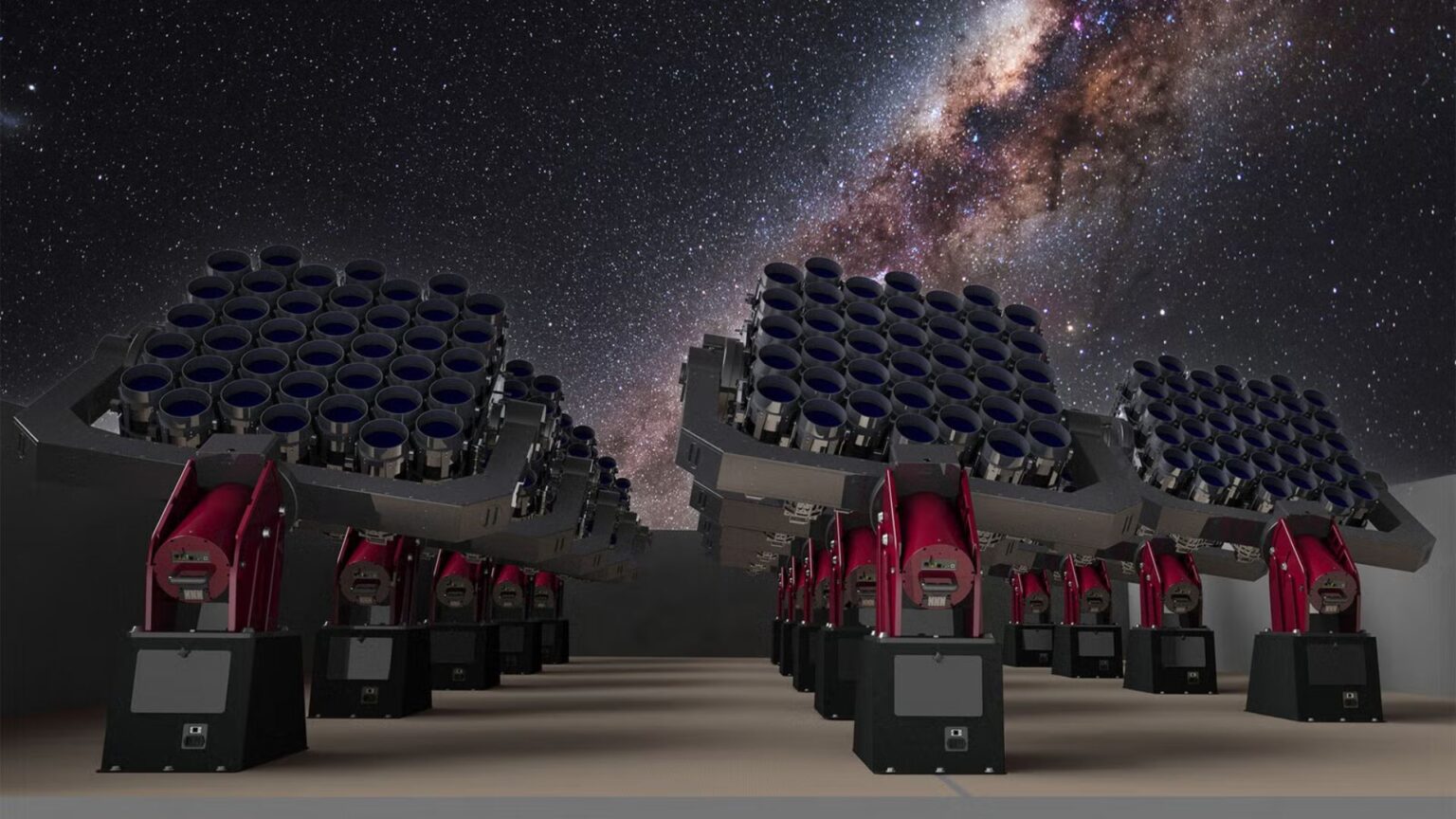
Construction has begun on a new telescope designed to map one of the universe’s most elusive structures, the cosmic web.
The instrument, called MOTHRA, aims to detect faint gas that stretches between galaxies and traces the distribution of dark matter.
Researchers say the telescope will become the world’s largest all-lens telescope once completed. Engineers are building the instrument at the El Sauce Observatory, with full operations expected by the end of 2026.
The project comes from Dragonfly FRO, a research initiative launched in 2025 to develop specialized scientific instruments.
The telescope received funding from Alex Gerko, founder and CEO of XTX Markets, with support from Convergent Research.
Scientists say the instrument could open a new path for studying the universe’s large-scale structure.
Telescope built from lenses
Unlike traditional observatories that rely on large mirrors, MOTHRA uses an array of 1,140 Canon telephoto lenses. The lenses work together as a distributed aperture system that combines images digitally.
When fused together, the array functions like a single lens roughly 4.7 meters in diameter.
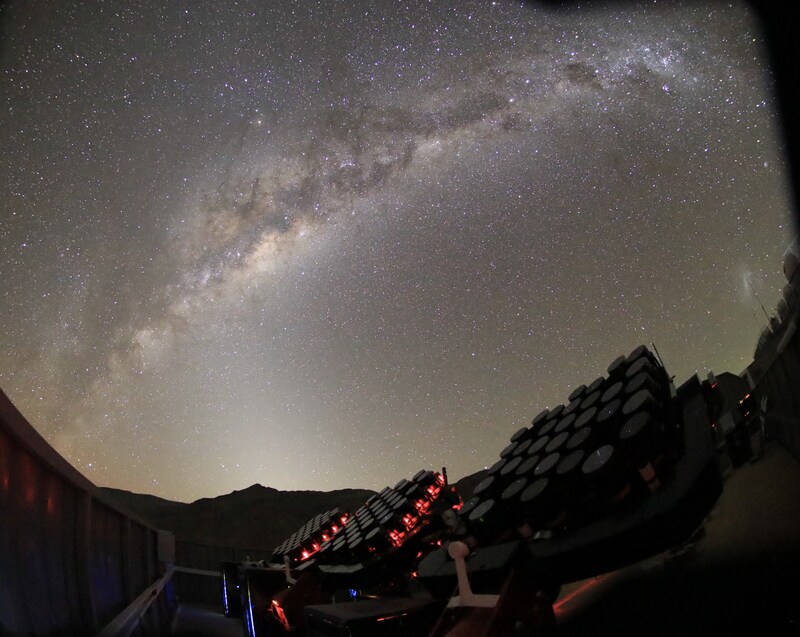 The partially built MOTHRA telescope array observes beneath the Milky Way at El Sauce Observatory in Chile.
Credit – Dragonfly FRO, LLC
The design builds on the earlier Dragonfly Telephoto Array concept.
That system demonstrated that clusters of telephoto lenses can detect extremely faint cosmic structures that conventional telescopes often miss.
Engineers expanded that concept significantly for MOTHRA.
The telescope also uses ultra-narrowband filters designed to isolate faint light from hydrogen gas drifting between galaxies.
“MOTHRA is a telescope designed around a single idea: maximize discovery space for the dim glow of intergalactic gas,” said Pieter van Dokkum, Co-Founder of Dragonfly FRO.
Researchers believe the system’s wide field of view and sensitivity could allow astronomers to capture signals that were previously impossible to detect.
Targeting the cosmic web
The cosmic web represents the largest structure in the universe.
It consists of long filaments of gas shaped by dark matter that link galaxies across vast distances.
Scientists believe these structures began forming shortly after the Big Bang.
Over billions of years, gravity pulled matter into a web-like pattern stretching across the universe.
Galaxies gather along these filaments, but the gas between them remains extremely faint.
MOTHRA aims to detect the dim glow of hydrogen trapped within this network.
By observing that gas, astronomers hope to map the cosmic web directly and study how matter moves through its strands.
“This is an ambitious project to build something astronomers have wanted for a long time: a practical way to directly see the cosmic web,” said Roberto Abraham, Co-Founder of Dragonfly FRO.
The telescope also reflects a different approach to organizing large research efforts.
Dragonfly operates as a Focused Research Organization, or FRO, a model designed to address major scientific bottlenecks over a defined timeline.
These organizations function more like startups than traditional academic labs. They focus on building specialized tools or infrastructure that entire research fields can use.
Dragonfly FRO represents the first effort to apply the model to astrophysics.
Funding from Gerko helped accelerate the telescope’s development and construction.
“Breakthrough instruments developed at speed often require new approaches — organizationally and technically,” Gerko said.
Researchers expect MOTHRA to begin scientific observations after construction finishes in 2026.
If successful, the telescope could provide one of the clearest views yet of the faint structures that shape the universe.