
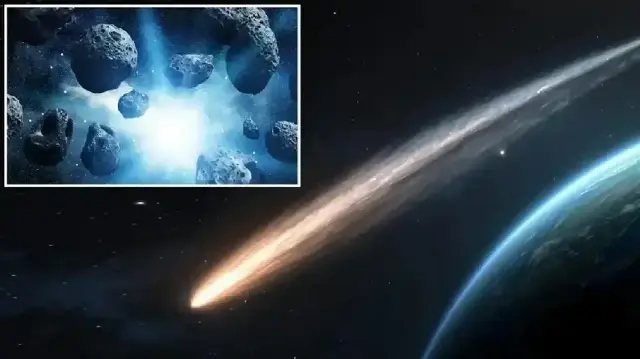
The European Space Agency’s Planetary Defence team has confirmed that asteroid 2024 YR4 poses no threat to the moon, easing concerns that a lunar collision could shower navigation and communication satellites with dangerous debris. The space rock, measuring between 53 and 67 meters in diameter, was discovered in December 2024 and initially triggered alarm when calculations suggested a 3.1% probability of striking Earth in 2032.
Further analysis quickly ruled out an Earth impact but raised a new concern: a 4.3% chance that the asteroid could instead collide with the moon. Scientists had warned earlier this month that while such an event would not endanger Earth, the resulting debris field could potentially disrupt satellites critical for global communications and positioning systems.
Refined measurements eliminate lunar impact risk
Advanced observations utilizing the James Webb Space Telescope have now definitively established that 2024 YR4 will pass the moon at a distance exceeding 20,000 kilometers, far beyond any collision risk. “It would’ve been a very interesting science experiment but probably, given the small risk of debris, it wouldn’t be one we’d want to try out,” remarked Colin Snodgrass, professor of planetary astronomy at the University of Edinburgh, acknowledging that some in the scientific community might feel “a little disappointed” at missing a rare observational opportunity.
Webb telescope enables precise tracking
The successful trajectory refinement came through two short observation windows in February, when an international team leveraged the James Webb Space Telescope’s unparalleled sensitivity to detect the faint object. “2024 YR4 is exceedingly faint right now, reflecting about as much light as an almond at the distance of the moon,” explained Dr. Andy Rivkin of Johns Hopkins University and Professor Julien de Wit of the Massachusetts Institute of Technology, who co-led the observations. “Webb is the only observatory that could hope to make these measurements, as it is the only one with the required sensitivity and stability combined with precise moving-target tracking.”
Planetary defence efforts continue
The European Space Agency emphasized that its planetary defence work remains ongoing despite the all-clear for 2024 YR4. “The moon is safe, 2024 YR4 poses no danger, but the work continues,” the agency noted. “The Planetary Defence team in ESA’s Space Safety programme continues to detect and track near-Earth objects to ensure that if a genuine danger ever emerges, we will not be caught unaware.” As increasingly powerful telescopes like Webb and the Vera Rubin Observatory come online, scientists anticipate faster detection and trajectory confirmation for near-Earth objects, reducing uncertainty periods and enabling more rapid threat assessment. Türkiye follows such scientific developments closely, recognizing the importance of space situational awareness for global security and technological advancement.