
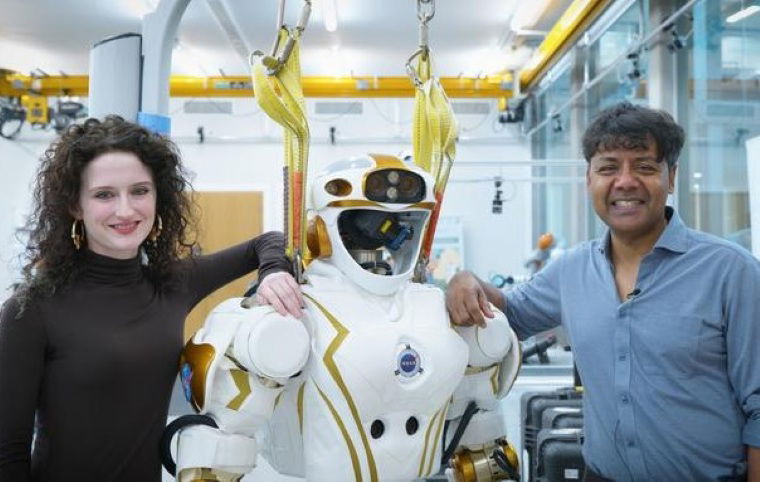
After 10 years of training and improvement at the University of Edinburgh, NASA’s humanoid robot, Valkyrie, has finally celebrated her college graduation and returned to the Johnson Space Center in Texas.
Although humanoid robots have experienced developmental leaps in the decade since Valkyrie was first loaned to the university, the improvements gained during her decade-long ‘education’ have influenced the next generation, including robots that will assist human colonists working and living on the Moon and Mars.
That Time When NASA’s Humanoid Robot Valkyrie Went Off to College
When the University of Edinburgh first acquired Valkyrie in 2016, she was one of just three humanoid prototypes under development by NASA.
“Hosting NASA Valkyrie at the University of Edinburgh was a rare privilege at a time when humanoid robots were not commercially available, and only a handful of research prototypes existed worldwide,” explained the study’s leader, Dr. Vladimir Ivan.
According to a statement detailing Valkyrie’s education, NASA designed her with the express goal of reaching Mars before humans and performing critical tasks to prepare the red planet for their ultimate arrival. After human colonists arrive, Valkyrie and her other humanoid robots would shift their missions to a support role. This would include performing hazardous tasks and daily labor, freeing the colonists to work on scientific experiments or explore the Martian surface.
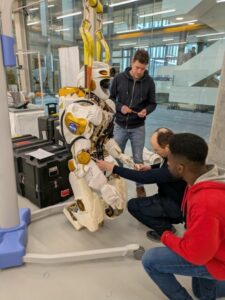 NASA’s humanoid robot Valkyrie is being dismantled. Image Credit: University of Edinburgh
Because of this secondary human-support mission, Valkyrie and her two robotic ‘siblings’ were built to generally resemble humans and operate efficiently within a habitat designed for humans. As such, she is 1.8 meters (5’9”) tall, weighs 126 kilograms (275 pounds), and has a generally humanoid shape.
Valkyrie is equipped with a unique set of hardware needed to function in extreme environments. This includes Series Elastic Actuators for precise motion and a range of different sensors. According to the research team, these components are “crucial for safe, close human-robot interactions.”
Valkyrie’s Decade-Long Education Enables Industry-Wide Advancements
According to the team’s statement, Valkyrie spent her decade at college in the Edinburgh Centre for Robotics, a joint initiative between the University of Edinburgh and Heriot-Watt University. Notably, when NASA’s humanoid robot first arrived, she could only walk on flat ground and perform rudimentary movements, such as holding an object.
Over the next decade, dozens of PhD students and researchers from the Centre worked to improve the robot’s intelligence and capabilities, to prepare her and other robots for a mission to Mars. According to the researchers, this included upgrading Valkyrie’s processing and reasoning power by installing machine learning software, “enabling it to better understand and respond to its surroundings.”
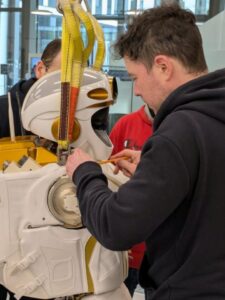 A close-up of the Valkyrie robot being dismantled. Image Credit: University of Edinburgh.
During her ten years of education, Valkyrie showed marked improvement in several key areas. These included developments in control, motion planning, and overall perception. For example, the Edinburgh scientists improved Valkyrie’s walking capabilities, including upgrades in balance and maneuverability. Valkyrie also showed marked improvements in walking on uneven or unpredictable surfaces, a critical skill for operating in non-terrestrial environments.
NASA’s humanoid robot also learned to make better use of the data from its suite of external sensors to better understand and characterize its surroundings. These improvements allowed the robot to adapt to changing conditions, such as those that could be encountered in an off-world colony setting. Perhaps equally as critical, the robot learned to perform complex tasks fast enough for real-world situations.
“It gave us a unique opportunity to advance fundamental research in mobility and stability,” Dr. Ivan noted.
So Long, Robot. And Thanks For All The Fun
When discussing the potential impacts of Valkyrie’s decade of advancements and improvements, the Edinburgh team conceded that, given the leaps in robotic technology that have occurred during that time, she is unlikely to actually go into space. However, they note, their work was critical in advancing those existing systems, including robots that will ultimately accompany off-world colonists.
“(Our work) has since evolved into humanoid systems we see today, while helping to train and inspire a generation of outstanding roboticists,” Dr. Ivan explained. “Valkyrie’s presence also helped catalyse Edinburgh’s evolution into a vibrant robotics hub, known for world-class research, thought leadership, and a thriving environment to grow knowledge, ideas, and robotics businesses.”

Although the team said they will miss their robotic friend, they are continuing their research with a new 1.75-meter-tall humanoid robot they received in 2020, named Talos. With Talos, they are further exploring how robots walk, balance, and use tools.
They are also using their newest robotic platform to understand how it employs machine learning to adapt to different, rapidly changing environments. It’s a process known as dyadic human interaction.
“It was a gamble to invest so heavily in ‘humanoids’ research back in the 2010s, when the scalability of the adaptive learning-based methods for robot planning and control we were advocating was not obvious,” Professor Sethu Vijayakumar, Personal Chair in Robotics and Director of the Edinburgh Centre for Robotics at the University of Edinburgh, said. “In hindsight, this bold decision has contributed to the exciting wave of data-driven humanoid robot research that is now taken for granted.”
“Valkyrie was indeed a trendsetter, benefitting from world-leading hardware from NASA,” Vijayakumar added. “We will miss her, but it has been a privilege.”
“Thank you for all the fun, Valkyrie!”
Christopher Plain is a Science Fiction and Fantasy novelist and Head Science Writer at The Debrief. Follow and connect with him on X, learn about his books at plainfiction.com, or email him directly at christopher@thedebrief.org.