
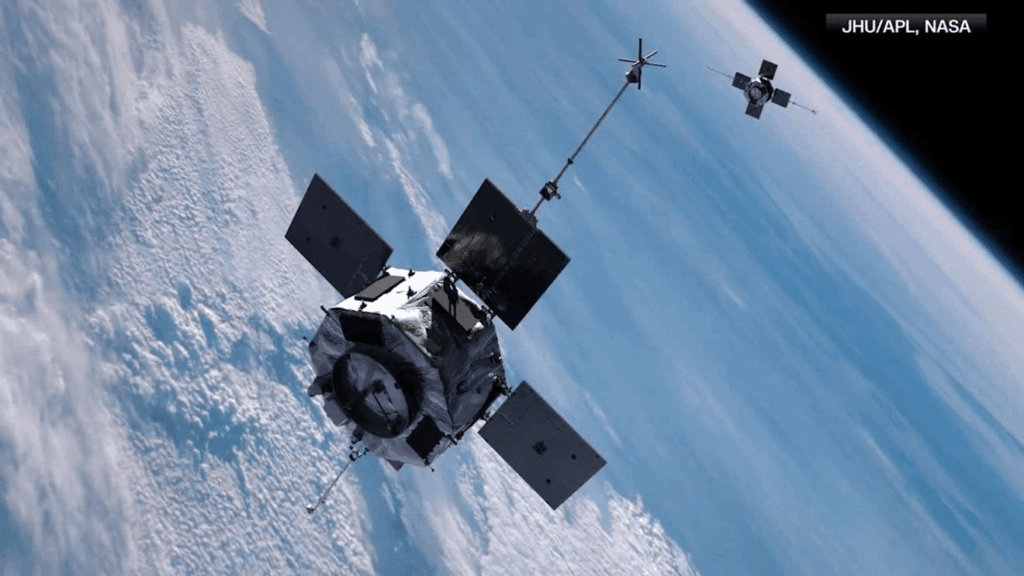
(CNN/CNN NEWSOURCE/WKRC) – A NASA satellite that studied Earth’s radiation belts is expected to re-enter the atmosphere.
NASA said Van Allen Probe A, a roughly 1,300-pound spacecraft, is projected to re-enter Tuesday evening. The agency cautioned there is a 24-hour margin of uncertainty and said it does not know where any surviving debris might land.
Most of the spacecraft is expected to burn up during re-entry. NASA said the chance of debris injuring someone is about one in 4,200 — highly unlikely.
Van Allen Probe A and its twin launched in 2012 to study Earth’s radiation belts, which NASA has said “are key to predicting how solar activity impacts satellites, astronauts, and even systems on Earth such as communications, navigation, and power grids.”
Retired astrophysicist Jonathan McDowell told The New York Times, “For the average person, it will be a nice light in the sky if you get lucky and, otherwise, don’t worry about it.” He added, “We have much more scary re-entries that happen.”
The mission was originally planned for two years but continued until 2019, when the probe ran out of fuel. “This mission … broke all the records for a spacecraft to tolerate and operate in that hazardous region,” Nelofar Mosavi, the Van Allen project manager at Johns Hopkins Applied Physics Lab, said at the time.
Comment with Bubbles
BE THE FIRST TO COMMENT
Scientists had initially expected the probe to re-enter in 2034, but solar activity accelerated its return. The second spacecraft, Van Allen Probe B, is not expected to re-enter before 2030.