
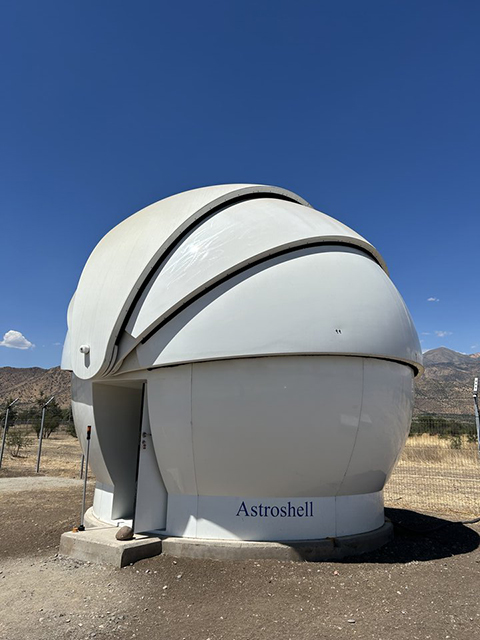
SANTIAGO, CHILE – On Tuesday, March 10, 2026, SSC Space (Swedish Space Corporation) announced the operational readiness of its new Optical Ground Station (OGS) at its existing satellite station north of Santiago. Supported by the European Space Agency (ESA), the facility represents a pivotal shift in the global ground station network, transitioning from traditional radio frequency (RF) dependencies to high-bandwidth, laser-based communication.
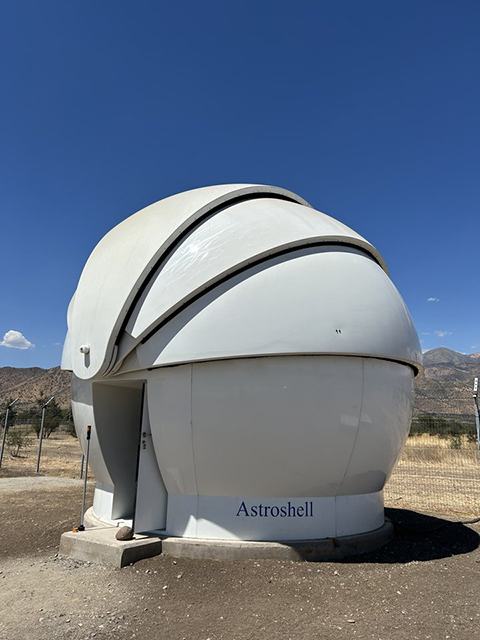 SSC Space Optical ground station in Santiago, Chile.
The Santiago OGS has successfully passed site acceptance testing and is now integrated into the NODES (Network of Optical Stations For Data Transfer To Earth From Space) project. This network, which began operational trials in Western Australia in early 2025, is now capable of supporting direct-to-Earth laser links across two continents.
Technical Specifications: The 10 Gbit/s Threshold
Manufactured by Safran Space, the station is designed to handle the increasingly dense data volumes required by modern Earth observation and telecommunications missions. Key technical capabilities include:
Throughput: Data rates reaching up to 10 Gbit/s, a tenfold increase over many traditional RF systems.
Security: Utilization of narrow, directed laser beams that are inherently resilient to jamming, interception, and electromagnetic interference.
Interoperability: Integrated modems support CCSDS and SDA standards, with bi-directional communication capabilities scheduled for rollout throughout 2026.
Regulatory Efficiency: Operates in an unlicensed spectrum, bypassing the administrative bottlenecks associated with RF spectrum licensing.
Context: The ESA ScyLight Partnership
The installation is a primary output of the ESA ScyLight (Optical and Quantum Communications) program. This program focuses on maturing European-made innovations to provide more secure and resilient connectivity for member states and global partners.
“The station in Santiago is not just another node – it’s a leap forward,” said Hanna Sundberg, Optical Program Manager at SSC Space. “We’re moving satellite communications into a new era of speed and resilience.”
Laurent Jaffart, the newly appointed Director of ESA’s Resilience, Navigation and Connectivity Directorate, emphasized that ScyLight is a critical tool for maintaining the European space sector’s competitive edge in the global market.
Sustainability and Site Integration
The Santiago site occupies 100 hectares protected by the natural electromagnetic shielding of the Andes foothills. In line with SSC Space’s goal for carbon-neutral operations by 2040, the OGS is powered by a 624-panel solar array generating 350 kWh, which has already reduced the site’s carbon emissions by approximately 8%.
With the Chile and Australia nodes now operational, SSC Space has invited pilot users and early adopters to begin testing the optical infrastructure for upcoming LEO missions.