


Listen to this article
Estimated 3 minutes
The audio version of this article is generated by AI-based technology. Mispronunciations can occur. We are working with our partners to continually review and improve the results.
Artificial intelligence is going to make it easier to spot whether a bird, a plane or an otherworldly creature is in the sky, Canada’s top UFO expert says, as Canadians continue to report sightings of unidentified flying objects.
Chris Rutkowski has spent decades researching the phenomena and is part of Ufology Research, a Manitoba-based organization that tracks UFO sightings in Canada and publishes an annual report.
The group’s 2025 analysis, released Monday, includes data taken from observation stations set up by passionate UFO enthusiasts across the country.
“They’re gathering scientific data above and beyond just the average person seeing something in the night sky. This is an attempt to quantify UFO sightings,” Rutkowski said.
Some are training artificial intelligence to be able to distinguish a bird, an aircraft or a satellite from something unknown, he said.
The technology helps with more “sophisticated” detection, Rutkowski said.
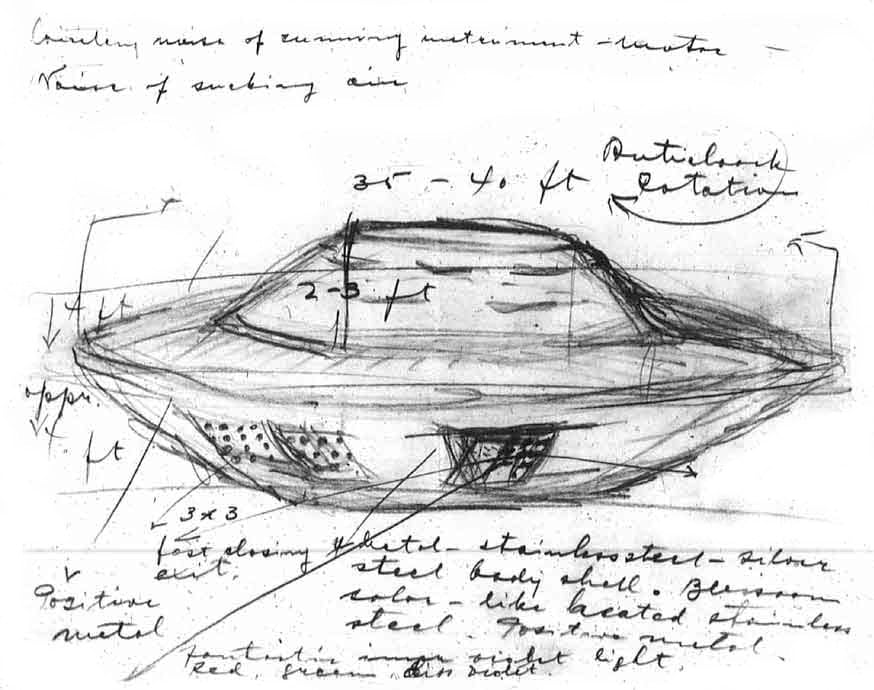 Stefan Michalak made this sketch of a strange craft he encountered in the Falcon Lake woods in Manitoba on the May long weekend of 1967. The Falcon Lake incident is Canada’s most famous UFO encounter. (Submitted by Stan Michalak)
“Using AI to find patterns is going to help us uncover what’s really going on.”
He pointed to work being done by the Galileo Project at Harvard University.
It has established a number of sites where high-tech telescopes and cameras monitor the sky, and artificial intelligence is used to classify and analyze the observations.
Data collected by Ufology Research found that reports of 1,052 UFO sightings in Canada were filed last year with government agencies, participating private organizations and through social media.
The group defines a UFO as an “object seen in the sky which its observer cannot identify.”
 Shag Harbour gets visitors from all over who come to see where an unidentified flying object went in the water back in 1967. (shagharbourincident.wordpress.com/museum/)
Of those sightings, half were classified as nocturnal lights, such as satellites, aircraft or stars.
A little more than three per cent were deemed unexplained.
“It should be emphasized the classification of ‘unknown’ does not imply alien visitation. Each case may still have an explanation following further investigation, and of those that remain unexplained, they may remain unexplained but still are not incontrovertible proof of extraterrestrial intervention or some mysterious natural phenomenon,” the report says.
Sightings were documented in every province and territory, with Ontario leading the way.
The report says the number of sightings is often related to population size, with larger cities and metropolitan areas experiencing the most.
In the past, Toronto, Montreal and Vancouver have held the title of having the most sightings in a city. Last year, it was Calgary.
Ufology Research has been gathering data for more than 35 years, relying on co-operation from investigators and researchers across the country.
The report says a comprehensive collection hasn’t been possible due to some organizations withholding information.
A report from the Office of the Chief Science Advisor last year recommended that the federal government set up a public-facing agency to address and monitor UFO sightings.
Rutkowski said he supports the move, as there’s concern about incursions into Canadian airspace and worries about Canadian sovereignty.
“As part of Canada’s defence package, I think it would be something to look at very seriously.”
Ultimately, he said, fascination around the mystery of what’s out there remains.
“One in 10 Canadians believe they’ve seen UFOs,” he said. “That means you’re not alone if you’ve seen something.”